Views: 0 Author: Site Editor Publish Time: 2026-08-19 Origin: Site
Ever wondered how tiny powders turn into tablets? The Pharmaceutical Granulator Machine makes this possible. It uses wet granulation to improve powder flow and uniformity. In this post, you’ll learn what this machine is, why wet granulation matters, and how the process works.
Table of Contents
Pharmaceutical granulator machines come in various types. Each suits different materials, batch sizes, and production goals. Understanding these types helps choose the right machine for your needs.
High shear mixer granulators are the most common in pharmaceutical manufacturing. They have a large mixing bowl with fast-spinning blades. These blades mix powders while adding liquid binder. The high speed creates granules quickly and uniformly.
Key features:
Rapid granulation, completing batches in 15-30 minutes
Consistent granule size and density
Suitable for high-volume production
Efficient mixing reduces processing time
They work well for most powders, especially when quick turnaround is needed. Their speed and consistency make them a favorite in tablet manufacturing.
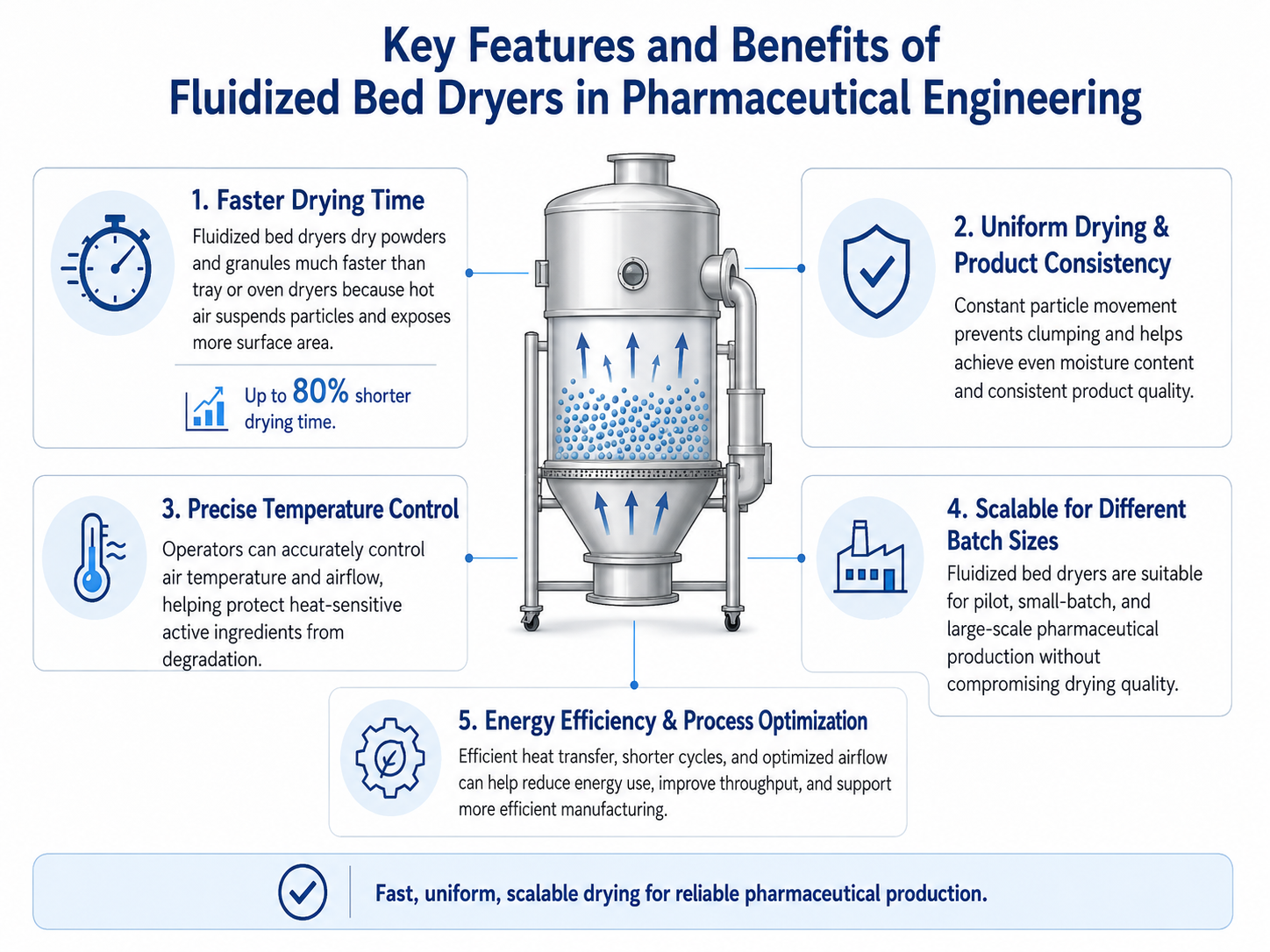
Fluid bed granulators use hot air to suspend powder particles in a stream of air. The particles float as if in a fluid. While suspended, a liquid binder sprays onto them, causing granules to form.
Advantages include:
Gentle granulation, ideal for heat-sensitive materials
Simultaneous drying and granulation saves time
Produces uniform granules with good flow properties
Easy control over granule size by adjusting spray rate and air flow
This type suits products that cannot tolerate high shear or heat. It’s common in pharmaceuticals and food industries.
Oscillating granulators push wet mass through a screen with holes of specific sizes. The wet material breaks into granules as it passes through.
Benefits:
Simple and reliable operation
Good for small batch sizes or pilot production
Produces granules with consistent size based on screen selection
Low maintenance and easy to clean
Generic drug manufacturers often use oscillating granulators for their flexibility and cost-effectiveness.
Roller compactors compress powders between two rollers to form sheets. These sheets break into granules afterward.
Key points:
Uses little or no liquid binder, suitable for moisture-sensitive drugs
Produces very uniform and dense granules
Ideal for direct compression processes
Higher initial cost but reduces drying time and energy use
Roller compactors are excellent when powders degrade in wet conditions or when granules need to be very dense.
Tip: When selecting a granulator, consider your material’s sensitivity, batch size, and production speed to match the machine type for optimal results.
Pharmaceutical granulator machines have several key features that make them essential in producing high-quality granules. These features improve the manufacturing process and ensure the final product meets strict standards.
Powders often stick together or to surfaces, causing blockages and uneven filling during tablet production. Granulation transforms fine powders into larger, free-flowing granules. These granules move smoothly through hoppers, feeders, and tablet presses. Better flow reduces machine downtime and improves batch consistency.
Fine powders create dust clouds during handling. Dust poses health risks to workers and can contaminate the production environment. Granules are heavier and less prone to airborne dispersion. Using a granulator machine significantly lowers dust generation. Many machines also feature enclosed designs and vacuum attachments to capture dust, maintaining a cleaner, safer workspace.
Uniform mixing is critical for consistent drug dosage in each tablet. Powders of different sizes and densities tend to separate during processing, causing uneven distribution. Granulation binds ingredients into uniform granules, locking them together. This prevents segregation and ensures each tablet contains the right amount of active pharmaceutical ingredient (API).
Granulation influences how drugs dissolve and release in the body. The choice of binder and granule size affects the dissolution rate. Machines allow precise control over granule formation, enabling manufacturers to design tablets for immediate or extended release. This feature supports tailored drug delivery systems, improving therapeutic effectiveness.
During transport and handling, powders often segregate due to differences in particle size or density. This leads to inconsistent mixtures and poor product quality. Granulation creates uniform granules that remain homogeneous throughout processing. This stability prevents segregation, ensuring product uniformity from batch to batch.
Tip: Choose granulator machines with enclosed systems and dust extraction features to enhance workplace safety and maintain product purity.
Pharmaceutical granulator machines are versatile tools used across many industries. Their ability to transform powders into uniform granules makes them invaluable where consistency, flow, and product quality matter. Below are the primary sectors benefiting from these machines.
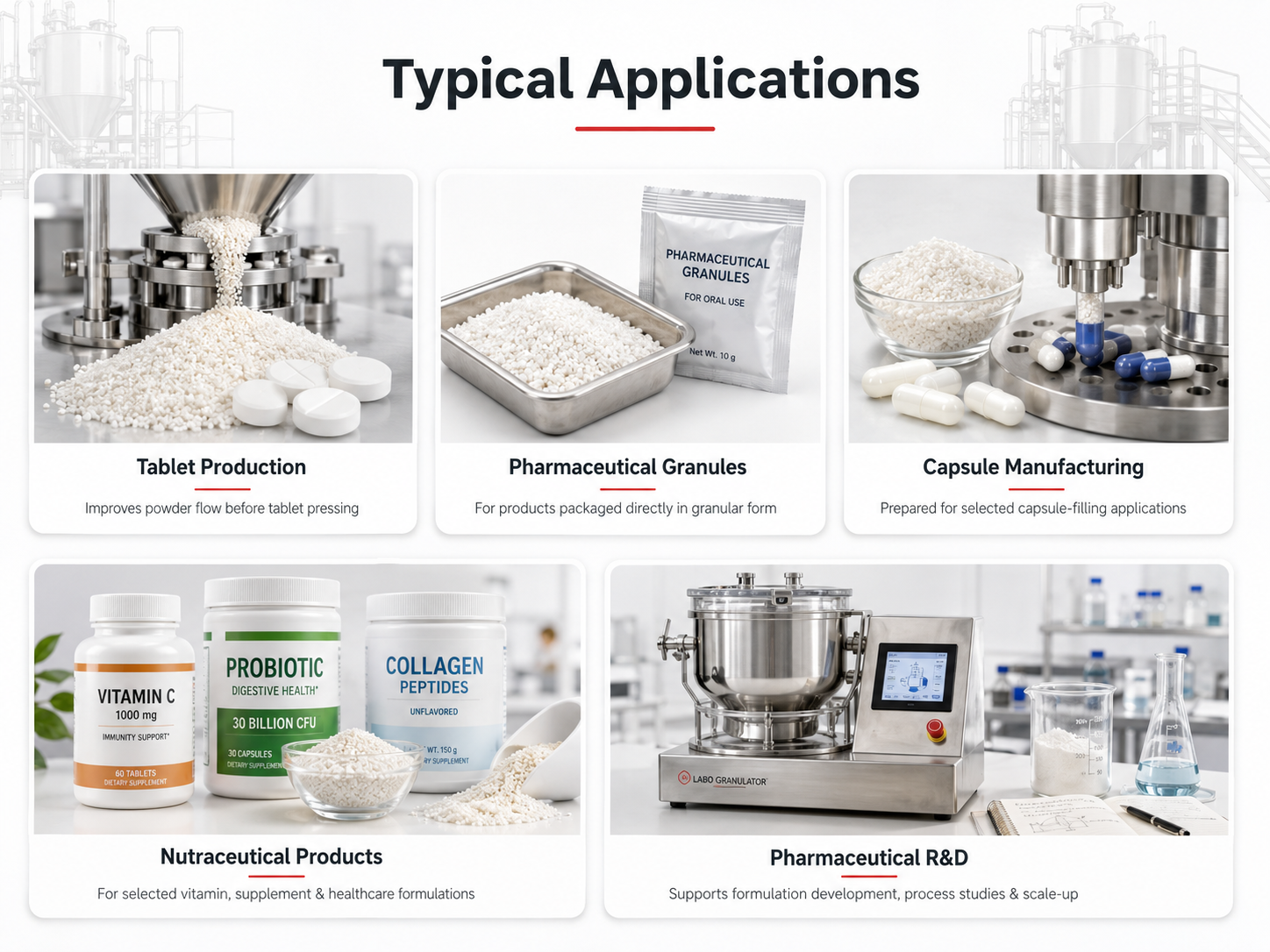
The pharmaceutical sector is the largest user of granulator machines. Tablets and pills require precise dosages and consistent drug release. Granulation ensures powders bind together, improving flow and compressibility. This results in tablets that:
Hold uniform strength across batches
Resist breaking or crumbling during packaging and transport
Dissolve properly inside the body for effective drug delivery
Have improved taste and texture for patient compliance
Granulation also helps incorporate active pharmaceutical ingredients (APIs) evenly with excipients, reducing segregation and dose variability.
Food manufacturers use granulation to improve instant powders and mixes. Examples include:
Instant coffee and tea granules that dissolve quickly
Soup and sauce mixes with better flow and uniformity
Breakfast cereals and baby food powders that resist clumping
Seasoning blends with consistent particle size for even flavor distribution
Granulation enhances shelf life and ease of use by preventing dust and caking. It also allows controlled release of flavors or nutrients during preparation.
In chemicals, granulation machines produce uniform particles for:
Fertilizers that spread evenly and absorb moisture properly
Detergent powders that dissolve efficiently in water
Paint additives ensuring consistent texture and application
Plastic compounds and agricultural chemicals requiring precise dosing
Granulation improves handling safety by reducing dust and explosion risks. It also enhances product stability and performance.
Cosmetic manufacturers rely on granulation to create powders and beads that feel smooth and apply evenly. Common products include:
Pressed powder makeup providing uniform coverage
Bath salts that dissolve uniformly in water
Face masks and exfoliants with consistent particle size
Perfume beads and encapsulated skincare ingredients
Granulation allows controlled release of active ingredients and prevents segregation during packaging.
Tip: When selecting a granulator machine, consider the specific product requirements and industry standards to ensure optimal granule quality and process efficiency.
The tablet-making process starts by accurately weighing all ingredients. This includes the active pharmaceutical ingredient (API) and excipients like fillers, binders, and disintegrants. Precision here is crucial because even small errors can affect tablet quality and dosage uniformity. Automated weighing systems often help reduce human error.
Next, the dry powders are loaded into the granulator machine. The powders mix thoroughly to ensure uniform distribution of each component. This step usually takes 5 to 10 minutes. Proper mixing prevents segregation and ensures each tablet has a consistent amount of every ingredient.
After dry mixing, a granulating liquid is added slowly while the machine continues to mix. This liquid acts as a binder, helping powder particles stick together. Common binders include starch paste, gelatin solutions, cellulose derivatives, or synthetic polymers. The amount of liquid must be carefully controlled; too little causes weak granules, too much creates a wet, sticky mass.
During granulation, the machine blends powders and binder until granules form. Operators monitor granule size and texture closely. They stop the process when granules reach the desired size and moisture content. This ensures good flow and compressibility later on. Some machines use sensors to detect the granulation end-point automatically.
Wet granules contain excess moisture that must be removed before further processing. They are transferred to a drying oven or fluid bed dryer. Drying typically lasts 2 to 4 hours at controlled temperatures. Proper drying prevents degradation and ensures granules don’t clump.
Once dried, granules may form lumps. They pass through a sizing machine or screen to break large clumps and remove fines. This step creates granules of uniform size, which improves flow and compression. Uniform granules help produce tablets with consistent weight and strength.
The sized granules are then mixed with lubricants like magnesium stearate and disintegrants such as croscarmellose sodium. Lubricants reduce friction during tablet compression, preventing sticking to the press. Disintegrants help tablets break apart quickly after ingestion for proper drug release.
Finally, the prepared granules move to the tablet press. This machine compresses granules into tablets of desired shape and size. The press applies high pressure to form solid tablets that hold their shape during packaging and transport. Each tablet contains the exact dose of the active ingredient.
Tip: Monitor moisture content carefully during drying to avoid over- or under-drying, which can affect tablet quality and stability.
Selecting the ideal pharmaceutical granulator machine is crucial. It impacts product quality, production efficiency, and overall cost. Several factors guide this decision.
First, consider the material properties. Some powders are fragile or heat-sensitive. Others might be sticky or abrasive. The granulator must handle these without damaging the product or itself.
Next, think about the desired granule characteristics. Do you need fine granules or larger, denser ones? Different machines produce varied granule sizes and densities.
Production goals also matter. Are you running small batches or large-scale manufacturing? Some machines suit pilot runs, others excel in continuous high-volume output.
Finally, regulatory compliance and cleanability are vital. Machines should meet GMP standards and be easy to clean to avoid cross-contamination.
Materials sensitive to heat or shear forces need gentle handling. Fluid bed granulators are ideal here. They use warm air and gentle spraying, reducing stress on powders.
High shear mixer granulators work well for robust powders requiring fast processing. They mix and granulate quickly but can generate heat.
Roller compactors suit moisture-sensitive materials since they use minimal or no liquid binder. This avoids exposing powders to excess moisture.
Oscillating granulators provide a middle ground. They handle wet mass by forcing it through screens, producing uniform granules with moderate shear.
For small-scale or R&D batches, oscillating granulators or small high shear mixers offer flexibility and easy cleaning.
Medium to large batch sizes often benefit from high shear mixer granulators. Their rapid processing reduces cycle time and increases throughput.
Fluid bed granulators combine granulation and drying, saving time in larger runs but may have longer cycle times than high shear mixers.
Roller compactors suit continuous or large batch processes, especially when drying capacity is limited or moisture is a concern.
Initial investment varies widely. High shear mixers and fluid bed granulators tend to be more expensive upfront but offer faster processing and better control.
Oscillating granulators cost less and require simpler maintenance, making them attractive for smaller operations.
Roller compactors have higher capital costs but reduce drying needs, saving energy and time long-term.
Maintenance ease and availability of spare parts should influence choice. Machines with modular designs and accessible components reduce downtime.
Tip: Evaluate your materials, batch size, and production goals carefully to select a granulator machine that balances performance, cost, and maintenance needs effectively.
Quality control is vital in pharmaceutical granulation. It ensures every batch meets strict standards for safety, efficacy, and consistency. Process Analytical Technology (PAT) tools help monitor and control granulation in real time, improving product quality and manufacturing efficiency.
The granulation end-point marks when granules reach the desired size, moisture, and consistency. Detecting this precisely avoids under- or over-granulation. Traditionally, operators judge this by visual inspection or manual sampling. However, these methods are subjective and can vary between batches.
Modern machines use sensors to identify the end-point automatically. They monitor parameters like power consumption, torque, or mixing speed changes. When these stabilize or reach set values, granulation stops. This improves reproducibility and reduces waste.
Near-Infrared (NIR) spectroscopy measures moisture content and chemical composition during granulation. It shines light on the material and analyzes reflected wavelengths. This non-destructive method provides fast, accurate data on granule moisture and uniformity.
Acoustic sensors detect sound waves generated during mixing. Changes in sound frequency or amplitude indicate granule formation stages. These sensors provide real-time feedback without disturbing the process.
Using NIR and acoustic sensors together offers a comprehensive view of granulation dynamics. They enable true in-line monitoring, supporting Quality by Design (QbD) principles.
Good Manufacturing Practice (GMP) compliance is mandatory for pharmaceutical equipment. Granulator machines must be designed and built to meet these standards. Key GMP requirements include:
Use of stainless steel (usually 316L) with smooth surfaces to prevent contamination
Easy cleaning and sterilization to avoid cross-contamination
Accurate documentation of all process parameters for traceability
Validation and qualification to prove consistent performance
Following GMP ensures product safety and regulatory approval. It also reduces risks of recalls or production downtime.
Regular calibration of sensors, load cells, and other instruments is essential. Calibration ensures measurements are accurate and reliable. It should follow manufacturer guidelines and regulatory expectations.
Preventive maintenance keeps granulator machines in optimal condition. Routine checks on seals, blades, motors, and control systems prevent breakdowns. Scheduled maintenance also extends equipment lifespan and maintains process consistency.
Maintenance logs and change controls document all activities. This supports regulatory audits and continuous improvement.
Tip: Integrate real-time PAT tools like NIR spectroscopy and acoustic sensors into granulation to enhance process control and ensure consistent product quality.
Scaling up pharmaceutical granulation from lab or pilot scale to full production presents several challenges. These challenges can affect granule quality, process efficiency, and product consistency. Understanding and addressing them is key to successful scale-up.
Binder amount and addition rate significantly influence granule properties. During scale-up, the binder volume must scale proportionally to batch size. However, simply increasing liquid volume can cause over-wetting or uneven distribution.
Solutions:
Use automated dosing pumps to control binder flow precisely.
Implement inline monitoring to track moisture levels in real time.
Adjust binder concentration or spray rate based on granule feedback.
Careful control ensures granules form uniformly, avoiding weak or sticky masses.
Mixing dynamics change with equipment size. Larger granulators require different impeller speeds to maintain similar shear forces. Power consumption also varies, affecting heat generation and granule moisture.
Solutions:
Maintain constant tip speed (impeller speed x diameter) rather than rpm alone.
Monitor power consumption curves during granulation to identify end-points.
Optimize mixing time and speed to balance granule strength and moisture.
Matching mixing conditions helps replicate lab-scale granule characteristics at production scale.
Granule size, density, and moisture must stay consistent batch after batch. Scale-up often introduces variability due to changes in equipment geometry and process parameters.
Solutions:
Use Process Analytical Technology (PAT) tools like NIR spectroscopy or acoustic sensors for real-time quality monitoring.
Develop robust scale-up protocols based on Design of Experiments (DoE) data.
Validate granulation end-point detection methods across scales.
This approach reduces batch failures and supports regulatory compliance.
Traditional batch granulation can be slow and less flexible. Continuous wet granulation offers advantages for high-volume manufacturing:
Smaller equipment footprint
Steady-state operation with consistent product quality
Easier scale-up by adjusting feed rates instead of equipment size
Challenges include:
Process integration with upstream/downstream units
Real-time monitoring and control complexity
Initial capital investment
Solutions:
Use twin-screw granulators designed for continuous operation.
Implement advanced PAT and control systems to maintain granule quality.
Train operators on continuous process management.
Continuous wet granulation is gaining popularity for its efficiency and scalability.
Tip: During scale-up, focus on controlling binder addition and mixing energy while leveraging PAT tools to maintain consistent granule quality across all batch sizes.
Pharmaceutical granulator machines improve powder flow, reduce dust, and ensure uniform mixing. They enhance product quality and manufacturing efficiency by creating consistent granules. Advances like real-time monitoring and continuous granulation are shaping the future of this technology. Marya offers innovative granulator machines that deliver reliable performance and meet industry standards, helping manufacturers achieve optimal results with ease. Their products combine precision, efficiency, and safety to support high-quality pharmaceutical production.
A: A Pharmaceutical Granulator Machine is equipment used to convert powders into uniform granules, improving flow, mixing, and tablet quality in pharmaceutical manufacturing.
A: It transforms fine powders into larger granules, reducing stickiness and ensuring smooth movement through production equipment.
A: High shear granulators provide rapid, uniform granulation ideal for high-volume tablet production with consistent granule size.
A: Cost depends on machine type, batch size capacity, features like PAT integration, and maintenance requirements.
A: Check binder addition rates, mixing speed, and screen sizes; ensure sensors and controls are calibrated properly.