Views: 0 Author: Shanghai Marya R&D Team Publish Time: 2026-09-08 Origin: Site
Are you designing a new pharmaceutical facility or upgrading an existing one to meet strict cleanliness rules? ISO 7 and ISO 8 cleanrooms are the most common controlled spaces for making medical devices and aseptic filling. But they serve different purposes based on particle limits. This article clears up the technical terms, comparing particle counts, air change rates, and real-world uses. You will learn which classification fits your needs. Remember, meeting compliance means building a strong system that keeps patients safe and products sound. This idea guides industry leaders. Whether you need a medical cleanroom for sterile mixing or packaging support, knowing these standards is your first step to success.
Table of Contents
ISO 7 cleanrooms are ten times cleaner than ISO 8, meaning they allow far fewer particles in each cubic meter of air.
Use ISO 7 for sterile filling and mixing medicines. Use ISO 8 for backup areas and packaging.
ISO 7 needs 30-60 air changes each hour, but ISO 8 only needs 10-25, which saves energy and money.
Use H14 HEPA filters and keep positive pressure to prevent contaminants from entering.
Wearing the right protective clothing and using airlocks correctly are key steps to stop people from bringing in dirt or germs.
Check your cleanroom every year and watch particle counts often to make sure it follows the rules.
Meeting ISO standards helps you get regulatory approval and lowers the chance of product recalls.
Working with experts such as Shanghai Marya can make design, validation, and certification easier and faster.
Before you design your facility, you need to understand how clean room classifications work. ISO 7 and ISO 8 cleanrooms follow rules from a global standard called ISO 14644-1. This standard sets the maximum number of airborne particles allowed in each cubic meter of air. The lower the ISO class number, the cleaner the space. An iso class 7 room allows far fewer particles than an iso class 8 room. In fact, ISO 7 is ten times cleaner than ISO 8. This difference drives your choice between the two for any medical cleanroom application.
ISO 14644-1:2015 defines nine clean room classifications, from ISO 1 (the cleanest) to ISO 9 (the least clean). Each class sets limits for particles of specific sizes. The two most common sizes are particles at least 0.5 micrometers (µm) and particles at least 5.0 µm. These clean room standards apply to any controlled space in the pharmaceutical or medical device industry. The classification system gives you a clear target for your facility design.
Before ISO 14644-1, the United States used Federal Standard 209E (FS 209E). That older system measured particles per cubic foot. The ISO system measures particles per cubic meter. Despite this difference, the two systems map directly to each other. The table below shows the comparison:
ISO Class | FS 209E Equivalent | Key Particle Limit (≥0.5 µm per m³) |
|---|---|---|
ISO 3 | Class 1 | 35 particles/m³ |
ISO 4 | Class 10 | 352 particles/m³ |
ISO 5 | Class 100 | 3,520 particles/m³ |
ISO 6 | Class 1,000 | 35,200 particles/m³ |
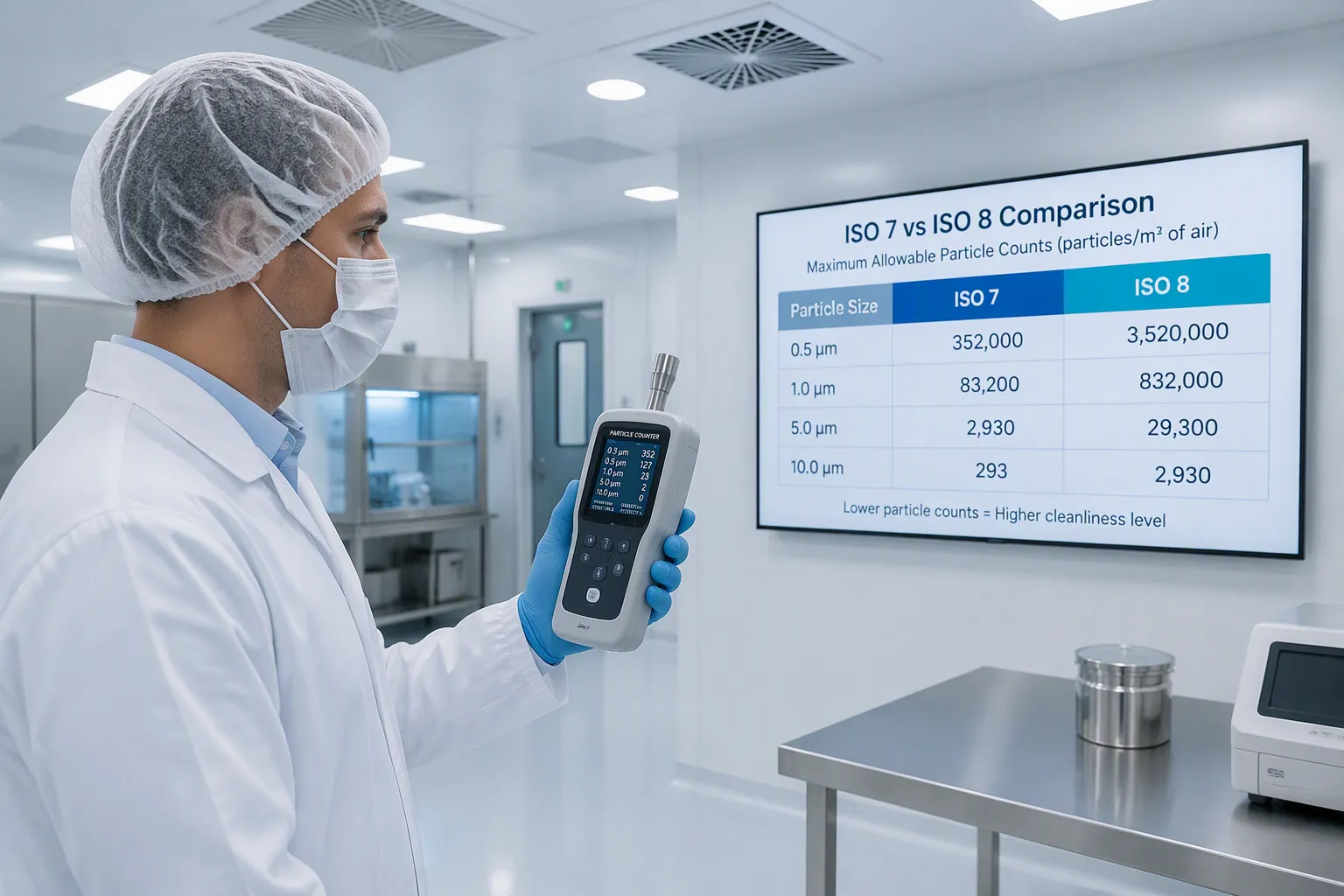
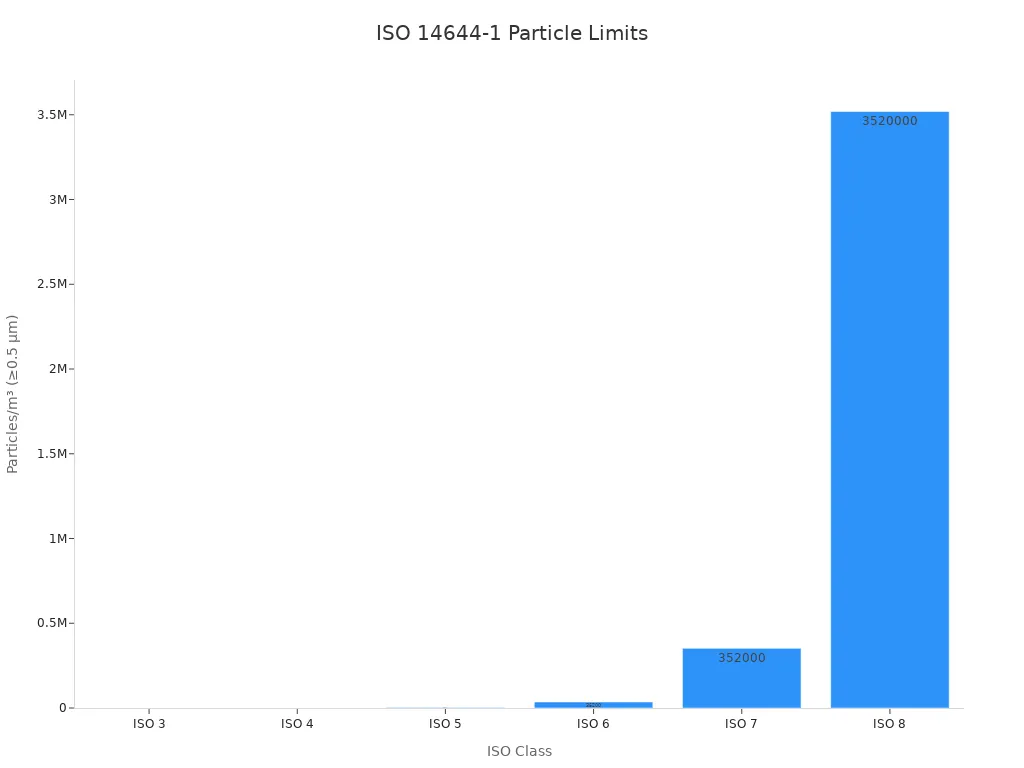
ISO 7 | Class 10,000 | 352,000 particles/m³ |
ISO 8 | Class 100,000 | 3,520,000 particles/m³ |
An iso class 7 matches the old Class 10,000. An iso class 8 matches Class 100,000. These iso cleanroom standards ensure global consistency. Many facilities still reference the old numbers, but ISO is now the accepted worldwide system. The chart below shows the particle limits across ISO classes.
ISO clean room classes require you to test your space in two conditions. The 'at-rest' state means all equipment runs, but no people are inside. The 'operational' state means the room is fully active with workers performing tasks. You need certification for both states. A clean room environment behaves differently when people enter because personnel shed particles. Your classification depends on meeting limits during both conditions. This dual testing gives you a complete picture of your space.
An iso 7 cleanroom must control particles within tight boundaries. This level suits tasks that require a very clean space, such as sterile compounding and medical device manufacturing. The limits are strict and require strong engineering controls.
For an ISO 7 cleanroom, the standard allows these maximum particle counts:
Particle Size (µm) | Maximum Count per m³ |
|---|---|
≥0.5 | 352,000 |
≥1.0 | 83,200 |
≥5.0 | 2,930 |
These numbers come directly from ISO 14644-1. You must test for these sizes during certification. The ≥0.5 µm limit is the most commonly referenced figure. Your facility design must achieve these levels consistently.
How does an ISO 7 cleanroom compare to everyday spaces? While specific data for hospital corridor air quality is not available in this article, it is clear that an ISO 7 cleanroom maintains particle counts far below normal indoor environments. This level of control requires HEPA filtration and high air change rates. You cannot achieve this cleanliness without dedicated engineering systems. The difference is substantial and measurable.
The iso-8 cleanroom classification suits less critical tasks. It still provides a controlled space but allows more particles than ISO 7. Many facilities use ISO 8 as a buffer zone around cleaner rooms. This iso-8 cleanroom classification is popular for support areas in pharmaceutical operations.
For an ISO 8 cleanroom, the limits are clear:
Less than 3,520,000 particles ≥0.5 µm per cubic meter of air
Less than 29,300 particles ≥5.0 µm per cubic meter of air
These numbers are ten times higher than ISO 7 limits. This makes the iso-8 cleanroom classification more affordable to maintain because you need fewer air changes per hour. Your cost savings come from lower energy and equipment demands.
An ISO 8 cleanroom is much cleaner than a normal room. A typical conditioned office space contains more than ten times as many particles per cubic meter. In general, an iso 8 cleanroom is five to ten times cleaner than a standard office environment. This comparison shows that even the lowest ISO classification offers significant protection for your products. You gain a measurable advantage over uncontrolled spaces.
Understanding these iso classifications helps you pick the right room for your process. If you need a very clean space for sterile work, choose the iso 7 cleanroom. If you need a controlled environment for less sensitive tasks, the iso 8 cleanroom works well. Your choice depends on your product sensitivity, your regulatory requirements for medical device manufacturing, and your budget for engineering controls. Both solutions have proven value in the pharmaceutical industry.
The special machines inside your cleanroom decide if you meet your target class. You cannot reach iso 7 and iso 8 cleanroom standards with normal heating and cooling equipment. You need special controls that clean the air, move it at exact speeds, and keep the right air pressure between rooms. These systems work together to keep particles away from your product.
Air changes per hour (ACH) tell you how many times all the air in a room gets replaced in one hour. More air changes mean more clean, filtered air comes in. This lowers the number of particles that people and machines make. Your needed ACH depends on your cleanroom class.
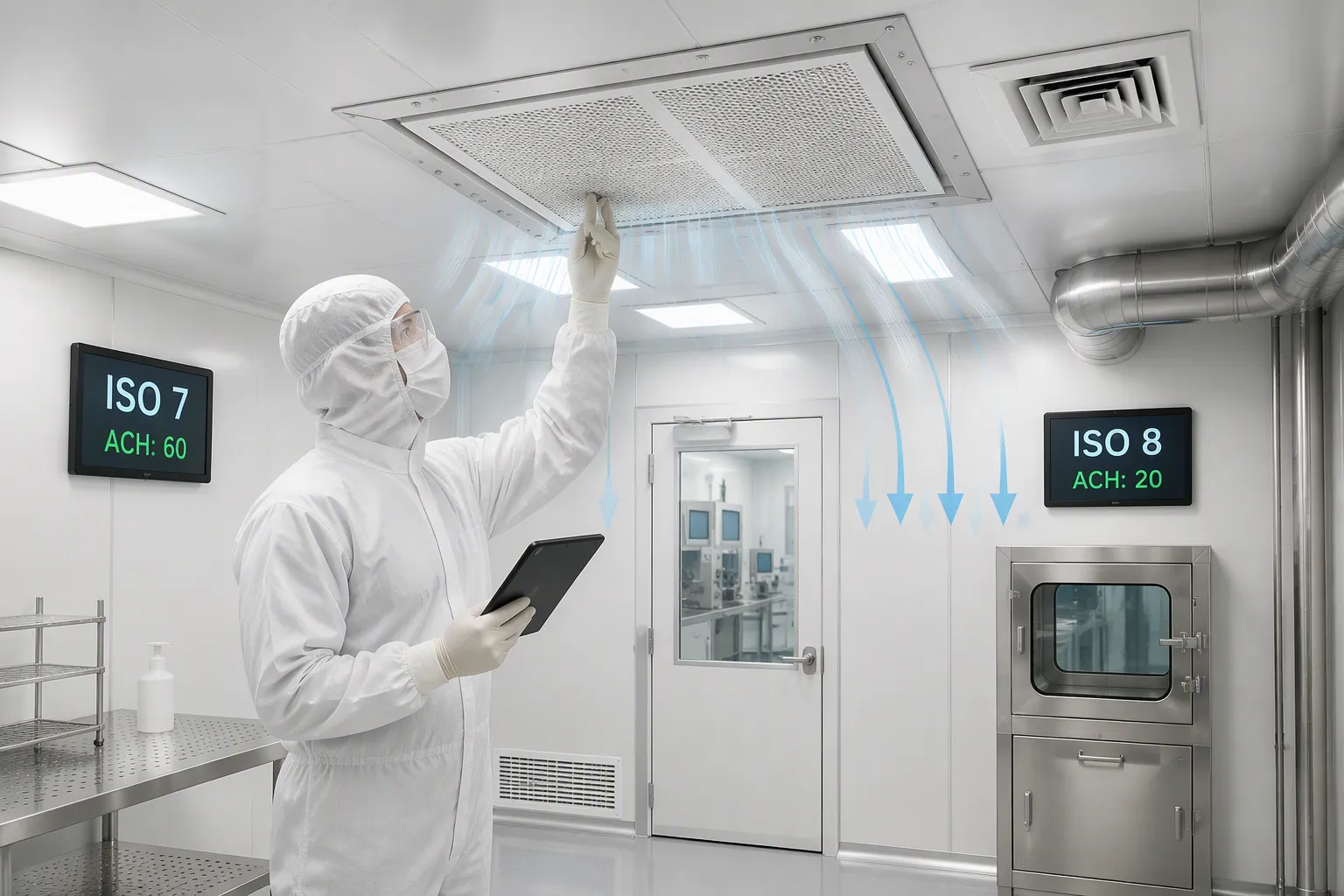
An iso 7 cleanroom needs a lot of airflow to meet its particle limits. Industry guides say you need between 30 and 60 air changes per hour for this class. Some sources say higher rates, from 60 to 150 ACH, based on your room size and risk. You should think about your own tasks when picking a target. A bigger room with more people needs more air changes to stay within limits. Your engineering team can model the airflow to find the best balance.
Cleanroom Class | Recommended Air Changes per Hour (ACH) |
|---|---|
ISO 7 (Class 10k) | 60 |
ISO 8 (Class 100k) | 20 |
An iso 8 cleanroom needs fewer air changes because it allows more particles. The normal suggestion is around 20 ACH. This lower rate cuts your energy use a lot. You spend less on fans, cooling, and filter upkeep. The iso-8 cleanroom class gives a good mix of cleanliness and cost. Many places pick this level for support areas where super clean air is not needed.
Filters clean the air before it gets into your cleanroom. High-efficiency particulate air (HEPA) filters catch almost all particles above a certain size. You cannot reach any ISO class without these filters in your system.
HEPA filters come in different grades. H13 and H14 are most common for drug making. H14 filters work better, catching up to 99.995% of particles. This level of filtering for iso-8 class cleanrooms means incoming air has almost no dirt. You should use H14 filters for both iso 7 and iso 8 cleanrooms to keep air quality steady. The filters sit in your ceiling or in air handling units. They trap particles before they reach your work area.
H14: Better efficiency (catches up to 99.995% of particles), needed for very clean spaces like chip factories and drug making.
Your airflow pattern changes how particles move through the room. Unidirectional airflow moves in straight lines from ceiling to floor. It sweeps particles away well. This design fits iso 7 cleanrooms where you need quick particle removal. Non-unidirectional airflow stirs the air to spread particles throughout the space. This works for iso 8 cleanrooms and less critical areas. Your choice depends on your process and room layout. Many places use non-unidirectional flow for iso 8 buffer zones and save unidirectional flow for the cleanest areas.
Pressure differences stop dirty air from flowing into your cleanroom from nearby rooms. You keep higher pressure inside cleaner rooms so air moves out when doors open. This pressure cascade protects your product from airborne dirt.
You must keep your iso 7 cleanroom at a higher pressure than areas around it. This positive pressure pushes air out instead of letting unfiltered air in. The pressure difference between rooms of different classes should be at least 10 to 15 Pascals (Pa) with doors closed. Your iso 8 cleanroom should also have positive pressure compared to unclassified spaces. This creates a gradient from cleanest to dirtiest zones.
For example, a positive pressure difference of at least 10–15 Pascals (Pa) should be kept between nearby rooms of different classes (with doors closed).
Pressure differences of 10-15 Pascals (0.04-0.06 inches w.g.) must be kept between ISO Class 8 zones and nearby unclassified or lower-class areas. Pressure should flow from cleanest to dirtiest zones, for example: ISO 7 > ISO 8 > Unclassified.
Airlocks act as transition zones between areas of different classes. You enter an airlock before moving into your iso class 7 cleanroom from an iso class 8 area. The airlock stops direct air swapping between the two spaces. Pass-through chambers let you move materials without opening doors directly between rooms. You put items in the chamber, close the outer door, then open the inner door. This design lowers contamination entry. Your airlock should have linked doors so only one opens at a time. This simple control keeps your pressure cascade and protects your cleanroom environment.
The engineering controls described here form the backbone of your contamination control plan. Each system has a specific job in keeping your iso class 8 or iso class 7 space clean. You must design these systems together for best results. A well-built cleanroom with proper ACH, filtration, and pressure relationships will always meet your class needs.
Knowing where each class fits helps you plan a facility that works well. The iso 7 and iso 8 cleanrooms play different parts in making drugs and medical tools. Your pick between them depends on what you create and how easily your product gets dirty. A smart medical cleanroom uses both classes in different areas to balance safety with cost.
An iso 7 cleanroom handles the most important steps in your making process. This class gives the clean setting for work where product exposure carries high risk. You need this level when particles or germs could harm patient safety.
Aseptic filling needs the tightest control. Rules require an ISO 7 room as the backdrop for Grade A (ISO 5) areas when you skip isolator technology. This rule confirms that iso class 7 is the required support space for critical aseptic work. Your iso 7 cleanroom acts as a shield, keeping ISO 5 conditions steady where product meets container. It also holds the pressure flow that guards the cleaner zone from dirt. Common jobs include:
Making sterile drug solutions
Mixing medicines in pharmacies
Doing biotechnology research
Preparing buffer rooms and media areas
The iso 7 cleanroom also stores materials before they move into the ISO 5 zone. You keep tested pressure gaps and air change rates to hold this guard role.
Making medical tools often needs an iso 7 cleanroom for putting together implantable devices. Surgical tools and bone implants touch sensitive body parts directly. Any particle on these surfaces creates infection risk. You also need this class for packing that keeps sterile wraps safe. The assembly work opens parts to the air, so you need strong dirt control. An iso 7 cleanroom gives that safety through high air change rates and HEPA filters.
An iso 8 cleanroom supports less critical work. This iso-8 cleanroom class fits jobs where products have lower dirt risk. You save money by matching your control level to the real threat.
The iso-8 cleanroom uses include second packing, labeling, and staging parts before they enter cleaner rooms. You also use this space for washing and staging containers. The making order for many drug products follows this path:
Filling operations
Sealing operations
Packing finished products
Only the filling step needs the cleaner ISO 7 space. The nearby support work happens fine in an iso 8 cleanroom. This iso-8 cleanroom class also works as a backdrop for ISO 5 or ISO 7 areas, creating a clean ladder throughout your facility.
In a normal layout, an iso 8 cleanroom wraps around an iso 7 cleanroom as a buffer zone. This setup creates a step-by-step move from dirty space to the cleanest area. Workers pass through the iso 8 zone before entering the iso 7 cleanroom. This medical cleanroom setup cuts the dirt load that reaches your key work. Side rooms like gowning areas and material staging spaces also fit the iso class 8 label.
Your pick between these classes shapes your facility's cost and ability. You need a clear method to match your work with the right space.
Start by knowing your product. Ask if dirt can hurt its performance or key surfaces. Products that touch sensitive body parts, like surgical tools and bone implants, need an iso class 7 space. Products in sealed sterile wraps or with lower dirt risk work fine in an iso 8 cleanroom. You also need to check your making process. Think about worker count, machines, and whether the work makes particles or involves open products. Industry rules often set the lowest class you must meet.
Cost gaps between classes are big. An iso class 7 cleanroom generally costs more upfront than iso class 8 due to higher air change rates and filtration requirements. One medical device manufacturer can save on HVAC costs by using ISO 8 for final packing instead of ISO 7. This way of matching control to risk saves real money. You should pick the lowest class that meets your real work needs. Higher classes add more HEPA filters, HVAC power, and energy use without adding value when your product does not need that level of safety.
You are the biggest source of dirt in your cleanroom. Your body lets go of thousands of skin cells every minute. These cells carry tiny germs. Your clothes also drop fibers. This makes people the main risk to your space. A good gowning process stops this issue. It keeps your products safe and meets your medical cleanroom rules.
People shed thousands of skin flakes each minute. These flakes often carry live germs, so they matter for both particle and germ risk checks. Even with full gowns on, small gaps in fit or movement can push fine particles into the air around you.
Work clothes in cleanrooms must control the dirt that people naturally give off all the time. Cleanroom suits help trap the skin flakes and oils that our bodies release every moment.
Your gowning room has its own class level. It works as a bridge between the normal world and your clean spaces. Gowning requirements vary by cleanroom class, with ISO 7 requiring more extensive coverage than ISO 8. Your clothes must use materials that do not shed. Reusable items need washing in ISO-approved facilities. This setup cuts the dirt you bring into the main area.
Gown fabrics, gloves, and safety gear break down from repeated washing, cleaning, and wear. Even ISO-approved cleanroom suits can drop tiny fibers when their surface layers or weave start to fail.
The order of putting on your gown lowers risk. Follow a top-to-bottom order. Work from the dirty side to the clean side. Clean your hands before any step that touches a clean surface.
Take off all jewelry and personal items.
Wash your hands and forearms.
Put on your hairnet and beard cover.
Put on your cleanroom coverall or smock.
Put on your shoe covers or over-boots.
Clean your hands again.
Put on your sterile gloves.
This order lowers the chance of spreading dirt. It makes sure you cover yourself from clean to dirty areas. How you take off garments matters too. Do not touch the dirty outer surface when you remove them.
Airlocks join spaces of different classes. They keep pressure gaps steady. There are several design types, each with specific pressure relationships. For example, a cascade airlock has intermediate pressure, while a bubble airlock has the highest pressure inside. The choice depends on the desired airflow direction and containment requirements.
You then move into an iso class 7 space. A cascade airlock works well to move from the gowning room to this cleaner area. This design keeps your iso class 8 gowning area from dirtying the cleaner zone.
You must plan your airlocks with care. The airlock links your gowning room directly to your cleanroom. It supports the pressure flow. This stops unfiltered air from getting into your key areas. A well-built airlock system is vital for meeting rules.
Certification proves your cleanroom meets its stated class. You cannot assume your space works just because you built it to plan. You must test it under real conditions. Trained experts run these tests with calibrated tools. The results give you written proof for auditors and regulators. This process applies the same to an iso 7 cleanroom and an iso 8 cleanroom.
Your path to iso certification starts before the testing team shows up. You need good prep to get correct results. The process follows a clear order that checks every key part of your controlled space.
Particle counting is the core of your class test. You measure airborne particles at set sizes using NIST-calibrated tools. The sample spots follow a formula from ISO 14644-1. You place these spots across return air grilles, work surfaces, and room centers. Every spot must pass the particle limits for your target class. If one spot fails, the whole room fails. This strict rule means you cannot skip any corner of your space.
Your testing expert figures out the least number of sample spots based on your room size. Each sample runs for a set time to gather enough data. The particle counter pulls air through a laser that finds and counts particles. You test for particles at 0.5 microns and 5.0 microns where needed. The results show whether your iso class 7 or iso class 8 space meets its limits.
Airflow testing checks that your ventilation system sends the right amount of clean air. For non-unidirectional rooms, you measure air changes per hour (ACH). You confirm that your HVAC system truly gives the designed air changes. There is no set speed target for this check. You simply confirm the system works as planned.
For unidirectional zones, you measure airflow speed at HEPA filter faces. The acceptable range is typically specified by standards. This applies mainly to ISO 5 areas. Your iso 7 cleanroom depends on ACH rather than speed targets. You also check pressure gaps between rooms and confirm filter health during this step.
Airflow and particle counts must be tested following the appropriate ISO standards, which list the testing methods for cleanroom certification.
Your cleanroom does not stay certified forever. You must watch it all the time and re-certify on a set schedule. This ongoing care finds problems before they hurt your products.
ISO 14644-2 does not set one yearly recertification rule for everyone. The timing and scope should be based on risk. But common practice for ISO 7 and ISO 8 cleanrooms follows a 12-month cycle. Some places pick shorter gaps for critical work. Your risk check should guide your choice. Higher-risk tasks may need testing every six months.
There is no single set gap in ISO 14644-1; full recertification of ISO Class 6-9 spaces, including ISO Class 8, is usually done on about a 12-month cycle.
Particle counting alone does not tell you about living germs. You need environmental checks for viable particles like bacteria and fungi. This testing uses culture media to catch and grow germs. You sample the air and surfaces in your cleanroom on a regular basis. The results show whether your cleaning and gowning steps work well. Your medical cleanroom needs both particle and germ checks for full compliance.
Many places fail certification due to easy-to-fix errors. Knowing these common issues helps you stop them. You save time and money by fixing problems before your certification test.
HEPA filters can fail even when particle counts look fine. Regular particle counting does not prove your filters are leak-free. You need in situ leak testing to find damage. Common failure causes include physical harm, bad setup, gaps around filter frames, and worn gaskets. Pressure shocks or maintenance touching the filter frame can cause leaks. You must run event-based health testing right after any such event.
The pass rule from ISO 14644-3 requires that downstream leakage is minimal, and H14-grade filters cannot be fixed; you must replace them fully. After replacement, you retest the system before going back to work. Finding issues early during building stops costly delays later.
Your staff can hurt your cleanroom results without proper training. Gowning mistakes and bad habits create particles that filters must remove. You need full training on dirt control for every worker. Missing paperwork also causes certification failures. You must keep complete records of all testing, upkeep, and fixes. Auditors expect to see a clear paper trail showing your compliance history. Without proper records, even a passing test result may not meet rules.
Validation services including FAT/SAT, setup, and startup are available to help you get first certification smoothly. These services guide you through the whole process from design to final testing. This partnership lowers the risk of certification failures and ensures your facility meets all rules.
Meeting the 14644-1 standard is the starting point for getting approved. The FDA uses this standard in its guidance papers. The 2022 EU GMP Annex 1 update introduced important requirements such as a Contamination Control Strategy, continuous viable air monitoring in Grade A zones, and specified pressure differentials. Not meeting these rules has serious results. The FDA has reported that drug recalls are costly, and contamination is a top cause.
Your pick between ISO 7 and ISO 8 cleanrooms can align with certain EU GMP grades, but the exact mapping depends on the specific process. Your ISO 8 cleanroom handles washing parts.
A cleanroom that follows rules lowers your recall risk. Bad conditions cause rejected batches and thrown-away products. Keeping proper conditions stops these problems. This work guards your good name.
Lower medical device manufacturing particle limits cut your germ growth risk. Fewer particles mean fewer spots for germs to grab onto. You must match the class to your process risk. All sterile product rules demand this match.
"Equipment for adequate control over air pressure, micro-organisms, dust, humidity, and temperature shall be provided when appropriate for the manufacture, processing, packing, or holding of a drug product"
This FDA rule from 21 CFR Part 211.46(b) sets the legal base.
Cleaner spaces make products last longer. Fewer particles mean fewer spots for chemical reactions that break down your product. Lower germ loads cut spoilage risk while stored. Patients get safer, better products.
Working with a turnkey partner can cut waste and rework. Modular building can significantly reduce material waste. In regular pharma builds, rework often takes up a significant portion of on-site work. Modular prefabrication with Factory Acceptance Testing (FAT) can reduce on-site rework. Modular units can save on costs through less labor and faster setup. Turnkey delivery makes accountability easier during startup. It lowers interface risk between water treatment, prep, filling, sealing, and packing systems.
A facility doesn't fail because a component is bad. It fails at the joint between components. A turnkey integrator delivers a validated environment designed, built, and commissioned to your classification.
A skilled partner helps you build a quality culture. Validation services including FAT/SAT, setup, and startup are available to help your facility pass Performance Qualification on the first try. Pre-validated design lowers rework costs. You gain a partner who knows the process from design to final certification.
Your choice between an iso 7 and iso 8 classification comes down to one factor. You need the right cleanliness level for your medical cleanroom process. Certification does not end with a passing test. You must maintain proper design, rigorous testing, and disciplined protocols continuously. View these standards as a framework for quality. They guide every decision in your facility. You can navigate the complexities of cleanroom design and validation by working with experts. Their turnkey solutions handle everything from concept to certification. Investing in the right infrastructure today positions your facility for future growth. You will meet regulatory demands in an increasingly strict industry. A well-designed cleanroom investment today secures your competitive edge for tomorrow.
ISO 7 allows 352,000 particles at 0.5 µm per cubic meter. ISO 8 allows 3,520,000 particles at the same size. So ISO 7 is ten times cleaner. Your product's sensitivity tells you what level you need in your medical cleanroom.
Most facilities re-certify every 12 months. Higher-risk operations can pick a 6-month cycle. Your risk assessment helps you decide. Regular monitoring between certifications keeps your room clean enough and finds issues early.
Yes. Gowning requirements differ, with ISO 7 typically requiring more extensive coverage than ISO 8. Both levels need materials that do not shed fibers. Your gowning room usually meets ISO 8 standards as a room that connects areas.
No. Aseptic filling needs an ISO 7 space behind it. This helps keep the ISO 5 zone where the product touches the container. The ISO classification system tells you what you need. You need the cleaner class to protect sterile products during important steps.
ISO 7 needs 30 to 60 air changes per hour. ISO 8 needs around 20 air changes per hour. More air changes remove particles faster but use more energy. Your choice finds a good mix of clean air and cost.
You set cleaner spaces at higher pressure than nearby areas. Air flows outward when doors open, so dirty air cannot get in. Keep at least 10 to 15 Pascals difference between rooms next to each other of different classes. This easy step stops contamination from reaching your product.
A turnkey partner gives you everything you need from planning to testing. Their services include FAT/SAT validation, installation, and startup. They also provide filling lines, isolators, and HVAC systems. One company does it all, lowering the chance of problems between parts and making sure your cleanroom reaches its target class.