Views: 0 Author: Site Editor Publish Time: 2026-08-12 Origin: Site
Table of Contents
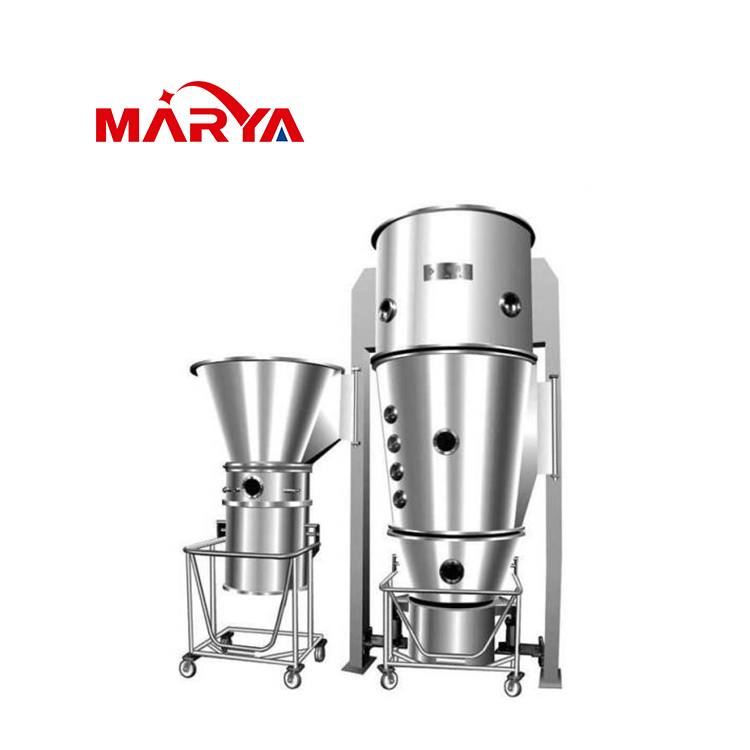
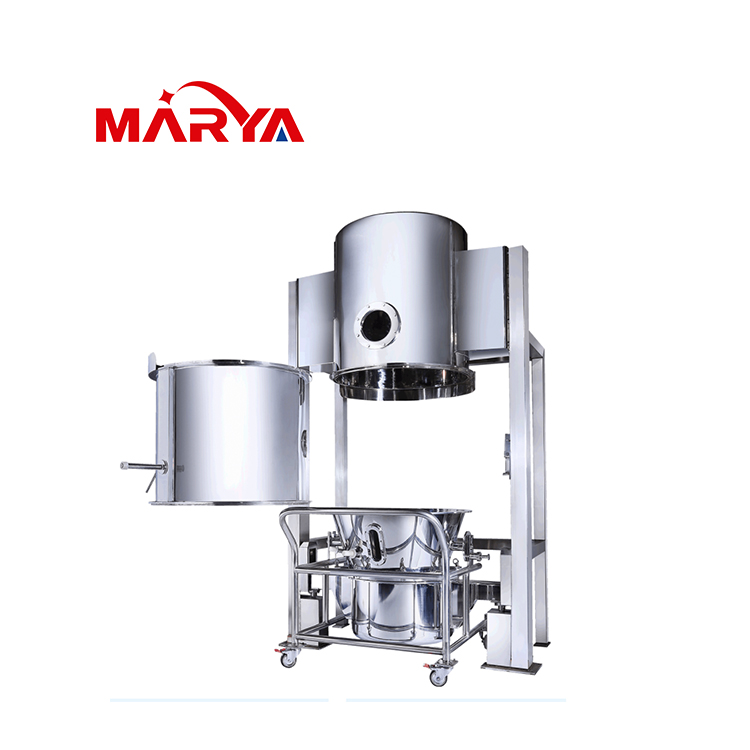
A fluidized bed dryer in pharmaceutical engineering is a machine used to dry powders, granules, and small particles that are later turned into tablets or capsules. In the machine, the hot air flows from the bottom of the container and lifts the particles, making them look like they are floating.
In pharmaceutical engineering, this is very important because medicines must stay consistent and effective. If powders are not dried properly, tablets can become weak, sticky, or even lose their strength over time.
Fluidized bed dryers come in various types, each designed to meet specific production needs and handle different materials efficiently. Let’s explore the main types used in pharmaceutical engineering and their typical applications.
Batch fluidized bed dryers process one batch at a time. You load the material, run the drying cycle, then unload the finished product. This setup offers precise control over drying parameters, making it ideal for small to medium batch sizes or when product consistency is crucial.
Use cases include:
Drying experimental or pilot-scale batches
Handling high-value or sensitive materials requiring careful monitoring
Producing specialty drugs in limited quantities
Its simple design and flexibility make it popular in research labs and smaller pharmaceutical plants.
Continuous fluidized bed dryers operate nonstop. Raw material feeds at one end, passes through the drying chamber, and exits fully dried at the other. This continuous flow suits high-volume manufacturing and improves throughput.
Advantages include:
Steady production rates for large batches
Reduced labor and handling time
Consistent product quality due to uniform drying conditions
Pharmaceutical companies running large-scale tablet or capsule production often prefer this type for efficiency.
Multi-stage dryers have several drying zones arranged sequentially. Each stage can have different temperature, airflow, or humidity settings. This design handles complex drying processes where gradual moisture removal is needed.
Applications involve:
Materials sensitive to rapid temperature changes
Products requiring stepwise drying to avoid degradation
Granules needing precise moisture content control
This type offers enhanced drying flexibility but requires more complex controls.
Some powders or granules tend to stick or resist fluidization. Vibrated fluidized bed dryers add mechanical vibration to the airflow, improving particle movement and preventing clumps.
This type is useful for:
Sticky or cohesive powders
Materials with wide particle size distribution
Products prone to agglomeration during drying
Vibration ensures better fluidization and uniform drying for challenging materials.
Dryer Type | Batch Size | Operation Mode | Best For | Complexity |
|---|---|---|---|---|
Batch Fluidized Bed Dryer | Small to Medium | Intermittent | Precise control, R&D batches | Simple |
Continuous Fluidized Bed Dryer | Large | Continuous | High-volume production | Moderate |
Multi-stage Fluidized Bed Dryer | Medium to Large | Intermittent/Continuous | Complex drying profiles | Complex |
Vibrated Fluidized Bed Dryer | Small to Medium | Intermittent | Difficult to fluidize materials | Moderate |
Choosing the right type depends on production scale, material properties, and drying requirements. Each offers unique benefits to optimize pharmaceutical drying processes.
Tip: For pharmaceutical production, selecting a fluidized bed dryer type that matches your batch size and material characteristics ensures optimal drying efficiency and product quality.
Understanding how a fluidized bed dryer works helps grasp why it’s so effective in pharmaceutical engineering. The process involves several key steps, each ensuring efficient and uniform drying of powders or granules.
The first step is placing the wet material inside the drying chamber. This chamber holds powders or granules that need moisture removed before further processing. Loading must be done carefully to avoid overfilling, which can disrupt airflow and fluidization.
Once loaded, warm air is introduced from below through a perforated distributor plate. This airflow is crucial—it must be strong enough to lift particles but not so strong that it blows them out. Operators control air temperature and velocity precisely to achieve optimal fluidization.
As warm air flows upward, it suspends the particles, making them behave like a boiling liquid. This “fluidized” state means particles move freely and mix continuously. This movement prevents clumping and exposes every particle to hot air evenly.
In this fluidized state, moisture inside the particles evaporates quickly. Hot air transfers heat to the particles, turning water into vapor. The vapor is then carried away through an exhaust system, reducing moisture content steadily.
Because particles constantly move and mix, each one receives the same drying conditions. This uniform exposure avoids wet spots or over-drying, which is vital for pharmaceutical quality. The even drying helps maintain consistent particle size and drug potency.
After drying, some fluidized bed dryers include a cooling phase. Cool air flows through the particles to lower their temperature, stabilizing them before collection. Finally, the dried product is discharged, ready for the next manufacturing step like tablet compression.
Tip: Always monitor and adjust airflow and temperature settings during drying to maintain optimal fluidization and prevent product damage or uneven drying.
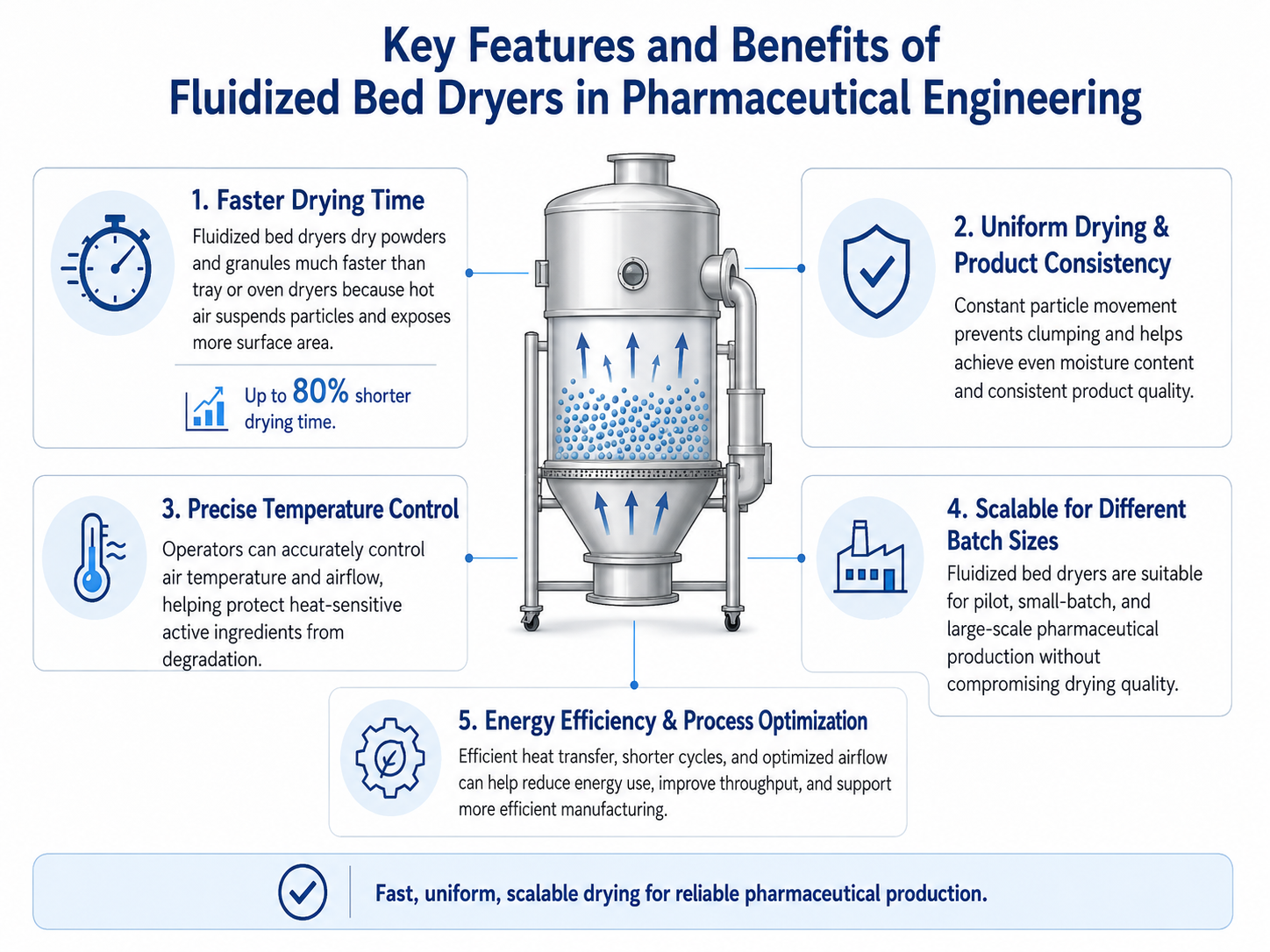
Fluidized bed dryers bring many advantages to pharmaceutical manufacturing. They help produce consistent, high-quality medicines by drying powders and granules efficiently. Here are the key features and benefits that make them essential in the industry.
One of the biggest benefits is speed. Fluidized bed dryers dry materials much faster than conventional tray or oven dryers. The hot air flows through and suspends particles, exposing every surface to heat. This rapid heat transfer cuts drying time significantly, sometimes by up to 80%. Faster drying means higher production rates and shorter batch cycles, which is crucial for meeting demand.
Uniformity matters a lot in pharmaceuticals. Uneven drying can cause some parts of a batch to remain moist, risking spoilage or reduced drug potency. Fluidization keeps particles moving constantly, preventing clumps and ensuring all particles receive equal heat exposure. This results in consistent moisture content and uniform particle quality, which supports product reliability and patient safety.
Many medicines contain heat-sensitive active ingredients. Fluidized bed dryers offer fine control over air temperature and velocity. Operators can adjust settings to dry gently without overheating. This protects delicate compounds from degradation while still removing moisture effectively. The ability to dry heat-sensitive materials safely expands the range of drugs that can be processed.
Whether you’re running a pilot study or full-scale manufacturing, fluidized bed dryers scale well. Small machines handle research batches, while larger models support mass production. The design adapts to batch size without sacrificing drying quality. This flexibility helps pharmaceutical companies optimize costs and resources across different production stages.
Although fluidized bed dryers consume energy to power blowers and heaters, their efficient drying process often lowers overall energy use compared to longer traditional drying methods. The rapid drying reduces run times, saving power. Modern systems also include process controls that optimize airflow and temperature, improving energy efficiency and reducing waste.
Tip: Regularly calibrate temperature and airflow controls on fluidized bed dryers to maximize drying efficiency and protect heat-sensitive pharmaceutical ingredients.
Fluidized bed dryers are versatile machines used in many industries. Their ability to dry particles quickly and uniformly makes them valuable beyond pharmaceutical engineering. Let’s explore some key applications across various sectors.
In pharmaceutical manufacturing, fluidized bed dryers play a vital role. They dry powders and granules that become tablets or capsules. The gentle, uniform drying protects heat-sensitive active ingredients, ensuring medicines retain potency and stability. This process prevents clumping and moisture-related issues that could affect drug quality. Whether drying small experimental batches or large production runs, these dryers maintain consistency and safety in pharmaceutical products.
Food producers rely on fluidized bed dryers to dry cereals, coffee, nuts, and spices. The rapid drying preserves flavor, aroma, and nutritional content better than slower methods. For example, drying coffee beans quickly helps maintain their rich taste. The uniform heat exposure also reduces spoilage risk. This technology supports producing high-quality, shelf-stable food powders and ingredients.
In the chemical sector, fluidized bed dryers handle drying of catalysts, polymers, and powders. Uniform moisture removal is crucial to prevent degradation or clumping, which can impact chemical reactions or product performance. The ability to control temperature and airflow precisely helps protect sensitive chemicals. This ensures consistent quality and functionality in products like polymer resins or catalyst powders.
Agricultural processors use fluidized bed dryers to dry grains, seeds, and fertilizers efficiently. Quick drying prevents mold growth and spoilage during storage. For instance, drying seeds at the right moisture level maintains their viability for planting. Fertilizers also benefit from uniform drying to avoid caking and maintain flowability during application. This technology helps extend shelf life and preserve product effectiveness.
Some environmental facilities employ fluidized bed dryers to treat waste and sludge. Drying reduces volume and weight, lowering disposal costs and environmental impact. It also stabilizes organic waste, making it safer for handling or further processing. This application supports sustainable waste management practices by improving efficiency and reducing hazards.
Tip: When selecting a fluidized bed dryer for your industry, consider the material’s sensitivity, batch size, and desired drying speed to maximize product quality and process efficiency.
Fluidized bed dryers are powerful tools in pharmaceutical manufacturing. However, they come with some challenges and limitations that engineers and operators should consider to ensure smooth operation and product quality.
Fluidized bed dryers require strong airflow and heating to keep particles suspended and dry them efficiently. This means they consume significant energy, especially in large-scale or continuous operations. The blowers and heaters run continuously during drying cycles, leading to higher electricity bills compared to simpler drying methods like tray dryers. For companies aiming to reduce operational costs, energy consumption becomes a critical factor when choosing fluidized bed dryers.
Although these dryers offer precise temperature control, they may not suit materials highly sensitive to heat. Some pharmaceutical ingredients degrade or lose potency when exposed to warm air, even for short periods. In such cases, alternative drying methods like freeze-drying or vacuum drying may be better options. Fluidized bed dryers can handle moderately heat-sensitive materials well, but extreme sensitivity limits their applicability.
Regular maintenance is essential for fluidized bed dryers. Powders can stick to internal surfaces, filters, and distributor plates, causing buildup and contamination risks. Thorough cleaning between batches prevents cross-contamination, a critical concern in pharmaceutical production. However, cleaning can be time-consuming and may require disassembling parts of the equipment. This downtime affects production schedules and requires well-trained personnel to perform maintenance safely and effectively.
Some powders or granules tend to clump or stick during drying, especially if they have high moisture or binders. Fluidized bed dryers rely on free-flowing particles to maintain fluidization. Sticky or viscous materials can disrupt airflow, cause uneven drying, or lead to blockages. While vibrated fluidized bed dryers help with some sticky materials, extremely viscous substances remain a challenge. Pre-treatment or formulation adjustments may be necessary before drying.
The constant movement and collisions in a fluidized bed can cause particle attrition — breaking or grinding particles into finer dust. This can affect particle size distribution and product quality, especially for fragile granules or coated particles. Attrition may lead to inconsistent drug release profiles or flow properties. Operators must carefully optimize airflow velocity and drying time to minimize attrition while ensuring complete drying.
Tip: To reduce downtime and maintain product quality, establish a strict cleaning and maintenance schedule tailored to your fluidized bed dryer’s design and your product’s characteristics.
In pharmaceutical manufacturing, both fluidized bed dryers (FBD) and fluid bed granulators (FBG) are essential but serve different purposes. Understanding their distinctions helps select the right equipment for your production needs.
Fluidized Bed Dryer: Its main job is to remove moisture from wet powders or granules. It dries the material to make it suitable for further processing, such as tablet compression.
Fluid Bed Granulator: It focuses on granulation—binding fine powders into larger granules by spraying a liquid binder onto the fluidized powder. This improves flowability and compressibility before drying.
FBD: Usually has a simpler vessel consisting of a perforated bottom plate for airflow. It relies on hot air to fluidize and dry the particles.
FBG: More complex, equipped with spray nozzles to atomize the binder solution onto the powder bed. It combines mixing, granulating, and drying in one unit.
FBD: Takes in wet granules or powders and outputs dry granules ready for the next manufacturing step.
FBG: Starts with dry powder blends and produces wet granules that typically require subsequent drying.
Fluidized Bed Dryer: Commonly used after wet granulation processes to dry moist granules. It ensures consistent moisture content and particle quality.
Fluid Bed Granulator: Used early in the formulation stage to improve powder characteristics by forming granules, which enhances tablet uniformity and reduces dust.
Aspect | Fluidized Bed Dryer | Fluid Bed Granulator |
|---|---|---|
Function | Efficient drying of powders/granules | Granulation and drying combined |
Process Complexity | Simpler, focused on drying | More complex due to binder spraying |
Product Quality | Produces dry, uniform granules | Improves flow and compressibility |
Flexibility | Best for drying after granulation | Combines multiple steps, saves time |
Limitations | Cannot granulate; only dries | Requires precise control of binder spray |
Choosing between these depends on your process needs. If you only need drying, an FBD is ideal. For combining granulation and drying, FBG is the better choice.
Tip: When selecting equipment, consider your production stage—use a fluid bed granulator for granulation plus drying, and a fluidized bed dryer solely for drying to optimize efficiency and product quality.
A fluidized bed dryer speeds up drying by suspending particles in hot air, allowing each particle to be exposed evenly. Unlike traditional tray or oven dryers, where materials sit still and dry slowly, fluidization lets air surround every piece. This constant movement boosts heat transfer and moisture evaporation. As a result, drying time can be cut by up to 50% or more. Faster drying means shorter production cycles and higher throughput, essential for pharmaceutical manufacturing where time is money.
Despite many benefits, fluidized bed dryers have some limits. They can consume more energy due to powerful blowers and heaters needed for fluidization. Materials extremely sensitive to heat may degrade during drying, even with precise temperature control. Sticky or viscous powders might clump, disrupting airflow and drying efficiency. Cleaning requires careful attention to avoid contamination, and maintenance can be complex due to moving parts and filters. Also, continuous particle movement may cause attrition, breaking fragile granules and affecting product quality.
When operated correctly, fluidized bed dryers enhance medicine quality. Uniform drying prevents moisture pockets that can cause spoilage or inconsistent drug release. Precise temperature control protects heat-sensitive active ingredients from damage. However, excessive heat or improper airflow can degrade compounds or cause uneven drying. Proper monitoring and process control ensure the medicine's potency, stability, and safety remain intact throughout drying.
Optimizing drying means adjusting airflow, temperature, and drying time based on material properties. Bulk density, particle size, and moisture content influence airflow velocity needed for fluidization. Heat-sensitive materials require lower temperatures and gentler air speeds. Operators should start with pilot tests to find ideal conditions, then fine-tune settings during production. Regular monitoring of moisture levels and product temperature helps avoid over- or under-drying. Using sensors and automation can improve consistency and reduce human error.
Pharmaceutical drying involves fine powders and sometimes volatile solvents, posing explosion and contamination risks. Fluidized bed dryers must comply with safety standards like GMP (Good Manufacturing Practice) to ensure product quality and cleanliness. In hazardous areas, ATEX certification is critical to prevent dust explosions. Equipment should include proper filtration, grounding, and explosion relief systems. Operators must follow strict cleaning protocols and maintain equipment to meet regulatory requirements and protect workers.
Tip: Regularly calibrate airflow and temperature controls and conduct pilot trials for each new material to optimize drying efficiency and maintain pharmaceutical product quality.
Fluidized bed dryers offer fast, uniform drying with precise control, essential for pharmaceutical quality. Challenges include energy use and handling sticky materials. New technologies improve efficiency and product safety. Choosing the right dryer type ensures optimal results for different scales and materials. Marya provides advanced fluidized bed dryers designed to meet these needs, enhancing pharmaceutical drying processes with reliable performance and innovation. Their expertise supports manufacturers in achieving consistent, high-quality medicines efficiently.
A: A Fluidized Bed Dryer is a device that dries powders or granules by suspending them in a hot air stream, ensuring uniform moisture removal essential for pharmaceutical quality.
A: It fluidizes particles with warm air, exposing all surfaces evenly, which speeds up drying and enhances product consistency compared to traditional methods.
A: It offers faster drying, precise temperature control for heat-sensitive materials, and uniform moisture removal, critical for maintaining drug potency.
A: Cost depends on batch size, dryer type (batch, continuous, multi-stage), complexity, and energy consumption requirements.
A: Using a vibrated fluidized bed dryer or adjusting airflow and temperature can reduce clumping of sticky or cohesive powders.