Views: 0 Author: Site Editor Publish Time: 2026-08-06 Origin: Site
You view Pharmaceutical Production Technology as a big system. It uses tools, machines, and digital tech. You use it to make safe medicine. The medicine is high-quality and fully compliant. You can make it in large amounts. Modern plants mix physical steps with live tracking. This helps you meet tough official rules. Smart software follows every physical change closely. You quickly tweak settings to keep drugs safe. This setup guides you through key steps. You easily grow from early tests to full sales. You keep things exact across many drug types. This helps you avoid human mistakes easily.
Modern drug factories use smart technology. They track work live. This helps them make safe medicine quickly.
Continuous manufacturing speeds up blending. It cuts quality changes in half.
Cleanroom robots and smart IoT tools stop pollution. They also catch equipment errors very fast.
Digital twins make virtual factory models. They find broken machine parts. This stops sudden breakdowns.
Process Analytical Technology checks chemical traits. It works inside active machines. This allows instant batch release.
Smart factory tools lower active ingredient costs by 25%. They also make product delivery much faster.
Modern Pharmaceutical Production Technology balances gentle chemistry with heavy factory tools. You start every process by choosing clean items. You map physical steps carefully.
Active pharmaceutical ingredients help sick patients heal. You mix active drugs with inactive materials. These extra items are called excipients. Excipients protect drug stability and taste. They also control drug release inside you. Excipients have very complex structures. Small impurities in excipients cause drug harm. You must check raw material sources.
Interaction Category | Primary Mechanism | Impact on Formulation |
|---|---|---|
Chemical Interactions | Breakdown caused by active group parts | Reduces drug strength and creates unsafe items. |
Physical Interactions | Bad state changes during storage time | Changes dissolution rates and dose evenness. |
You pick special additives to boost health:
Cyclodextrins boost drug solubility and absorption.
Safe starches absorb moisture to protect drugs.
Mixing acids with omeprazole breaks drugs down.
You make drugs with batch or flow methods. Batch making needs human hands often. This causes high labor costs. It causes longer times and variable quality.
Efficiency Metric | Batch Manufacturing Baseline | Continuous Manufacturing Improvement |
|---|---|---|
Product Variations | Standard baseline | 50% reduction |
Quality Control Processing Time | Standard baseline | |
Power Consumption | Standard baseline | 40% reduction |
Flow making speeds up blending times. You get better active ingredient uniformity fast. Flow lines run without stopping often. This steady flow cuts total costs. It protects product quality always.
Unit operations form the core drug steps. Each unit makes one physical change. You link milling, mixing, granulating, and drying. They create one long line.
Every unit operation must run under strict safety rules to protect clean products.
You start solid lines by cutting powders. You blend them well. You build granules and dry them next. Powder compression gets much easier then. You press tablets and coat them. Liquids need special mix tanks and filters. Learning each step gives you control. You secure batch repeatability every single time.
Modern pharmaceutical production is shifting from isolated machines toward connected, automated and data-driven manufacturing systems. These technologies help manufacturers reduce manual intervention, maintain stable process parameters, detect deviations earlier and improve production traceability.
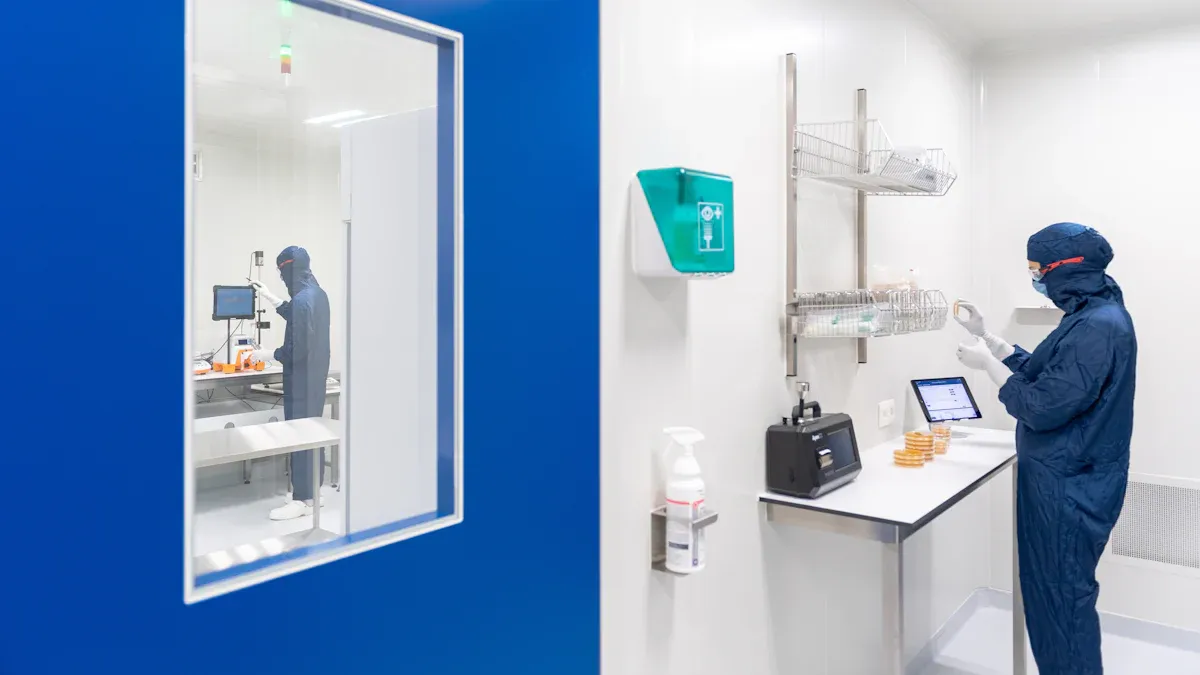
Cleanroom robots are increasingly used in sterile filling, material transfer, inspection and packaging operations. Compared with standard industrial robots, pharmaceutical robots typically use smooth surfaces, sealed joints, cleanroom-compatible lubricants and materials resistant to repeated cleaning and decontamination.
Their main advantage is reducing direct operator intervention. Human operators can introduce particles, fibers and microorganisms into critical production areas. Robotic systems installed inside isolators or restricted access barrier systems can transfer vials, syringes, cartridges, stoppers and other components while maintaining a more controlled environment.
Common applications include:
Loading and unloading sterile containers
Removing tubs, nests and protective liners
Transferring products into filling or freeze-drying equipment
Handling highly potent or cytotoxic products
Supporting automated visual inspection
Robotic systems must still be integrated with airflow control, machine vision, safety interlocks and environmental monitoring. Manufacturers should also validate robot movements, cleaning procedures and fault-recovery operations to ensure that automation does not affect sterility or product quality.
IoT-based pharmaceutical production connects sensors, machines and software platforms so that process data can be collected and analyzed continuously. It is often combined with Process Analytical Technology, or PAT, to monitor critical process parameters and quality attributes during manufacturing.
Typical measurements include:
Temperature, pressure and flow rate
pH and dissolved oxygen
Mixing speed and agitator torque
Moisture content and particle size
Tablet weight and compression force
Cleanroom pressure and particle levels
The data normally move from field sensors to PLC or distributed control systems. SCADA platforms display process conditions and alarms, while historians and manufacturing execution systems store production records and batch information.
More advanced systems can support closed-loop control. For example, a fluid-bed dryer may adjust airflow or temperature based on real-time moisture readings. A bioreactor may change feeding, agitation or gas flow according to pH, dissolved oxygen and metabolite data.
However, automatic adjustment should only be used when the relationship between process variables and product quality has been validated. Data integrity, sensor calibration, audit trails, cybersecurity and system access must also be controlled.
Pharmaceutical 3D printing creates dosage forms through controlled layer-by-layer deposition or solidification. Unlike conventional tablet compression, it allows manufacturers to adjust tablet geometry, porosity, internal structure and drug distribution through digital design.
Common printing technologies include:
Binder jetting
Fused deposition modeling
Semi-solid extrusion
Selective laser sintering
Stereolithography
Important process parameters include printing temperature, extrusion pressure, layer thickness, printing speed, infill density and tablet geometry. These factors can influence dose accuracy, mechanical strength, disintegration and drug-release performance.
Pharmaceutical 3D printing is especially valuable for:
Patient-specific doses
Pediatric and geriatric medicines
Rapidly disintegrating tablets
Controlled-release dosage forms
Multi-drug or multi-layer tablets
Small clinical-trial batches
The technology still faces challenges in production speed, raw-material consistency, printer calibration, cleaning validation and digital-file control. It is therefore more suitable for customized or complex products than for every high-volume tablet application.
Machine learning analyzes historical and real-time production data to identify patterns, predict deviations and optimize operating conditions. It can process more variables than traditional alarm systems and may detect gradual process changes before a parameter exceeds its approved limit.
Manufacturing Stage | ML Application | Process Benefit |
|---|---|---|
Upstream bioprocessing | Neural networks and supervised learning | Predicts cell growth and supports temperature, pH and oxygen control |
Fed-batch fermentation | Reinforcement learning | Optimizes nutrient feeding and process timing |
Downstream purification | Predictive analytics | Estimates filter loading, column performance and cleaning requirements |
Tablet manufacturing | Regression and classification models | Predicts tablet weight, hardness and compression stability |
Equipment monitoring | Anomaly-detection models | Identifies abnormal vibration, pressure or energy consumption |
Machine-learning models may support soft sensors, endpoint prediction, deviation detection and production scheduling. For example, a model may estimate product moisture when direct measurement is difficult or predict when a filtration process is approaching its operating limit.
These systems should not operate as uncontrolled black boxes. Training data must be representative, model performance must be tested and changes to algorithms or input data must be documented. Human review remains necessary for critical quality and release decisions.
A digital twin is a virtual representation of a machine, production line, or manufacturing process. It combines engineering models with real-time sensor data to simulate the behavior of equipment and the performance of manufacturing processes.
In pharmaceutical production, digital twins can monitor variables such as:
Motor load and vibration
Pump pressure and flow rate
Heating and cooling performance
Filter resistance
Filling-cycle stability
Cleaning and sterilization conditions
By comparing actual equipment data with expected performance, the system can detect early signs of wear, contamination, or mechanical failures. This allows maintenance to be scheduled in advance, preventing unexpected downtime and ensuring product quality is not compromised.
Digital twins can also be used to test production changes before implementing them in physical equipment. Engineers can simulate various parameters such as batch size, filling speed, temperature settings, and cleaning procedures, without having to interrupt ongoing production.
The reliability of a digital twin depends on sensor accuracy, model quality, and regular updates. It should serve to support engineering and maintenance decisions, rather than replacing the need for equipment testing, preventive maintenance, or process validation.
You start making drugs now. You prepare active materials first. You mix liquid drugs carefully. You process raw powders next. This steps keep drugs exact.
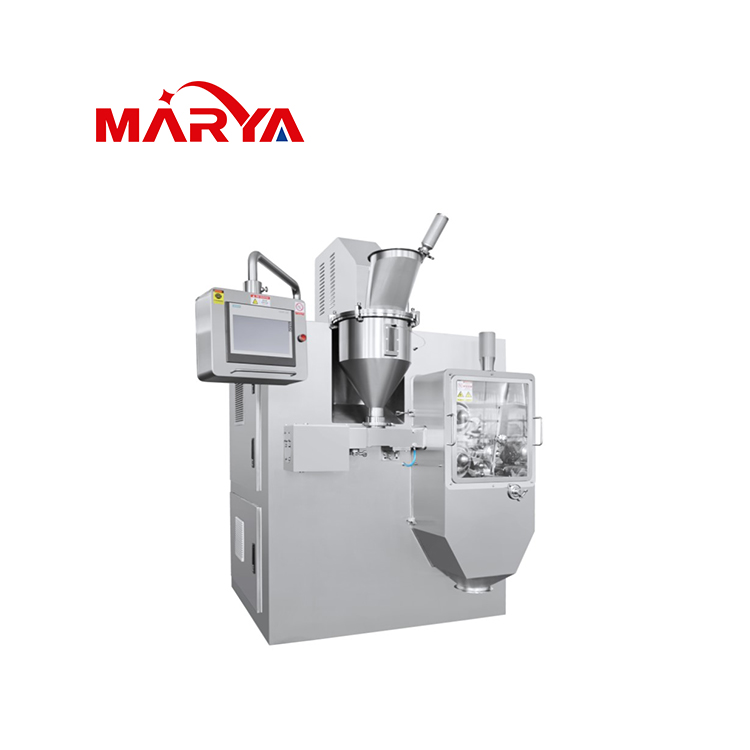
You pick special machines. You blend and mill powders. A V-Blender mixes very gently. A Ribbon Blender handles sticky powders. The Marya Pharmaceutical Granulator Machine. It works inside clean isolators. Powders flow much better then.
You turn small particles bigger. Larger granules flow very easily. Wet granulation uses liquid binders. Dry granulation uses strong force. Roller compaction uses this force. Dry granulation guards warm drugs.
Fluid bed processors lift powders. Upward air keeps them floating. One chamber granulates and dries. The machine works very fast. It makes soft, porous granules. They hold 25%–35% more air. High-shear wet methods cannot.
You finish final dosage steps. You press granules into tablets. Fast tablet presses squeeze granules. They make solid tablet shapes. They apply precise physical pressure.
You put coatings on tablets. Drums rotate during coating steps. Special films control drug release. They shield active ingredients well. Stomach acid cannot destroy them.
Hot melt extrusion uses heat. It uses mechanical pressure. The process mixes active pharmaceutical ingredients. These drugs dissolve poorly. You use specialized polymer carriers. You load dry raw materials. A heated barrel takes them. Twin screws rotate inside. Rotating screws push materials. Control thermal settings well. Machine shear forces act. They mix active drugs. Molten polymer matrices form. This process makes dispersions. Solid amorphous dispersions form. No organic solvents are used. Chemical solvents are gone. The technology is eco-friendly. It is very safe. You protect plant operators. You keep environmental standards. You process hard drug formulations.
This operation changes state. The drug changes structure. Crystalline molecules melt down. They become an amorphous state. Polymer carriers hold them. This shift helps absorption. Oral absorption rates grow. You beat solubility barriers. Drug oral bioavailability increases. Continuous extrusion gives shape. Outputs stay very uniform. You shape tablets next. You fill capsules later. Thermal sensors track heat. Machines read temperatures continuously. Good Manufacturing Practice rules apply. They control heat and feeders. You stop product defects. High quality standards stay. Every output batch succeeds.
You follow rules. You keep drug quality high.
Regulatory Standard | Governing Scope & Purpose |
|---|---|
Rules to make safe drugs. | |
21 CFR Parts 210 and 211 | FDA rules for US plants. |
European Union GMP Guidelines | Quality rules for EU nations. |
ICH Guidelines | Global rules for drug quality. |
You set up clear quality systems. They help guide daily factory operations. You keep standard procedures ready. You secure raw materials. You run testing labs. You check errors to stop germs.
You map plant layouts on paper. A Site Master File holds them. This file lists tool rules. It saves test policies. You check drug-contact tools. They use AISI 316 steel.
You test water lines and tools. You run sanitation routines often. This stops germ growth fast. You check air filters daily. You protect clean rooms well.
You run digital workflows. They secure ALCOA+ data compliance.
User Attribution: Personal tokens control system logins safely.
Audit Trail Depth: Locked logs store time tags for changes.
Timing Accuracy: Smart tools log data fast without delay.
You link tools to batch software. Streaming data cuts typing errors. You search batch files fast.
You install Process Analytical Technology to monitor drug manufacturing continuously. You place near-infrared spectrometers, Raman probes, and physical sensors directly inside active manufacturing equipment. These smart instruments measure chemical compositions and physical attributes without stopping the processing machinery. You collect clear process data every second. You stop relying on slow manual laboratory samples.
You achieve real-time release testing through several integrated operational steps:
Continuous Quality Monitoring: You track critical quality parameters constantly during active manufacturing to gather comprehensive process datasets.
Multivariate Model Integration: You combine real-time operational streams with validated software models to ensure high product quality.
Bypassing Post-Production Lab Testing: You verify drug safety dynamically during processing, allowing instant batch release based on live operational data.
In-Process Attribute Control: You adjust key equipment parameters mid-process to correct tiny product deviations immediately at crucial stages.
Cycle Time Reduction: You execute analytical tests concurrently with active production steps to shorten batch release timelines dramatically.
You follow strict regulatory frameworks to manage these computational decision models safely. You validate software algorithms routinely to maintain complete measurement precision. You establish automated control systems to prevent human mistakes during validation steps. This operational framework transforms standard quality assurance into a dynamic defense system. You safeguard total batch uniformity across every single production run.
Pharmaceutical Production Technology reshapes how you manufacture essential medicines. Advanced automation systems help you lower operating expenses while speeding up overall factory throughput. You improve daily product consistency across all drug manufacturing lines.
You cut factory expenses significantly by modernizing your production systems. Automated machinery combined with smart scheduling software enables continuous 24/7/365 operations without interruptions. This continuous operational model boosts your product output while reducing extra headcount and direct labor spending.
Cost Reduction Category | Metric / Saving Percentage | Operational Impact |
|---|---|---|
Overall API Manufacturing Cost | 25% – 45% total reduction per kg | Combines procurement, conversion, and quality savings |
Procurement | 5% – 10% savings | Achieved via AI-optimized raw material purchasing |
Conversion Costs | 10% – 20% reduction | Decreases labor, energy usage, yield loss, and rework |
Cost of Quality | 10% – 15% reduction | Reduces testing overhead and batch rejections |
Energy Consumption | Up to 20% reduction | Achieved by replacing batch reactors with continuous flow |
Facility Footprint | >10x size reduction | Minimizes capital expenditures for physical plants |
You save money by adopting continuous manufacturing setups. Replacing old batch reactors with continuous flow lines cuts energy consumption by up to 20%. The Pfizer Manufacturing Network halved production cycle times by adopting automation tools. Integrated continuous platforms compress total processing times from 200 days down to 2 days, achieving a 99% reduction in cycle duration.
You speed up medicine launches by using continuous processing platforms. Pharmaceutical Continuous Manufacturing eliminates the traditional scale-up phase between development and commercial production. You bypass intermediate storage and release steps, driving faster regulatory approval.
Identical Equipment Setup: Replicating exact equipment sets across clinical and commercial manufacturing eliminates equipment mismatch risk.
Bypassing Demonstration Batches: Matching your development setup to commercial scale reduces the need for site engineering batches.
Digital Technology Transfer: Executing digital transfers of control strategies allows direct transitions into clinical supply.
Continuous platforms use design of experiments approaches to conserve active pharmaceutical ingredients. Traditional batch testing uses 40 kg of active material. Continuous methods use only 20 kg of material across a 2-factor, 2-level factorial design with center points, achieving a 50% reduction in material usage.
You maintain high product standards by installing real-time process control tools. Standardized continuous platforms favor direct compression steps. Direct compression minimizes complicated optimization studies. Automated systems stream constant data to prevent batch errors instantly.
Bypassing intermediate storage steps cuts handling errors while protecting total batch safety.
You eliminate manual sampling steps through inline sensors and continuous monitoring. Continuous platforms collect operational data every second. Your software identifies parameter shifts early. You fix equipment deviations before product defects occur, securing uniform quality across every batch run.
New tech helps us make medicine. It joins physical work with computers. Live checks keep drugs very safe. Rules protect sick people always. This work lowers total costs. Plants ship new drugs faster. Factory growth becomes very easy.
Category | Emerging Trend | Impact |
|---|---|---|
Facility | Generative AI layouts | Smart tools design fast. Plants grow easily. |
Quality | Computers check drug safety. They approve batches fast. | |
Operations | Digital Twins & Predictive Analytics | Digital clones run tests. They fix plant work. |
Supply Chain | Blockchain Integration & Live IoT Tracking | Blockchains save true records. Sensors track items live. |
Data | Cloud Analytics & Cobots | Web tools store facts. Team robots help humans. |
Smart tech powers future drug factories.
You use this big system to build safe drugs. It combines tools, physical steps, and software. You make good medicine at scale. You meet key rules easily.
Batch operations stop at each phase. Workers help move goods often. Continuous lines move materials without stops. You cut power use by 40%. You drop product shifts by 50%.
You mix filler items with active drugs. They protect drug strength inside you. They control how drugs dissolve. They also make medicine taste better.
Digital twins build virtual factory clones. They use live sensor data. These smart models spot breaks early. You drop tool downtime by 40%.
Process Analytical Technology checks drugs inside working machines. You track safety facts live. You release good batches fast. You skip slow lab checks.
Robots shift clean items without hands. You stop skin flake messes inside cleanrooms. Fast tools keep work moving. They guard clean spaces well.
You heat and push drugs into polymers. You use zero chemical solvents. This process melts solid drug crystals down. Your body absorbs the medicine faster.