Views: 0 Author: Site Editor Publish Time: 2026-07-23 Origin: Site
You face many problems in the pharmaceutical industry if you do not know the right medical words. Many doctors, patients, and pharmacists have trouble with medical information. Medical research, clinical research, and r&d teams need clear medical communication. This helps keep patients safe and makes treatments work. Pipeline drugs and biologic product progress depend on correct medical and patient information. Medical treatment and patient care need a good understanding of therapeutic biological product details. Biologic license application and therapeutic biological product steps help patient treatment and medical progress.
34.1% of healthcare workers said they did not know about the medical information service from pharmaceutical companies.
48.3% said they did not know about the website.
Knowing pharmaceutical terminology helps people talk better in research and manufacturing. You make fewer mistakes, help meet rules, and help patients and pharmacists get the right treatment. Marya is a leader in pharmaceutical and cleanroom solutions. Marya helps you reach patient-focused medical success.
Table of Contents
Knowing pharmaceutical terminology is very important in healthcare. It helps people talk clearly and avoid mistakes. This makes sure patients get the right care.
Active Pharmaceutical Ingredients (APIs) are the main parts in medicine that help treat sickness. Learning about APIs can help you know how well a drug works.
Capsules and ampoules are common ways to give medicine. They protect the medicine and make it easier to take. They also help give the right amount and keep the medicine safe.
Generic drugs work the same as brand-name drugs but cost less. They help more people get the medicine they need.
Good Manufacturing Practices (GMP) are important for making safe and good-quality medicine. Following GMP stops germs from getting in and keeps the product the same every time.
Adverse Drug Reactions (ADRs) can cause bad health problems. Always tell your doctor if you have side effects. This helps keep medicine use safe.
Blister packaging is a good way to keep medicine safe and neat. It helps stop mistakes with doses and keeps medicine fresh.
Regulatory agencies like the FDA help make sure drugs are safe and work well. Learning their rules can help you understand more about medicine.
API is a word you see a lot in this field. The Active Pharmaceutical Ingredient is the main part of medicine that helps you feel better. When you take medicine, the API is what fixes your health problem. APIs can be tiny molecules or big biologics. Companies use APIs to make many kinds of drugs for people. The worldwide API market keeps getting bigger. In 2023, it was worth $247.8 billion. Experts think it will reach $347.9 billion by 2029. This steady rise shows APIs are very important for making and studying medicines.
Marya gives you advanced machines for filling APIs. Their machines fill vials, syringes, and cartridges fast and safely. You get steady and good production for your medicine needs. Marya also has isolators and water systems to keep your area clean. These systems help with aseptic work and help you follow strict rules.
An ampoule is a tiny sealed container for liquid drugs. You see ampoules in hospitals and clinics. They keep medicine clean and safe until you need it. Ampoules protect the drug from air and germs. You break the top to get the medicine for injection or other uses.
Groups like the FDA and EMA have strict rules for ampoule packaging. You must keep the drug clean, show if it was opened, and make it easy to track. The European Pharmacopoeia sets rules for materials like borosilicate glass. ISO 15378 gives Good Manufacturing Practices for packaging. These rules help you give safe and good medicine to patients.
Marya helps you make ampoules with strong filling lines and cleanroom solutions. Their technology keeps your drugs safe and follows the rules.
A capsule is a solid form that holds medicine inside a shell. You swallow capsules. The shell melts in your stomach and lets the medicine out. Capsules make it easy to take and absorb medicine. Companies use capsules for many kinds of prescription and store-bought drugs.
Capsules help you give exact doses of medicine. They keep the drug safe from water and light. You can use capsules for powders, liquids, or pellets. Marya has filling lines that work well with capsules. Their systems help you make high-quality medicine for the industry.
Tip: Capsules are liked because they hide the taste of the drug and make it easier for you to take your medicine.
Term | Definition |
|---|---|
The finished dosage form that contains a drug substance, generally, but not necessarily in association with other active or inactive ingredients. | |
Commercial products | Marketed and FDA-approved pharmaceuticals available for sale and distribution. These products have completed clinical trials and regulatory review to confirm their safety and effectiveness. |
Drugs | Chemical or biological substances used to diagnose, cure, mitigate, treat, or prevent diseases. They can be small molecules, peptides, or complex biologics like antibodies. |
Dosage form is how medicine is given to you. You see tablets, capsules, liquids, creams, and injections. Each form helps you take medicine safely. Tablets and capsules are very common. You swallow them with water. Liquids are good for kids and older people. Creams and ointments help with skin problems. Injections put medicine into your body quickly.
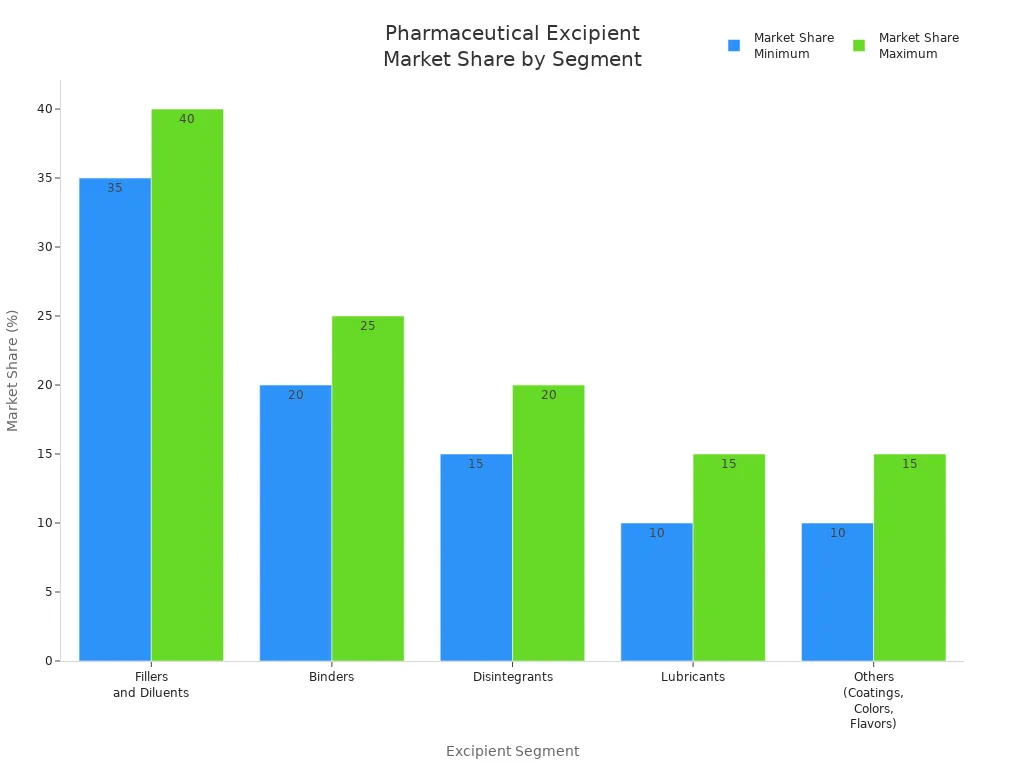
Manufacturers use fillers, binders, disintegrants, and lubricants. Fillers and diluents are used the most. They help make tablets and capsules. Binders keep the tablet strong and together. Disintegrants help tablets break apart in your stomach. Lubricants stop tablets from sticking to machines. Coatings, colors, and flavors make medicine look and taste better.
Segment | Market Share (%) | Key Characteristics |
|---|---|---|
Fillers and Diluents | Largest segment by volume, essential for tablet formulation | |
Binders | 20-25 | Crucial for providing cohesiveness and tablet integrity |
Disintegrants | 15-20 | Enable drug release in gastrointestinal tract |
Lubricants | 10-15 | Prevent adhesion to manufacturing equipment |
Others (Coatings, Colors, Flavors) | 10-15 | Enhance patient compliance and product differentiation |
Marya helps make many dosage forms. Their machines fill tablets, capsules, vials, and syringes. You get clean and safe medicine. Marya’s isolators and solution systems help with aseptic work. You meet strict rules and keep medicine stable.
Note: Picking the right dosage form makes patients feel better and helps treatment work.
Drug product is the finished medicine you use. You see drug products as tablets, capsules, liquids, creams, or injections. Drug products have the active pharmaceutical ingredient and other things. These things help the medicine work and stay safe. You find drug products in stores, hospitals, and clinics.
Groups like the FDA define drug product carefully. Drug products are listed in official books called pharmacopoeias. They must help diagnose, cure, treat, or prevent disease. Drug products also change your body’s structure or function. You need clear labels to know how to use medicine. Labels show the name, strength, dosage form, and instructions.
Definition Component | Description |
|---|---|
Includes those listed in the United States Pharmacopoeia, Homoeopathic Pharmacopoeia, or National Formulary. | |
Intended uses | Products meant for diagnosis, cure, mitigation, treatment, or prevention of disease. |
Effects on body structure/function | Products intended to affect the structure or function of the body. |
Marya gives you fast filling lines for drug products. You get quick and steady production. Their cleanroom solutions help you meet industry rules. Marya’s machines help make prescription and store-bought medicine.
Tip: Always check the label before using any drug product. This keeps you safe and helps you follow instructions.
Blister packaging keeps medicine safe from air, water, and light. You see blister packs for tablets and capsules. Each dose sits in its own pocket. You push the tablet out through the foil. Blister packaging keeps medicine fresh and stops germs. It is easy to count doses and track your medicine.
Drug companies use blister packaging for many medicines. This packaging helps you follow your treatment plan. You see clear labels and expiry dates. Blister packs are easy to carry and help avoid mistakes.
Marya offers blister packaging for the pharmaceutical industry. Their machines and cleanroom systems keep medicine safe. You get steady and good production. Marya’s technology helps make high-quality packaging for many drug products.
Alert: Blister packaging helps you avoid taking the wrong dose. It keeps your medicine organized and easy to use.
Brand products are common in the pharmaceutical industry. A brand product is a medicine made by the company that first finds and creates it. You can spot these medicines by their special names and packaging. Companies spend many years testing and studying these drugs. They send a New Drug Application to get approval from health agencies. This step takes a long time and costs a lot.
Brand products get market exclusivity, which is special protection. Companies usually have five years to sell their drug alone. Sometimes, this time gets longer for new uses or studies with kids. Only the first company can sell the medicine during this period. Brand products often cost more than other choices.
You use brand products for new treatments and better therapies. These drugs help you handle health problems and live better. Marya helps make brand products with advanced filling lines and clean rooms. Their systems help you make safe and steady medicines.
Brand products need a New Drug Application, which takes a long time and costs a lot.
NDAs give the company five years of market exclusivity.
This time can be longer for studies with kids or new uses.
Note: Brand products bring new ideas to medicine. You get new treatments and better health from them.
A generic drug gives you the same care as a brand product. It has the same active ingredient, strength, and dosage form. Generic drugs help you save money and make medicine easier to get. Companies make generic drugs after the brand product’s exclusivity ends. These drugs get approved with an Abbreviated New Drug Application. This process is faster and costs less.
Generic drugs must meet strict rules for safety and quality. Health agencies check that these drugs work like the original. You can trust generic drugs to help your health. In the United States, 90% of prescriptions are for generic drugs. Only 10% are for brand products. You spend less on generics, even though you use them more.
Type of Drug | Percentage of Prescriptions | Percentage of Spending |
|---|---|---|
Generic Drugs | 90% | 12% |
Brand Drugs | 10% | 88% |
Generic drugs use an Abbreviated New Drug Application, which is quicker and cheaper.
The first company to file an ANDA may get 180 days of exclusivity.
Marya helps you make generic drugs with fast filling lines and clean rooms. Their technology helps you make good medicine. You get safe and steady drugs for your patients and customers.
Tip: You can trust generic drugs to work like brand products. They help you stay healthy and save money.
Adverse drug reactions are unwanted effects from medicine. You might feel mild problems like nausea or serious issues needing a doctor. ADRs can happen in clinical trials or after the drug is sold. You must report these reactions to keep people safe.
ADRs cause many hospital stays and emergency visits each year. In the USA, about 2,216,000 hospital stays are linked to ADRs. These reactions cause over 106,000 deaths every year. ADRs are the fourth to sixth leading cause of death. Almost 1,300,000 emergency visits happen because of ADRs.
You need to watch for signs of adverse drug reactions. Doctors, pharmacists, and patients must pay attention. Marya’s solutions help lower risks by making safe and high-quality medicine. Their systems help you track and manage medicine safety.
About 2,216,000 hospital stays each year in the USA are due to ADRs.
ADRs cause over 106,000 deaths every year and are a top cause of death.
ADRs lead to almost 1,300,000 emergency visits each year.
Alert: Always tell your doctor about any side effects. You help make medicine safer for everyone.
Distributors are found in many places in this industry. They move drugs from where they are made to stores and hospitals. Distributors help you get the medicine you need on time. They are important for keeping the supply chain working well. You count on them to deliver prescription drugs safely.
Distributors have some problems when moving drugs:
Bad roads and weak storage can cause trouble. These things make it hard to keep medicine safe.
Hard-to-reach places and bad weather can hurt drug quality. These problems can damage medicine.
Not enough trained workers at the last stop can cause mistakes. Workers may not handle special drugs the right way.
Traffic jams and other surprises can slow down deliveries. These delays can break the cold chain, which keeps drugs safe.
Marya helps fix these problems for you. You get complete solutions for moving and storing medicine. Marya’s systems keep your drugs safe and steady at every step.
Tip: Always make sure your distributor follows safety rules. This keeps your medicine safe and helps patients stay healthy.
Actual Acquisition Cost (AAC) is the price pharmacies pay for drugs. You see AAC used when talking about prices and supply chains. Pharmacies figure out AAC by looking at what they really pay, including any discounts. The price changes depending on how and where pharmacies buy drugs.
AAC is different for many reasons. Wholesalers give different discounts to pharmacies. Some pharmacies buy straight from the maker, others use wholesalers. Prices also change in different places. For example, pharmacies often get 10% to 18% off the usual price. This helps them save money on prescription drugs.
Marya gives you good systems for moving and tracking medicine. You get help with AAC and keeping drug costs low. Their solutions make it easier to handle prices and supply chain problems.
Note: Knowing about AAC helps you make smart choices about drug prices. This keeps your business strong.
Counterfeit medicine is a big danger in this field. You need to watch out for fake drugs that look real but are not. These drugs can get into the supply chain and hurt people. You must be careful to keep your medicine safe.
The World Health Organization says about 1 in 10 medical products in some countries is fake or not good. Up to 10% of drugs in these places are counterfeit. Even rich countries sometimes find fake drugs, which is risky.
You can fight fake medicine by checking packages, labels, and where you buy. Marya gives you clean and safe ways to move and store medicine. You get help keeping your drugs safe and stopping fake ones from reaching people.
Alert: Always buy your medicine from trusted places. This keeps you safe and helps stop fake drugs.
Over the Counter (OTC) drugs are medicines you can buy without a doctor’s prescription. You find these drugs in stores like pharmacies and supermarkets. OTC drugs help with common problems like headaches, colds, allergies, and minor pain. You use them for fast relief when you do not need to see a doctor.
You see many kinds of OTC drugs, such as:
Pain relievers like acetaminophen and ibuprofen
Cough and cold medicines
Allergy tablets
Antacids for upset stomach
Creams for rashes or burns
OTC drugs must follow strict safety rules. The Food and Drug Administration (FDA) checks these medicines before you can buy them. The FDA looks at the active ingredients, labels, and directions. You get clear instructions on how to use OTC drugs safely. Labels show the dose, warnings, and side effects.
Tip: Always read the label before you use any OTC medicine. This helps you avoid mistakes and keeps you safe.
You play a big part in using OTC drugs the right way. You should:
Follow the directions on the package
Do not take more than the dose shown
Watch for side effects or allergies
Ask a pharmacist if you have questions
OTC drugs move through a special supply chain. Manufacturers make the drugs in clean places. Distributors bring them to stores and pharmacies. You count on this system to get safe and good medicine. Companies like marya help with this process. Marya gives solutions for drug distribution and cleanroom projects. Their technology keeps OTC drugs safe from contamination. You get high-quality products that meet industry standards.
OTC Drug Type | Common Use | Example Brand Names |
|---|---|---|
Pain Reliever | Headache, fever | Tylenol, Advil |
Allergy Medicine | Sneezing, itching | Claritin, Zyrtec |
Antacid | Heartburn | Tums, Maalox |
Cough Suppressant | Cough | Robitussin, Delsym |
Topical Cream | Skin irritation | Neosporin, Cortizone-10 |
You see OTC drugs as an easy way to handle small health issues. You do not need a prescription, so you save time and money. But you must use these medicines carefully. If your symptoms do not get better, you should talk to a doctor.
Alert: Some OTC drugs can mix badly with other medicines you take. Always check with a healthcare professional if you are not sure.
OTC drugs are an important part of the pharmaceutical supply chain. You depend on safe production, good storage, and steady delivery. Marya’s cleanroom and distribution solutions help you get the best quality OTC products every time.
The abbreviated new drug application is important for generic drugs. The FDA uses it to check if a generic drug matches a brand-name drug. You do not need full clinical trials for this application. You must show your drug is bioequivalent to the original. This means your drug gives the same amount of active ingredient in the same time.
The abbreviated new drug application saves time and money. You can sell generic drugs faster.
Generic drug makers must prove their product works like the brand drug. You measure how fast the drug enters the bloodstream.
The FDA checks your application and looks at bioequivalence. You get approval if your drug meets all rules.
Generic drugs approved this way are about 90% of prescriptions in the United States. You get medicine that costs less and is easy to find. The FDA makes sure these drugs are safe and work well.
A drug master file shares secret information with the FDA and other agencies. The drug master file has details about how drugs are made, where they are made, and what goes in them. You send this file to help meet rules and protect your ideas.
You use the drug master file in other applications like investigational new drug and new drug application.
The FDA checks the drug master file during review. You must meet safety and effectiveness standards.
The drug master file keeps your private information safe. You can work with other companies in drug development.
The drug master file helps you follow rules. You support your application without showing secrets to competitors. The FDA uses the drug master file to see if your drug meets approval standards.
A clinical trial tests if a drug is safe and works. The FDA and other agencies need clinical trials before approval. You follow different steps to collect data for your application.
Phase | Description | Success Rate |
|---|---|---|
Phase I | You check safety and dosage in 20-100 healthy volunteers. | ~70% |
Phase II | You test effectiveness on 100-300 volunteers and find the right dose. | ~33% |
Phase III | You study hundreds to thousands of people for data needed for FDA approval. | 25-30% |
Not every drug passes each phase. The FDA looks at your application based on clinical trial results. You must show your drug is safe and works for approval.
Note: You need strong clinical trial data for a new drug application. The FDA wants clear proof before giving approval.
Regulatory agencies like the FDA use different ways to approve drugs. You may get early approval with limited clinical data. You talk with the regulator often during the process. The FDA has faster approval paths, like Priority Review, to speed up approval. You must follow all rules and send the right application for your drug.
Shanghai Marya always follows FDA rules and requirements. You get help with your application, approval, and clinical trial needs. Marya helps you meet rules and succeed in the pharmaceutical industry.
The FDA is a very important group in medicine. The FDA keeps you safe by checking drugs, vaccines, and medical devices. You trust the FDA to make rules and watch over companies. If you want to sell a drug, you must follow FDA rules. The FDA checks everything, from making the drug to selling it.
The FDA does many jobs:
The FDA checks if drugs for people and animals are safe and work well.
You get good information from the FDA to use medicine and food safely.
The FDA makes sure food is safe and has the right labels.
The FDA controls tobacco products to protect health and stop kids from using them.
The FDA keeps you safe from harmful radiation from some electronic items.
You must follow FDA rules to sell your drug. The FDA looks at your clinical trial results and how you make the drug. You need to prove your drug is safe and works. The FDA checks your labels and packages to make sure you give clear instructions. You cannot sell a drug without FDA approval.
The FDA sets tough rules for drug companies. You must meet these rules to keep your products in stores. The FDA checks your buildings and looks at your records. You must keep your work area clean and follow Good Manufacturing Practice. The FDA helps you avoid mistakes and keeps patients safe.
Marya always follows FDA rules and standards. Marya helps you with approval and following the rules. Marya’s machines and clean rooms help you meet FDA needs. You can trust Marya to help you pass FDA checks and get your products approved.
Tip: Always look at FDA rules before starting a new drug. You save time and avoid problems when getting approval.
The International Pharmaceutical Excipients Council is a worldwide group. It helps set rules for excipients. Excipients are the parts of medicine that do not treat you. IPEC gives advice on how to use, test, and approve excipients. You need excipients to make your drug safe, stable, and easy to use.
IPEC works with the FDA and other groups to make rules the same everywhere. You follow IPEC rules to get your drug approved. IPEC helps you pick excipients and check their quality. You use IPEC papers to show your excipients are safe.
IPEC helps in many parts of the drug industry. IPEC helps you get approval for new and generic drugs. You use IPEC rules to meet FDA needs. IPEC gives tools to manage excipient risks and make your work better.
Marya uses IPEC rules in its production lines. You get good products that meet FDA and IPEC approval. Marya’s clean rooms help you control excipient quality and follow world rules. You can count on Marya for help with excipient approval and following rules.
Note: Always check IPEC rules when picking excipients. You make your drug safer and improve your chances for approval.
You should know the expiry date for every medicine you use. The expiry date shows how long a drug stays safe and works well. You must check expiry dates at different steps in the industry. Expiry dates are on all prescription and over-the-counter medicine. These dates help you avoid using unsafe or old drugs.
Manufacturers follow strict rules to set expiry dates. They look at when the drug was made and released. If the release date is more than 30 days after making the drug, you use the month and year for the expiry date. This keeps your medicine safe to use.
Example | Result | |
|---|---|---|
From release date | 14/01/2007 | 12/2006 |
From release date | 15/01/2007 | 01/2007 |
Calculation Method | |
|---|---|
From release date | MM/YYYY |
From production date | If > 30 days from release |
Always check the expiry date before you take any medicine. This step keeps you healthy and helps you follow important rules.
Tip: Never use medicine after its expiry date. It might not work or could hurt you.
Bioavailability is an important idea in drug research. It shows how much and how fast a drug gets into your blood. You need to know this to make sure your medicine works right. Scientists use bioavailability to make better drugs and set doses.
Bioavailability measures how much of the main part of a drug gets into your blood.
Absolute bioavailability compares your medicine to an intravenous dose.
Relative bioavailability checks how different forms of the same drug work in your body.
Important numbers are the time to reach the highest concentration (tmax) and the area under the curve (AUC).
You need to understand bioavailability to make better drugs and set the right dose.
You see bioavailability studies in clinical trials and new drug development. These studies help you get safe and good medicine.
Bioequivalence means two drugs work the same way in your body. You must show bioequivalence when making a generic medicine. This helps you trust that a generic drug will work like the original prescription.
Regulators use special study designs to check bioequivalence. You see crossover studies in the industry. These studies compare how your body absorbs two drugs. You also need strong manufacturing and quality control steps.
Step | Description |
|---|---|
Crossover designs test how your body absorbs each drug. | |
Manufacturing | You must develop the formula, test it, and follow good manufacturing practices. |
Bioanalytical Method Development | You need to measure the drug in your blood and follow strict rules for testing. |
You must prove bioequivalence to get approval for a generic prescription. This process helps you get safe and affordable medicine.
Note: Ask your pharmacist if you have questions about generic drugs and bioequivalence.
GMP is a set of rules for making medicine safely. You must follow GMP to keep drugs safe and working well. GMP covers everything from research to packaging. You need to know the main ideas of GMP. These ideas help you make medicine the right way:
People – Workers must follow steps exactly. Everyone needs training and must obey the rules.
Products – You check each drug before sending it out. Quality checks keep patients safe.
Processes – You write down every step. Clear instructions help you avoid mistakes and keep things steady.
Procedures – You use guides for each important step. This makes sure you get the same result every time.
Premises – You keep your workspace clean. Clean areas stop germs and protect medicine.
You also need written steps for each job. Equipment and rooms must stay clean and in good shape. You use only tested materials. Each step must be checked and controlled. Quality checks happen at many points.
Tip: GMP helps you trust medicine. It keeps patients safe and helps people use medicine the right way.
Isolator systems help keep medicine clean and safe. Isolators make a closed space. This stops germs from getting in and protects medicine. People do not go inside the critical area. This lowers mistakes and keeps drugs safe.
Marya’s isolators use smart machines. You get steady work without human errors. Real-time checks watch for germs. You see results that help you meet tough rules. Marya’s isolators help with research and making medicine.
Isolators keep people out of important areas.
They stop germs from getting in.
Machines keep work steady.
Checks watch for germs all the time.
You use isolator systems for clean drug making. Marya’s technology helps you follow GMP and other rules.
Note: Isolator systems help you give safe medicine and keep patients healthy.
Solution preparation systems mix and make medicine. These systems help make drugs and prescriptions. Marya’s systems help with research and making medicine. You get exact mixing and control for each batch.
Marya builds solution systems to follow GMP rules. You use these systems for mixing ingredients and excipients. The equipment keeps your area clean and stops germs. You can change the system for different drugs.
Feature | Benefit |
|---|---|
Precise Mixing | Makes medicine accurate |
Clean Design | Stops germs |
Customization | Works for many drug types |
GMP Compliance | Follows tough rules |
You count on solution systems for safe and good medicine. Marya’s systems help you make drugs that follow industry rules.
Alert: Always use systems that follow GMP rules for mixing solutions. This keeps your medicine safe and helps people use prescriptions the right way.
You need pure water to make safe medicine. Water is used in almost every step. You clean tools with water. You mix solutions with water. Water is also an ingredient in many drug products. If water has dirt or germs, medicine can be unsafe. Even tiny bits of dirt can cause big problems for patients.
Marya gives you advanced water treatment systems for this industry. These systems take out particles, bacteria, and chemicals from water. You get water that is very pure. Marya’s technology helps keep your workspace clean and your products safe.
Groups like the FDA, USP, and EP set strict rules for water quality. You must follow these rules to avoid trouble. If you do not meet the standards, you could get audited or fined. Sometimes, you may have to throw away whole batches of medicine. This costs your company a lot and slows down your work.
Here is why water purity matters and what you must do:
Aspect | Details |
|---|---|
Importance of Water Purity | Makes medicine safe and stops contamination. |
Regulatory Compliance | Must meet world pharmacopeial standards (USP, EP). |
Consequences of Noncompliance | Risk of audits, fines, and throwing away medicine batches. |
You must watch water quality at every step. Pure water keeps drugs strong and safe. Even a tiny impurity can put patients at risk. If you do not follow the rules, you may have costly production stops.
Pure water is needed to keep medicine working.
Even small impurities can make medicine unsafe.
Following standards is important to avoid expensive production stops.
Marya’s water treatment systems use smart controls and real-time checks. You can see water quality data anytime. The system warns you if something is wrong. You can fix problems fast and keep your work going.
Tip: Always check your water treatment system before making medicine. Clean water helps you make better medicine and keeps patients safe.
Regulatory groups like the FDA make sure water quality rules are followed. If you do not follow the rules, you may get audited, fined, or have to throw away medicine batches. This can cost a lot and stop your work.
You can trust marya to help you meet all water quality rules. Their systems help your research and production. You get safe, high-quality medicine for patients.
You see the term Actual Acquisition Cost (AAC) when you look at how much a pharmacy pays for a drug. AAC shows the real price that a pharmacy pays after discounts and rebates. You use AAC to understand the true cost of medicine. This helps you compare prices between pharmacies and see how much you spend on drugs.
AAC matters in the pharmaceutical industry because it affects how much you pay for prescriptions. You use AAC to set budgets and plan for expenses. If you work in a pharmacy, you check AAC to make sure you pay the right price. You also use AAC to help insurance companies decide how much to reimburse for a drug.
Tip: Always check AAC before you buy medicine for your pharmacy. This helps you avoid paying too much.
Average Wholesale Price (AWP) is another important term. You see AWP when you look at the price that wholesalers charge pharmacies for drugs. AWP is not always the real price you pay. Sometimes, the actual price is lower because of discounts. You use AWP as a reference point to compare prices.
AWP helps you understand how much a drug costs in the pharmaceutical industry. You use AWP to set prices for insurance claims and reimbursement. If you work in a pharmacy, you look at AWP to see if you get a good deal. You also use AWP to check if the price matches what other pharmacies pay.
Term | What It Means | How You Use It |
|---|---|---|
AAC | Real price paid by pharmacy | Set budgets, compare costs |
AWP | Reference price from wholesaler | Compare deals, set insurance claims |
Note: AWP is a guide, not the exact price. Always check the real price before you buy a drug.
Pharmacy Benefit Managers (PBMs) play a big role in the pharmaceutical industry. You see PBMs when you use insurance to pay for drugs. PBMs help you get medicine at a lower price. They work with pharmacies, drug makers, and insurance companies to set prices and manage benefits.
PBMs decide which drugs you can get and how much you pay. They use price lists to choose the best deals. You use PBMs to save money and get the right medicine. If you work in a pharmacy, you follow PBM rules to fill prescriptions. PBMs also help you handle rebates and discounts.
PBMs manage drug lists and prices.
You use PBMs to get lower prices for medicine.
PBMs help you with insurance claims and reimbursement.
Alert: Always ask your PBM about the price of a drug. This helps you find the best deal for your pharmacy.
You see AAC, AWP, and PBMs in every part of the pharmaceutical industry. These terms help you understand how prices work and how you pay for medicine. You use them to make smart choices and keep your pharmacy strong.
CMS is a big group in the pharmaceutical industry. CMS helps you know how medicine is paid for in the United States. CMS runs programs like Medicare and Medicaid. These programs help many people get health care and medicine. CMS sets rules for drug coverage and reimbursement.
CMS decides what you pay for medicine. The agency uses different ways to set drug prices. CMS uses Average Wholesale Price, Actual Acquisition Cost, and other formulas. These ways help you know the cost for each prescription. CMS checks if the price matches the medicine’s value. You get clear rules for what is covered and what you pay.
You use CMS rules to get medicine for older adults and people with low income. CMS helps you see if your medicine is covered. You check the price before you fill a prescription. CMS updates price lists often. Prices change when new drugs come out or rules change. You must follow CMS rules to get money back for medicine.
CMS works with pharmacies, hospitals, and drug makers. CMS sets the price for many drugs. The agency checks if the price is fair. CMS helps you avoid paying too much. You use CMS data to compare prices between medicines. CMS helps you make smart choices about what medicine to buy.
Tip: Always look at CMS price lists before buying or prescribing medicine. You save money and help patients get good care.
CMS Program | Who It Helps | How Price Is Set |
|---|---|---|
Medicare | Older adults | Uses price formulas |
Medicaid | Low-income people | Checks price and value |
WHO is a world leader in health. WHO helps you know how medicine is priced and used everywhere. The agency sets rules for drug safety, quality, and price. You count on WHO for advice to make medicine safe and affordable.
WHO checks medicine prices in many countries. You use WHO reports to compare prices between nations. WHO helps you find ways to lower the price of important drugs. The agency works with governments, drug makers, and pharmacies. WHO pushes for fair prices so everyone can get medicine.
WHO sets rules for drug quality and safety. You follow WHO guidelines to make sure your medicine meets world standards. WHO helps you track price changes and learn why some drugs cost more. You use WHO data to plan budgets and make smart choices about buying medicine.
WHO helps countries talk about the price of vaccines and treatments. WHO gives advice on paying for medicine and getting the best price. You use WHO tools to check if the price is fair. WHO helps you avoid paying too much and makes sure medicine is available to all.
Note: WHO price reports help you see trends and make better choices about medicine.
WHO Role | What You Get | How Price Is Managed |
|---|---|---|
Set standards | Safe medicine | Tracks price worldwide |
Give advice | Lower price | Helps negotiate price |
You see Rx everywhere in the pharmaceutical industry. Rx stands for "prescription." Doctors write an Rx when you need medicine that is not available over the counter. You take the Rx to a pharmacy, and the pharmacist gives you the drug. Rx helps you get the right medicine for your health problem. You must follow the instructions on the Rx to stay safe.
Pharmacists use Rx to check the dose, the type of drug, and how often you should take it. You trust the pharmacy to give you the correct medicine. Rx is a symbol that shows you need a professional to help you. You cannot buy Rx drugs without a doctor's approval.
Tip: Always ask your pharmacist if you have questions about your Rx. You stay safe and avoid mistakes.
OTC means "over the counter." You buy OTC drugs without a prescription. You find these medicines in every pharmacy, supermarket, or convenience store. OTC drugs help you treat simple health problems like headaches, allergies, or minor pain. You do not need a doctor's Rx for these medicines.
You must read the label before using any OTC drug. The label tells you how much to take and what side effects to watch for. You ask the pharmacist if you are not sure about an OTC drug. OTC drugs are safe when you use them the right way. You help yourself and your family by choosing the correct OTC medicine.
You use OTC drugs for common problems.
You find OTC drugs in every pharmacy.
You must follow the directions on the label.
Alert: Some OTC drugs can cause problems if you mix them with other medicines. Always check with your pharmacist.
NDC stands for National Drug Code. You see this code on every drug package in the United States. The NDC helps you and the pharmacy track and identify each drug. The code has three parts: the labeler, the product, and the package. You use the NDC to make sure you get the right medicine.
Pharmacies use the NDC to manage inventory and avoid mistakes. You see the NDC on receipts, insurance claims, and drug labels. The NDC helps you know the drug's maker, its strength, and its form. You trust the NDC to keep your medicine safe and organized.
Abbreviation | Definition | Description |
|---|---|---|
Rx | Prescription | Symbol for prescription drugs that require a doctor's approval. |
OTC | Over the Counter | Drugs you buy without a prescription for common health problems. |
NDC | National Drug Code | Unique code for each drug, used by pharmacies and manufacturers. |
API | Active Pharmaceutical Ingredient | The main part of a drug that treats your health problem. |
ANDA | Abbreviated New Drug Application | Application for generic drugs in the pharmaceutical industry. |
You see these abbreviations every day in the pharmacy. They help you talk to professionals and understand your medicine. You use Rx, OTC, and NDC to make smart choices about your health.
Note: Learning these abbreviations helps you communicate better in the pharmaceutical industry.
GMP stands for Good Manufacturing Practice. You see this abbreviation everywhere in the pharmaceutical industry. GMP means you follow strict rules when you make medicine. These rules help you keep drugs safe, clean, and effective.
You must use GMP in every step of making medicine. This includes how you handle raw materials, how you mix ingredients, and how you package the final product. GMP helps you avoid mistakes that could harm patients. If you do not follow GMP, you risk making unsafe medicine.
Here are some key points about GMP:
Clean Work Areas: You must keep your workspace clean. This stops germs and dirt from getting into the medicine.
Trained Staff: You need workers who know the rules. Training helps everyone do their job the right way.
Clear Instructions: You use written steps for every task. This helps you avoid confusion and errors.
Quality Checks: You test the medicine at different stages. This makes sure each batch is safe and works as it should.
Record Keeping: You write down what you do. Good records help you find and fix problems fast.
Tip: Always check if a company follows GMP before you buy or use their medicine. This keeps you and your family safe.
GMP is not just a rule in one country. Many countries have their own GMP standards, but the main ideas stay the same. The FDA in the United States checks if companies follow GMP. Other groups, like the World Health Organization (WHO), also set GMP rules.
Here is a simple table to help you remember the main parts of GMP:
GMP Principle | What You Must Do |
|---|---|
Cleanliness | Keep all areas and tools clean |
Training | Teach staff the right procedures |
Documentation | Write down every step |
Quality Control | Test products at each stage |
Traceability | Track every batch and ingredient |
If you work in the pharmaceutical industry, you must know GMP. You use it every day to make sure your products are safe. Companies like marya design their equipment and cleanroom solutions to help you meet GMP standards. This helps you pass inspections and keep your customers healthy.
PhRMA stands for Pharmaceutical Research and Manufacturers of America. You see this group in news about new drugs and health policies. PhRMA is an organization that represents big drug companies in the United States.
You hear about PhRMA when you read about new medicines, drug prices, or health laws. PhRMA works to support research and help companies bring new drugs to market. The group talks to lawmakers and helps set rules for the industry.
Here are some things PhRMA does:
Supports Research: PhRMA helps companies spend money on new drug research. This leads to new treatments for diseases.
Advocates for Patients: PhRMA works to make sure you get access to safe and effective medicine.
Sets Industry Standards: The group helps create best practices for making and testing drugs.
Educates the Public: PhRMA shares information about how drugs are made and why research matters.
Note: When you see PhRMA in the news, you know they are working to improve health care and support new drug discoveries.
PhRMA also helps companies follow rules from the FDA and other agencies. If you work in the pharmaceutical field, you may use PhRMA resources to learn about new laws, research trends, and best practices.
Here is a quick look at what PhRMA stands for:
Abbreviation | Full Name | Main Role |
|---|---|---|
PhRMA | Pharmaceutical Research and Manufacturers of America | Supports research, sets standards, advocates for patients |
You can visit PhRMA’s website to find more information about drug research and industry news. If you want to stay updated on new medicines and health policies, PhRMA is a good source.
You feel sure when you know the words used in this industry. Simple terms help you talk about drug safety and approval. You make fewer mistakes and choose better for patients. Marya gives you trusted help for cleanrooms and making medicine. You can look at this glossary again to remember what you learned. Find more resources to keep up with new trends and research.
API stands for Active Pharmaceutical Ingredient. You find this as the main part of a medicine that treats your health problem. Companies use APIs to make drugs work.
GMP means Good Manufacturing Practice. You follow GMP to keep medicine safe and clean. GMP helps you avoid mistakes and protects patients from harm.
You see generic drugs with the same active ingredient, strength, and dosage form as brand drugs. Generic drugs cost less and work the same way.
The FDA checks if drugs are safe and effective. You must follow FDA rules to sell medicine. The FDA protects you by setting tough standards.
Blister packaging keeps each dose safe from air, water, and germs. You push out one tablet at a time. This packaging helps you track your medicine and avoid mistakes.
You need pure water to make safe medicine. Water treatment systems remove dirt and germs. Clean water keeps your drugs strong and protects patients.
Rx means "prescription." You get Rx drugs only with a doctor's approval. The pharmacist checks your Rx to give you the right medicine.
You buy medicine from trusted pharmacies. You check labels and packaging. Counterfeit drugs can harm you, so always ask your pharmacist if you are unsure.