Views: 0 Author: Site Editor Publish Time: 2026-07-23 Origin: Site
You can tell the main difference between granulation methods by looking at liquid use. Dry granulation does not use any liquid. Wet granulation uses a liquid binder. Knowing the difference between granulation helps you make better choices in making medicine.
Your choice changes how fast you can make products.
It also changes how much it costs to make them.
It affects how strong and even the tablets are in the end.
Table of Contents
Dry granulation does not use any liquids. This is good for drugs that cannot get wet.
Wet granulation uses a liquid binder. This makes tablets stronger and more even.
Dry granulation is faster and costs less. It does not need a drying step.
Wet granulation helps control granule size and shape. This makes the product better.
Always pick the right granulation method for your material. This gives the best results.
Dry granulation is used when you do not want liquids. This method lets you make granules without water or solvents. First, you mix the active pharmaceutical ingredient (API) with excipients. Lubrication is added so the powder moves easily. Next, you press the mixture with a tableting press or roller compactor. The pressed mix turns into slugs or ribbons. You break these slugs or ribbons into granules. Then, you mix the granules with more lubricants.
Here is a table that shows the main steps:
Step | Description |
|---|---|
Blending | Mix API and excipients into a uniform powder. |
Lubrication | Add lubricants to reduce sticking and improve flow. |
Compaction | Compress powder into slugs or ribbons using a press or roller compactor. |
Milling | Break slugs or ribbons into granules. |
Final Blending | Mix granules with remaining lubricants for tablet properties. |
Shanghai Marya has roller compactors and tableting presses for dry granulation. You can trust Marya’s machines to give steady results and fast production.
Dry granulation has many good points. You can work fast because there is no drying step. This method is great for drugs that do not like moisture or heat. You avoid problems that water or heat can cause. Dry granulation makes powder flow better and helps you make solid forms easily. You can keep the process going, so you make more products.
Tip: Dry granulation works best for drugs that lose strength when they touch moisture.
Dry granulation can have some problems. The process can make dust, which may cause contamination. Strong pressure can harm some active compounds. Granule size may not be as even as with wet granulation. You need to add lubricant two times. The process can be tricky to control, and the machines are big.
Note: Dry granulation may not give you granules as even as wet granulation.
Dry granulation helps materials flow better and stops particles from separating. This method lets you make tablets and capsules with steady weight and strength. Dry granulation is best for drugs that do not like moisture and for high-dose products. You can change how fast drugs are released by using porous granules.
Shanghai Marya gives you strong dry granulation machines and support. You get expert help and good equipment for making medicine.
Wet granulation helps make strong and even granules. You start by adding liquid to the powder. The liquid forms a thin layer between the particles. When you add more liquid, it fills tiny spaces in the powder. The liquid moves through the powder by capillary action. The solvent dries up, and the particles stick together. This makes bigger granules. Here are the steps:
Add liquid to powder and start wetting.
Add more liquid to fill small spaces in the powder.
Let the solvent dry so granules stick together.
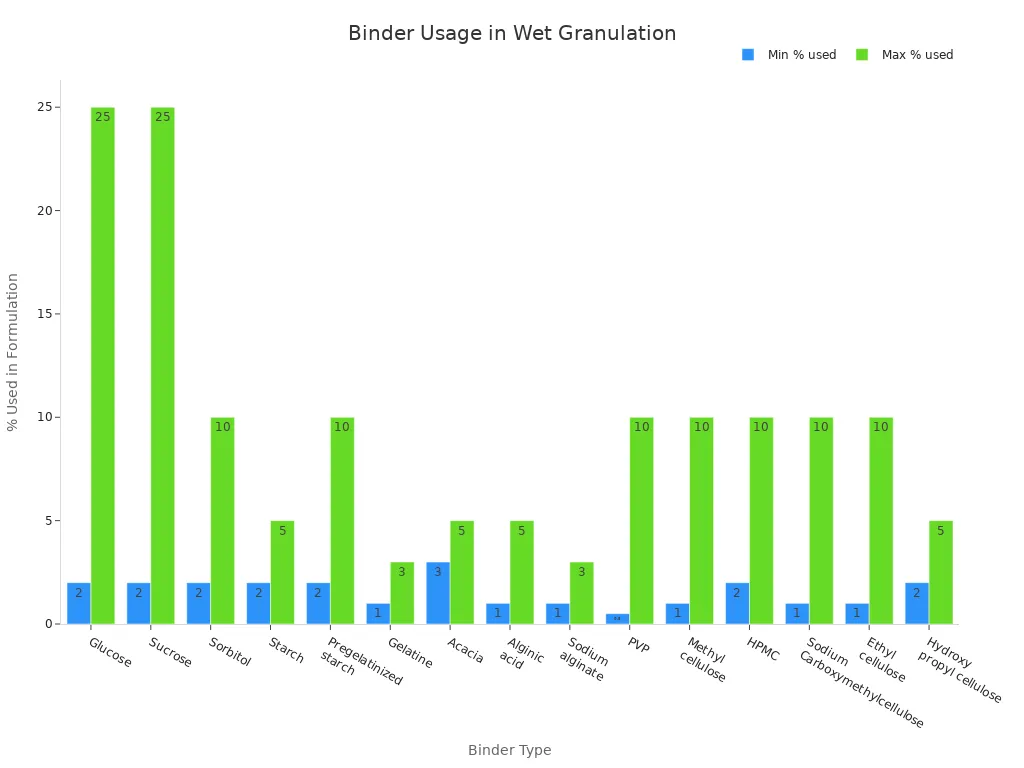
Wet granulation uses binders and solvents to help particles join. Here is a table with common binders and their solvent systems:
Binders | % used in the formulation | Solvent System |
|---|---|---|
Glucose | 2–25 | Water |
Sucrose | 2–25 | Water |
Sorbitol | 2-10 | Water |
Starch | 2–5 | Water |
Pregelatinized starch | 2-10 | Water |
Gelatine | 1–3 | Water |
Acacia | 3–5 | Water |
Alginic acid | 1–5 | Water |
Sodium alginate | 1–3 | Water |
PVP | 0.5–10 | Water or isopropyl alcohol or Hydro-alcoholic |
Methyl cellulose | 1-10 | Water |
HPMC | 2-10 | Water or isopropyl alcohol or Hydro-alcoholic |
Sodium Carboxymethylcellulose | 1-10 | Water |
Ethyl cellulose | 1-10 | Ethanol |
Hydroxy propyl cellulose | 2-5 | Water or isopropyl alcohol |
Wet granulation makes powders flow and press better. Granules move easily and do not stick much. The process makes powders heavier and helps them stick during pressing. You can make tablets with steady weight and strength. Wet granulation works for many materials, even ones that do not press well.
Tip: Wet granulation lets you control granule size and shape.
Wet granulation needs drying, which takes more time. You must be careful with solvents and binders. Some drugs cannot handle moisture. The process is harder and needs more machines. You have to check each step to keep quality good.
Wet granulation is good for drugs that need exact doses and even mixing. You can use it for products with low amounts of drug or powders that do not press well. Wet granulation helps you make tablets, capsules, and pellets that work well. Marya gives you advanced wet granulation machines and clean rooms. You get help for quality and rules in every project. Marya’s systems help you follow strict standards and make safe, good medicines.
Knowing the difference between granulation methods helps you pick the best way to make medicine. You need to look at some important differences before you decide. Let’s go over the main points.
The biggest difference is how each method uses liquids.
Dry granulation does not use any liquids.
Wet granulation needs a binding liquid, like water or alcohol, to help powders stick.
Dry granulation is safer for drugs that do not like moisture. Moisture can make drugs break down and change how powders act. Wet granulation can cause phase changes, which may lower the glass transition temperature. This can make powders clump or change shape. You also need to think about packaging. Wet granulation products need packaging that keeps out water vapor. This helps keep your medicine safe and stable.
The steps in each process are another big difference.
Wet granulation has more steps. You mix, add liquid, dry, and mill the powder. This makes the process longer and harder.
Dry granulation skips drying. You only mix, compact, and mill. This makes dry granulation faster and easier to control.
Wet granulation changes the size and surface of particles. This helps medicine dissolve better. Dry granulation mostly makes powders denser and stops them from separating. Dry granulation is simpler, so it is good for small batches or when you need to work fast.
Each method needs different machines.
Wet granulation uses mixers, dryers, and mills. You need more space and energy.
Dry granulation uses roller compactors or tablet presses. You do not need dryers or as many machines.
Dry granulation is a good choice if you want to save money on equipment. Marya gives you all the machines and help you need for both wet and dry granulation.
The kind of material you use matters.
Dry granulation works well for powders that break down with moisture or heat. You can use it for hygroscopic or thermolabile drugs.
Wet granulation is better for powders that do not stick together easily. You can use it for low-dose drugs or powders that need better flow.
You need to match the granulation method to your material. This helps you get the best results and avoid problems.
You want to know how much each method costs and what quality you get. Here is a table to help you compare:
Granulation Method | Complexity | Equipment Cost | Operational Cost | Granule Quality |
|---|---|---|---|---|
Wet Granulation | More complex | Higher | Higher | Uniform, free-flowing granules; good blend uniformity |
Dry Granulation | Simpler | Lower | Lower | Less uniform granules; avoids moisture exposure |
Dry granulation usually costs less. You use less energy and fewer materials. Wet granulation costs more because you need more steps and machines. Wet granulation gives you more even granules and stronger tablets. Dry granulation is better for sensitive drugs but may give you weaker or less even granules.
When you pick a granulation method, think about your product, your process, and your budget. Marya can help you with both wet and dry granulation. You get expert advice, custom machines, and full support for your project.
You should think about a few things before picking a granulation method for making tablets. Granulation changes how good and safe your medicine is. Here are some main points:
If your drug breaks down in water, dry granulation is best.
Wet granulation needs more steps and machines. Dry granulation is quicker and easier.
Dry granulation saves money and time. Wet granulation costs more because you need drying and extra machines.
Wet granulation makes granules that are all the same size. Dry granulation is good for making lots of tablets and keeping things safe.
Granulation affects how well your tablets work and how safe they are.
You can ask Marya for help. Marya gives advice and custom solutions for granulation projects. You get expert help that fits what you need.
Tip: Always pick your granulation method based on your product and your goals.
You can learn from real cases in tablet making. For example, dry granulation was used to make eplerenone tablets. The tablets met the lowest standards for dissolving, but they dissolved slower than tablets made with wet granulation. This shows that compaction force changes how fast drugs come out.
Another example is moisture-activated dry granulation. This method made placebo tablets that stayed in the stomach longer and had controlled properties. Dry granulation worked well for special types of tablets.
Wet granulation is used for powders that do not flow or press well. You see this method when you need to control granule size exactly.
Granulation technology keeps improving. You see new ways like high-shear granulation, twin-screw granulation, and hot-melt extrusion. These modern methods help you make good granules faster. Automation and checking in real time help keep quality high and stop mistakes.
Process Analytical Technology (PAT) lets you check granulation as it happens. This cuts down errors and helps you meet strict rules. There are also new wet granulation methods, like steam granulation and foamed binder granulation. These give you more choices for making tablets.
Marya offers advanced granulation solutions. You get modern machines, clean rooms, and expert help. Marya helps you pick the best granulation method for your project.
Note: Granulation is an important step in making tablets. Picking the right method makes your product better and helps you work faster.
Dry granulation does not use any liquid. Wet granulation uses liquid. Dry granulation is good for drugs that cannot touch moisture. Wet granulation makes granules even and tablets strong.
Dry granulation helps you save time and money.
Wet granulation makes tablets better.
If you need help, you can count on Marya. Marya gives you good machines and support for both granulation methods.
You should pick dry granulation if your drug breaks down with water or heat. This method keeps your medicine safe and stable. You also save time because you skip the drying step.
No, you cannot use wet granulation for every powder. Some powders react badly with water or solvents. You should check if your material can handle moisture before you choose this method.
Yes, granulation changes tablet strength. Wet granulation often gives you stronger and more even tablets. Dry granulation may give you less uniform tablets, but it works well for sensitive drugs.
You should look at your drug’s properties, cost, and production needs. Ask yourself:
Does your drug react to water?
Do you need fast production?
What is your budget?
Tip: You can contact Marya for expert advice on choosing the best method.