Views: 0 Author: Site Editor Publish Time: 2026-08-10 Origin: Site
Capsule shells act as protective outer covers for active medicine ingredients and health supplements. You depend on these delivery systems daily for accurate medication doses. Still, you might wonder about the materials used to make them. Do makers pick standard animal gelatin, plant-based HPMC, or tapioca-fermented Pullulan? How are hard two-piece designs different from liquid-filled softgel shells? Which strict quality rules protect these sensitive health products? You should clearly understand these different physical traits. Choosing the right material ensures exact dosage accuracy for every person. These choices also keep the inner ingredients safe from damaging room moisture. In the end, smart shell choices satisfy important consumer preferences and special diet needs.
Table of Contents
Capsule shells protect medicine ingredients and ensure exact dosage accuracy for users.
Manufacturers choose firm two-piece shells for dry powders and one-piece softgels for liquid blends.
Enteric coatings protect delicate drugs from harsh stomach acid and help them open inside the intestines.
Plant-based HPMC and pullulan shells offer great vegetarian choices with strong protection against air and moisture.
Factories keep air moisture levels between 30 and 50 percent to prevent shell cracking or sticking.
Encapsulation hides bitter flavors and helps the body take in medication so it is easier to swallow.
Leading makers follow tough quality rules and check kosher or halal credentials to ensure world safety.
Hard two-piece structures are common tools used in daily health products and medicine. These handy units use two distinct tube-like parts: a longer, thinner body paired with a shorter, wider cap. Factory workers snap the cap neatly over the main body to keep your active ingredients safe inside. Clever inner designs feature tiny built-in locking rings along the inside wall. These custom bumps stop the pieces from coming apart during shipping, high-speed packing, and normal home use.
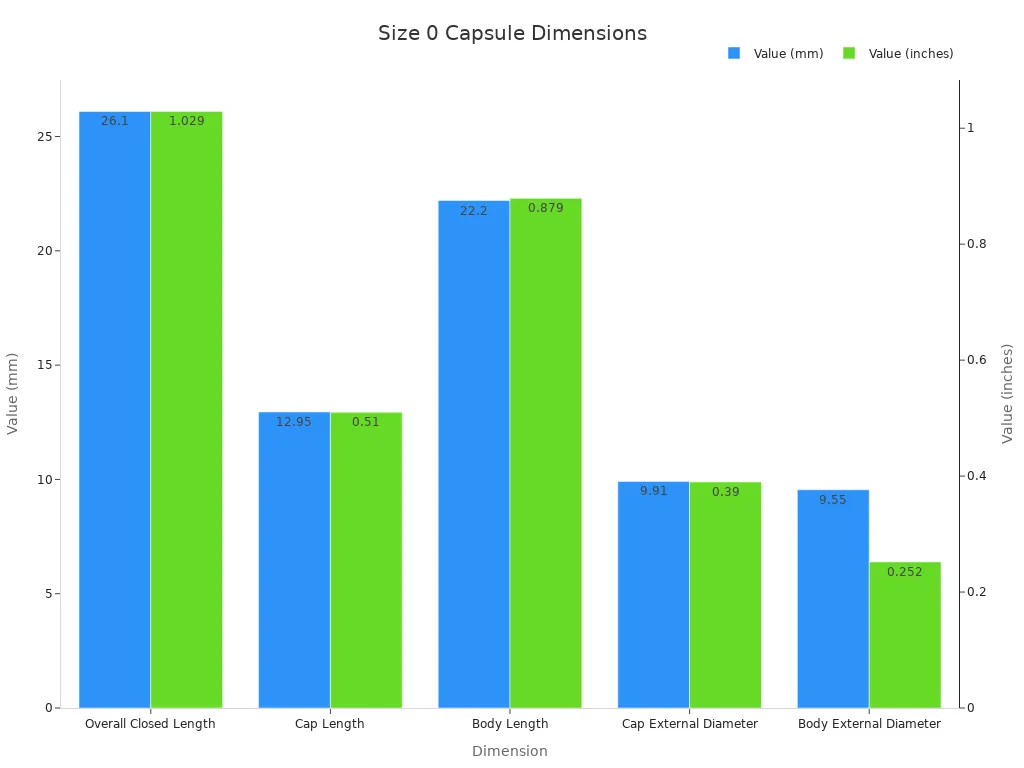
Exact measurements control how well these physical parts snap together on factory machines. For example, a normal size 0 hard gelatin shell built with strict design rules fits machinery perfectly.
Dimension | Value (mm) | Tolerance (mm) | Value (inches) | Tolerance (inches) |
|---|---|---|---|---|
Overall Closed Length | 26.1 | ±0.3 | 1.029 | ±0.012 |
Cap Length | 12.95 | ±0.35 | 0.510 | ±0.014 |
Body Length | 22.20 | ±0.35 | 0.879 | ±0.014 |
Cap External Diameter | 9.91 | - | 0.390 | - |
Body External Diameter | 9.55 | - | 0.252 | - |
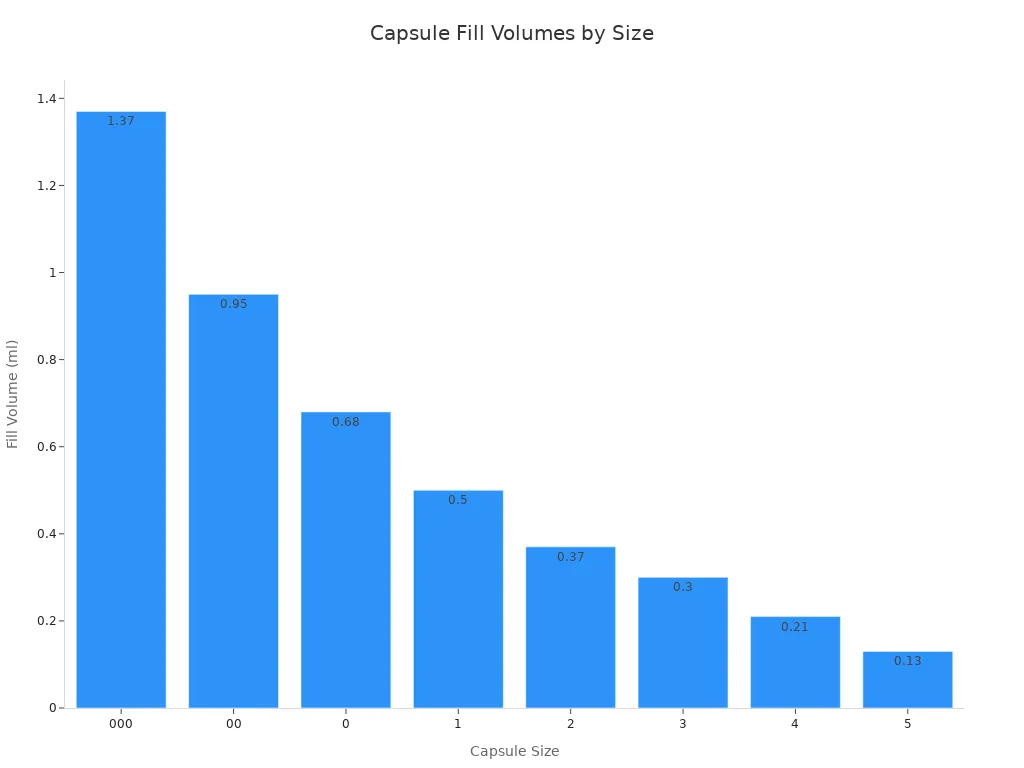
Factories make standard numbered sizes to fit different amounts of active ingredient mixtures. Standard options run in order from huge size 000 down to tiny size 5. You can also pick extra-long options like 00E and 0E to hold more powder without widening the shell.
Capsule Size | Fill Volume (ml) |
|---|---|
000 | 1.37 |
00 | 0.95 |
0 | 0.68 |
1 | 0.50 |
2 | 0.37 |
3 | 0.30 |
4 | 0.21 |
5 | 0.13 |
Makers fill hard outer shells mostly with dry powders, small grains, pellets, or tiny tablets. Fast machines pack loose powder into firm plugs before dropping them cleanly into the shell body. Double-locking side walls shield delicate active ingredients from damaging room air and bright light. In addition, smooth outer surfaces make swallowing easy and help the unit break down smoothly in your stomach.
Softgels offer a solid, single-piece outer skin designed to protect delicate liquid mixtures. Unlike two-piece hard shells, softgel units feature a tight, single-piece seal that keeps out all air and moisture. Product makers choose softgels when liquid or oily active formulas need airtight protection against air damage.
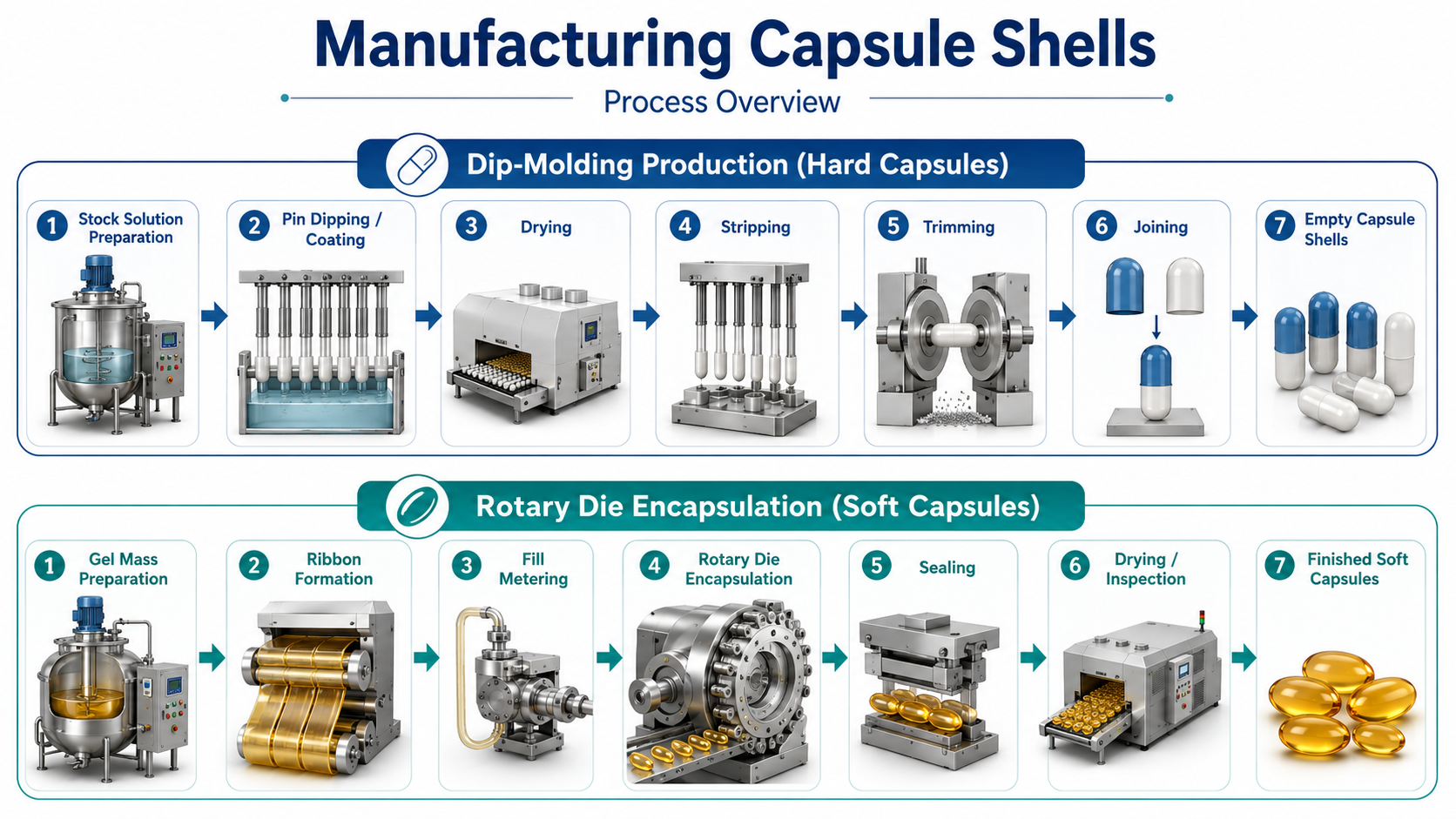
Making liquid-filled softgel units requires a set sequence of smooth manufacturing steps.
Prepare the Gelatin Shell Mixture: You heat up gelatin, water, and plasticizer glycerin inside a sealed vacuum tank, then hold the smooth gel liquid in a warm tank.
Prepare the Fill Material: You mix the active ingredients, oils, and liquids together, then grind and stir the blend until it forms a smooth fluid fill.
Ribbon Formation and Filling: You roll out continuous gel sheets on a machine, squeeze measured liquid between the sheets, and seal the edges using heat and pressure.
Drying and Polishing: You tumble-dry the fresh softgels to remove top moisture, then dry them on trays under controlled air to harden the outer skin.
Final Quality Control: You inspect the finished softgels to check their weight, seal strength, outer shape, and how well they dissolve.
Softgels excel at carrying oil-based ingredients, health vitamins, and thick liquid mixtures. You enjoy rapid absorption because the inner liquid spills out right after the protective softgel skin dissolves in stomach fluids. This fast action helps your gut absorb healthy liquid ingredients much faster.
Regular hard gel and soft gel options dissolve fast in your acidic stomach juices. However, sensitive active ingredients need extra shelter to avoid acid damage. Formulators mix acid-proof plastics to construct tough outer layers. Popular protective options include:
Methyl acrylate-methacrylic acid copolymers
Cellulose acetate phthalate (CAP)
Cellulose acetate succinate
Hydroxypropyl methyl cellulose phthalate
Hydroxypropyl methyl cellulose acetate succinate (HPMCAS)
Polyvinyl acetate phthalate (PVAP)
Shellac and sodium alginate
Enteric coatings prevent early shell melting inside strong stomach acids. The special coating layer stays totally solid while inside stomach fluid. As soon as the pill travels into your upper small intestine, surrounding pH levels climb to 6.0-7.0. This higher pH level triggers fast melting and instantly releases the active contents inside. Specialized synthetic polyacrylates, known in industry as Eudragit grades, offer exact custom release points. Product developers select targeted Eudragit types to release active ingredients at pH 5.5 for intestine delivery or pH 7.0 for colon delivery. Choosing proper Capsule Shells guarantees maximum medicine success while stopping tummy pain.
Traditional capsule products usually contain standard gelatin. Makers gather natural collagen from animal tissues to make this flexible material. They collect raw collagen mostly from cow bones, cow hides, and pig skins. The collecting process uses controlled acid or alkali steps. These chemical steps turn tough proteins into water-soluble gelatin molecules. Cow collagen offers strong support networks for firm two-piece hard shell designs. Pig skin creates flexible, clear material ideal for softgel units. Product makers pick specific gelatin types based on needed outer strength. You receive a strong, safe holder that protects your daily medication. Animal gelatin dissolves quickly and smoothly at normal human body heat.
Gelatin melts easily in warm liquids inside your stomach. Stomach acid breaks down these protein shapes for quick release into your body. Yet, heat, chemicals, and high humidity cause unwanted chemical links called cross-linking. Also, specific compounds in raw fill ingredients can start cross-linking actions. Cross-linking forms tight chemical bonds across separate gelatin protein chains. These strong bonds block the outer wall from melting correctly in your gut. Bad storage conditions slow down the overall speed of shell breakup. You must guard raw gelatin holders against high moisture to protect fast melting speeds and release active ingredients well.
Plant options offer great picks for vegetarian and vegan buyers who skip animal products. Hydroxypropyl methyl cellulose, or HPMC, comes right from natural wood fibers or cotton plant pulp. You get strong physical safety against room moisture with HPMC capsule options. Plant cellulose shells stay bendy even in dry desert air. These synthetic plant polymers avoid chemical cross-linking during long storage times. Makers choose HPMC for blends with moisture-sensitive powders or liquids. HPMC provides less air protection than pullulan. Still, HPMC stays a versatile, cheap material for standard vegetarian products in global health markets.
Tapioca starch ferments into a smooth, natural polymer called pullulan. Tiny organisms turn plant sugars into thick natural chains during clean fermentation steps inside sterile tanks.
Material | Key Properties | Oxygen Permeability Comparison |
|---|---|---|
Pullulan | Exceptional Oxygen Barrier, Moderate Moisture Resistance, High Transparency, Strong & Elastic, Allergen-Free & Clean, Biodegradable | Pullulan capsules block oxygen far better than gelatin or HPMC capsules. Pullulan's barrier to oxygen is significantly stronger than HPMC. |
HPMC | N/A | Offers lower oxygen barrier protection compared to pullulan. |
Pullulan shells provide top airtightness and strong air defense. Thus, pullulan shells shield delicate health ingredients from harmful air damage. You see high clarity and smooth shiny outer layers when picking pullulan capsule shells for your natural health mixes.
Flexibility needs specific chemical additives during the shell making process. Water works as a key softening part, making up 30–40% w/w in wet shell mixes. Stable softeners, like glycerol, make up 15–30% w/w of wet shells and 0.3–1.0% w/w of dry gelatin. Makers follow a clear list when picking softening ingredients for regular plant work:
Glycerol (85% or 98% w/w) serves as the primary reference plasticizer for all gelatin types.
Sorbitol and maltitol act as effective secondary plasticizers in custom liquid shell mixtures.
Polypropylene glycol, propylene glycol, and polyethylene glycol refine outer skin elasticity.
Dyes give clear visual traits to finished health products. Makers add natural pigments like iron oxides or safe artificial dyes. Bright colors prevent pill mix-ups among daily users and boost brand awareness.
Light-sensitive ingredients spoil fast under bright room lights or direct sun rays. Factories add clouding agents like titanium dioxide to block strong light beams completely. These solid ingredients turn clear liquid gel mixes fully non-transparent. Clouding agents guard fragile active ingredients inside the middle storage area against light damage. Plus, exact room moisture controls stop shell cracking or sticky tops during long factory runs. Makers balance water levels inside raw materials. This balance keeps finished capsule shells steady across their full shelf life. Good storage stops softgels from sticking together in bottles. You keep delicate vitamins strong by managing light and water contact.
Making hard two-piece capsule shells begins with preparing a rich stock solution. Factory workers dissolve raw gelatin or plant polymers in clean warm water using metal tanks. Workers mix colorants, opacifiers, and water into this warm fluid. Automated equipment lowers cool metal pins into the liquid mix. Wall thickness depends on fluid thickness. The liquid clings to the smooth pins as machines pull them up.
You must check the exact volume capacity of each body before filling powders. Formulators find the total powder load using a basic capacity formula where volume times density equals weight.
Drying racks lift the coated pins into controlled air tunnels. Gentle warm air removes water from the wet liquid layer. Machine arms pull the dried caps and bodies off the metal pins. Sharp spinning blades trim the uneven open edges to exact sizes.
Special machine arms push the matching caps and bodies together. These pre-locked parts form empty two-piece units for shipping to packaging plants.
You build one-piece softgel units using a continuous rotary die process. Warm liquid gel spreads evenly onto two chilled spinning drums. Cold metal surfaces turn the liquid gel into two smooth sheets called gel ribbons.
Source | Ribbon Thickness | Thickness Unit |
|---|---|---|
Industry Standard Specification | 0.032–0.040 | inches |
Metric System Guide | ~0.8 | millimeters |
These flexible sheets move continuously into the main encapsulation assembly.
Two matching rotary die rolls press the gel ribbons together. An exact pump injects active liquid medicine right between the sheets. The machine uses heat and pressure to seal the edges right away. Cutters trim the closed softgels away from the outer ribbon sheet.
Strict climate management protects the physical shape of fresh Capsule Shells. Factory air controls prevent brittle cracking and soft stickiness during production.
Relative Humidity: Keep levels between 30 and 50 percent.
Temperature: Keep levels between 20 and 30 degrees Celsius.
Critical Control Note: Air moisture changes internal water levels much more than temperature.
You keep the dry shells within these safe rooms to guarantee high physical quality.
You test finished batches to confirm proper stomach melting. Quality teams place random test samples into warm artificial stomach fluid. Standard test rules demand complete shell breakup within 30 minutes or less. Fast breaking releases active ingredients quickly inside the human body. High-grade Capsule Shells meet all official standards to ensure safe medication delivery.
Capsule shells quickly dissolve in your stomach fluids. This fast breakdown releases active health ingredients into your blood with zero delay. Thus, your body absorbs good compounds quickly through the gut.
You get fast relief because liquid or powder fills spill out immediately. Thin outer walls melt within minutes in natural body heat. Quick breakdown makes sure your medicine works right when needed.
Modern capsule machines measure exact powder and liquid amounts for every shell body. You get steady health benefits from every dose you swallow. Precise filling heads remove dosing mistakes during quick factory production runs.
Automated tools cut down weight differences across giant factory batches. This strict quality control ensures reliable drug performance for your overall safety. Exact doses help you keep up correct daily treatment levels.
Many active drug ingredients carry super bitter tastes or sharp chemical smells. Encapsulation builds a solid wall that hides harsh active compounds from your taste buds.
Mechanism | Description | Example Materials |
|---|---|---|
Physical Barrier Formation | Prevents bitter ingredients from contacting taste receptors | Polymers (HPMC), Gelatin |
Prevention of Drug-Receptor Interaction | Blocks active molecules from reaching taste buds on your palate | Liposomes, Cyclodextrins |
Reduced Solubility in Saliva | Lowers immediate drug dissolution inside human oral fluids | Impermeable polymer coatings |
Capsule shells get slippery when wet with human spit. You swallow smooth gel and plant capsules way easier than rough plain tablets. Smooth outer walls stop annoying rubbing against your throat.
The bendy outer skin slides down your throat without sticking anywhere. This slick texture helps young kids and older adults take daily medicine easily. Easy swallowing makes daily pill routines stress-free.
Air exposure ruins sensitive health supplements and active drug compounds over time. Capsule Shells lock delicate inside ingredients away from oxygen gas in the room. Sealed outer walls keep products strong inside store bottles.
Data shows that normal gelatin shells block oxygen very well. Meanwhile, suppliers make special HPMC capsule types with extra air protection built in. Both materials protect air-sensitive fills from oxygen harm.
Room air moisture ruins delicate dry powders inside medicine bottles. Capsule Shells seal sensitive active ingredients away from wet air during long storage times. Protective plant skins guard water-sensitive powders well.
Picking the right shell material stops powder clumping and inner breakdown. You get stable health supplements that stay strong through their full shelf life. Safe shell walls guarantee protection from factory to bathroom cabinet.
You need to check how quickly your active drug powder draws water from the air. Powders that soak up water need safe storage to stay dry. Picking the right shell design keeps these sensitive powders safe from wet room air. Sturdy hard shell choices shield water-sensitive powders much better than softgel options.
Factor | Consideration for Hygroscopic Formulations |
|---|---|
Moisture Permeability & Stability | Hard shell units block moisture better to keep inside powders safe and dry. Soft shells face higher risks of breaking down from wet air. |
Suitability for Hygroscopic Substances | Hard shell units store powders and small grains safely without water damage. |
Fill Material Compatibility | Hard shell units work best when packing solid powder mixtures inside. |
Stability & Shelf Life | Hard shells build a strong barrier against room air to make products last longer. |
Overall Selection Priority | Makers pick hard shells when delicate powders need solid protection from damp room air. |
You figure out the right dose weight by matching powder space with powder weight. Water-absorbing powders need strict moisture checks before factory workers pack them into shells.
Keep moisture inside the fill powder at or below 5% of its total weight.
Hold this strict water cap to stop moisture moving between the powder and outer shell.
Stop dry powder from clumping together inside the shell body while filling the capsule.
Keeping powder moisture low protects your capsule walls from physical damage. You avoid shell softening or structural breakdown by following this clear moisture limit.
You satisfy global buyers by checking religious rules for all raw ingredients. Daily buyers expect clear factory checks on every single health product.
Source Material: You must pick approved cow gelatin or fish gelatin while avoiding all pig materials.
Dedicated Production: You must use separate factory machines to prevent mixing clean batches with non-halal items.
Traceability: You must track every raw ingredient back to the original animal source.
You build deep market trust by running clean, certified production plants. Verified ingredient sources unlock giant global markets across Muslim and Jewish communities.
You draw in health-focused shoppers by offering plant-based capsule choices. Modern buyers read health labels very closely before buying any new supplement. Plant options like HPMC give non-animal choices to daily health users.
You deliver simple labels by removing fake additives and animal products. Pure tapioca pullulan choices offer crystal clear shells without hidden chemicals. These plant choices boost your overall brand name among green shoppers.
You protect empty shell supplies by managing moisture inside your storage rooms. Extra room moisture turns the outer shell soft, while dry air makes the walls snap easily.
Capsule Shell Material | Key Moisture-Related Property | Typical Humidity Tolerance | Impact on Shelf-Life & Packaging Requirement |
|---|---|---|---|
Hard Gelatin | Shell walls hold trapped water; they turn brittle in dry air. | 35–65% Relative Humidity | Needs tight foil packs or moisture-absorbing bottles kept at 15–25°C and 35–65% RH. |
HPMC (Vegetarian) | Natural water levels stay much lower than animal gelatin options. | Up to ~70% Relative Humidity | Protects moisture-sensitive active drugs when stored inside damp room air. |
Softgel (Gelatin) | Holds a lot of liquid water inside its thick gel walls. | Very Low Tolerance | Requires thick glass bottles or special foil wrappers to stop water loss. |
Generally, empty capsules break easily whenever room moisture drops below 40 percent.
You help your products last longer by choosing smart protective packaging. Sealed blister packs with protective layers guard hard shells against wet room air. You put small moisture packets inside sealed bottles to soak up extra water. Smart material choices reduce store returns while keeping your medicine strong over time.
You must check capsule suppliers carefully to ensure strong physical and chemical matching across all lots. Regular factory visits check that every batch meets strict size rules and moisture limits. You need matching wall thickness and steady breaking speeds to stop costly delays on fast filling lines. Base materials like gelatin and HPMC must carry FDA GRAS safety status and follow exact color rules.
Inspectors check testing labs to confirm supplier quality rules. You must check BSE- and Prion-Free status for cow gelatin to ensure total animal safety. Plant capsule choices need Non-GMO checks to ensure clean ingredients. Careful batch testing stops material changes from hurting your final pill doses.
Full paperwork tracks protect your product supply chain from raw material gathering down to final packing. You must ask for full material tracking from suppliers to follow FDA 21 CFR Part 117 rules for health supplements. Detailed shipping logs track raw material sources, processing dates, and storage heat for every lot.
FDA 21 CFR Part 117 Compliance: Demands strict cleaning, safe hazard controls, and full supply tracking.
Safety and Purity Checks: Confirms BSE- and Prion-Free status for gelatin and Non-GMO roots for plant polymers.
Dietary Law Confirmations: Checks real Halal and Kosher papers for diverse world buyer groups.
Specialty Label Guarantees: Secures Vegan Society Papers for HPMC items and Fair Trade Papers (EU) for fair supply lines.
Papers must show that your making plants keep strict mix-up controls during work. You easily check special health labels when your supplier keeps clean record books. Strong paperwork guards your brand name during world safety reviews.
Capsule making plants must keep high cleaning levels and exact room air controls. You should ask your capsule suppliers to show full matching with accepted world ingredient making rules.
Capsule makers need full matching with NSF/IPEC/ANSI 363 or USP <1078> rules for raw drug materials to ensure steady shell quality.
Air systems keep strict air cleanliness standards across clean factory areas.
GMP Requirement Area for HVAC Systems | Key Implementation Aspects Mentioned |
|---|---|
Product Protection | Control of airborne dirt using air flows, setting air swap speeds, and defense against mix-ups. |
Environmental Protection | Air cleaning of outgoing air using EN779 or EN1822 HEPA filters, plus tracking filter pressure drops. |
Prevention of Cross-Contamination | Setting up correct air pressure steps and flow directions, mostly for strong medicine items. |
Certified ISO quality rules ensure constant tracking across every step of your making plant. ISO rules ask factory workers to adjust tools often and write down cleanroom states daily. You get reliable outer shell items because approved plants follow strict quality control paths.
Outside checkers run regular plant visits to review safety notes and lab testing steps. ISO control rules force plant bosses to fix making errors right away. Picking ISO-approved plants helps you ship safe, top-quality health items to smart buyers.
You now understand how different materials shape modern drug delivery systems. Traditional gelatin, plant-based HPMC, and tapioca pullulan offer unique protective barriers for powders and oils. Selecting correct sizing, from size 000 down to size 5, ensures precise active doses. Managing clean production rooms between 30 and 50 percent relative humidity protects raw materials from cracking or sticking.
Smart material choices enhance bioavailability and hide bitter tastes. Choosing high-grade Capsule Shells protects fragile active ingredients against destructive moisture and oxygen. Proper manufacturing controls help you meet global pharmacopeial standards easily. Ultimately, premium raw materials build deep consumer trust and secure total market success.
Makers get animal collagen from cows or pigs for gelatin shells. Plant cellulose from nature forms HPMC shells. HPMC options fight off damp room air better and remain bendy in dry weather without forming bad chemical links.
Size 000 shells store the biggest amount at 1.37 milliliters. Normal sizes go from big size 000 all the way down to small size 5. You can pick longer options like 00E to pack in more powder.
Official safety rules require full shell breakdown inside warm stomach liquid in 30 minutes or faster. Quick melting spills your active medication right into your system with no extra wait time.
You should keep the air humidity level in the room between 30 and 50 percent. Set indoor temps between 20 and 30 degrees Celsius. Unfilled shells snap easily if air moisture levels fall under 40 percent.
Fermenting tapioca starch creates natural pullulan polymers. You get a strong air block that guards delicate supplement ingredients against air harm. Pullulan delivers clear walls, high shine, and simple plant labels.
Acid-proof plastics shield delicate medicine mixes from harsh stomach acid. The outer protective skin remains whole inside your tummy. It melts easily once it reaches your upper small intestine at pH points from 6.0 to 7.0.