Views: 0 Author: Site Editor Publish Time: 2026-08-06 Origin: Site
Capsule sizes use a backward number rule. Size 000 is the biggest choice. Size 5 is the smallest shell. Sizes 00 and 0 are most common. You see them in store supplements. People also use them at home.
Picking the right capsule shell needs simple math. First, find your target milligram dose. Next, find the powder density. Then, divide the dose by the density. This gives the needed milliliter volume. After that, check a Capsule Size Chart. This chart matches your volume to a size. This easy step ensures correct doses every time.
Capsule sizes use a reverse system. Size 000 is largest. Size 5 is smallest.
Dividing your target dose weight by powder density gives you the right capsule volume.
Sizes 00 and 0 are the top choices. People pick them for human dietary supplements.
Gelatin and vegetable capsules have the exact same sizes.
Good storage keeps empty capsules safe. It stops moisture damage. It stops machine jams.
Table of Contents
Learn capsule sizing rules before buying any shells. The sizing scale runs completely backward. Lower size numbers mean bigger capsule shells. Larger numbers mean smaller capsule capacity.
Size 000 holds the most powder blend. Size 5 is the smallest shell option. Most brands use sizes 00 and 0. These choices fit good doses. They are easy to swallow.
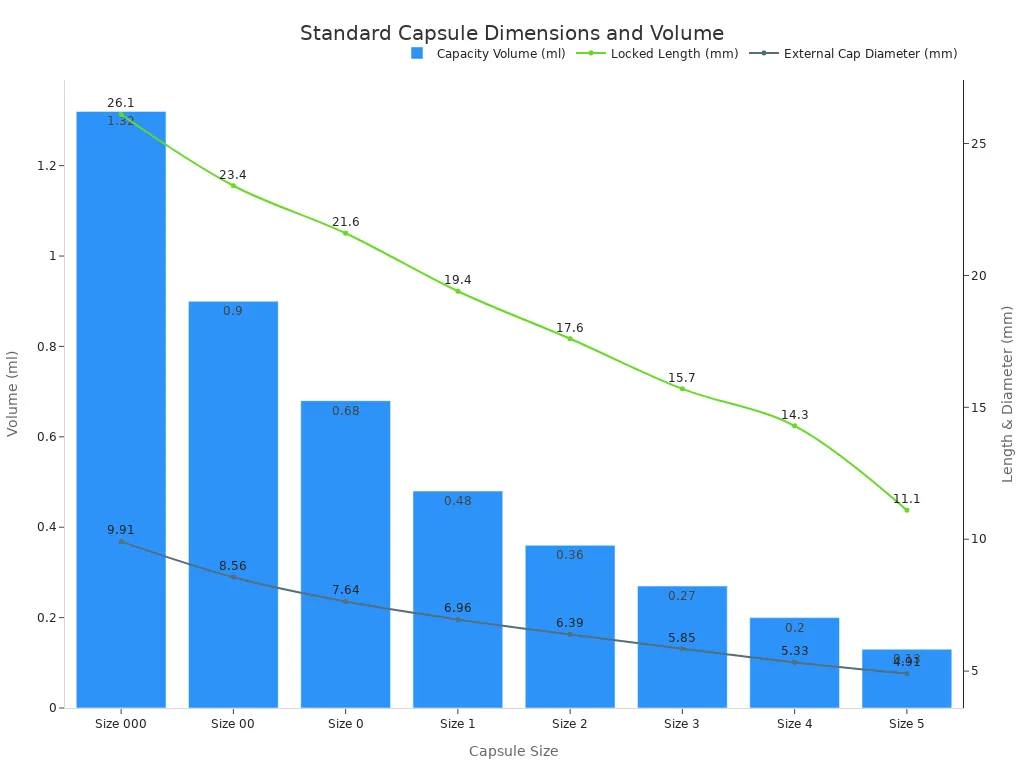
Correct measurements help you pick capsule sizes. Inside volume controls total powder capacity. Outer cap width impacts swallowing comfort. Closed length helps set up filling machines.
Check standard Capsule Size Chart details below.
Capsule Size | Capacity Volume (ml) | Locked Length (mm / in) | External Diameter (mm / in) |
|---|---|---|---|
Size 000 | 1.27 - 1.37 | 26.1 mm / 1.029 in | 9.91 mm / 0.390 in |
Size 00 | 0.90 | 23.4 mm / 0.921 in | 8.56 mm / 0.337 in |
Size 0 | 0.68 | 21.6 mm / 0.850 in | 7.64 mm / 0.301 in |
Size 1 | 0.48 | 19.4 mm / 0.764 in | 6.96 mm / 0.274 in |
Size 2 | 0.36 | 17.6 mm / 0.693 in | 6.39 mm / 0.252 in |
Size 3 | 0.27 | 15.7 mm / 0.618 in | 5.85 mm / 0.230 in |
Size 4 | 0.20 | 14.3 mm / 0.563 in | 5.33 mm / 0.210 in |
Size 5 | 0.13 | 11.1 mm / 0.437 in | 4.91 mm / 0.193 in |
This quick reference guide displays exact measurements. Comparing inner volume numbers is simple.
Buy capsules made of gelatin or HPMC. Animal collagen makes gelatin shell options. Plant cellulose creates HPMC veggie shells. Both capsule materials share identical sizing specs.
Gelatin absorbs water fast in damp air. Veggie shells handle humidity better in storage. Pick HPMC shells for vegan powders. Use gelatin shells to save money.
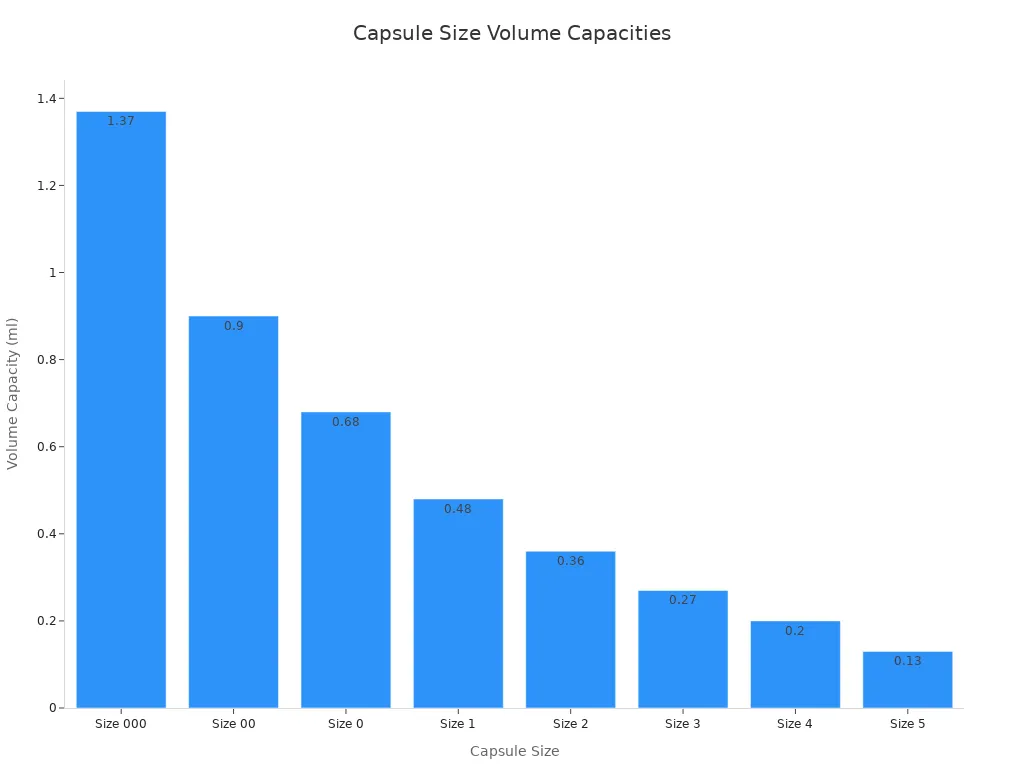
Capsule size specifications help you choose right containers. You must pick precise specs for your needs. Shells range from size 5 to size 000. Each size holds a fixed volume in milliliters. Tiny size 5 holds very small amounts. Sizes 0 and 1 store medium amounts. Large size 000 carries the most volume. Compare volume capacities using these exact numbers.
Capsule Size | Volume Capacity (ml) |
|---|---|
Size 000 | 1.37 |
Size 00 | 0.90 |
Size 0 | 0.68 |
Size 1 | 0.48 |
Size 2 | 0.36 |
Size 3 | 0.27 |
Size 4 | 0.20 |
Size 5 | 0.13 |
Check total volume before buying empty shells. Right volumes keep filling tools running smoothly.
Powder density controls final capsule weight in milligrams. Calculate target weight using a simple math rule. Milligram weight equals milliliter volume times density times 1000. Size 000 holds up to 1,370 mg. Commercial supplements use size 00 most often.
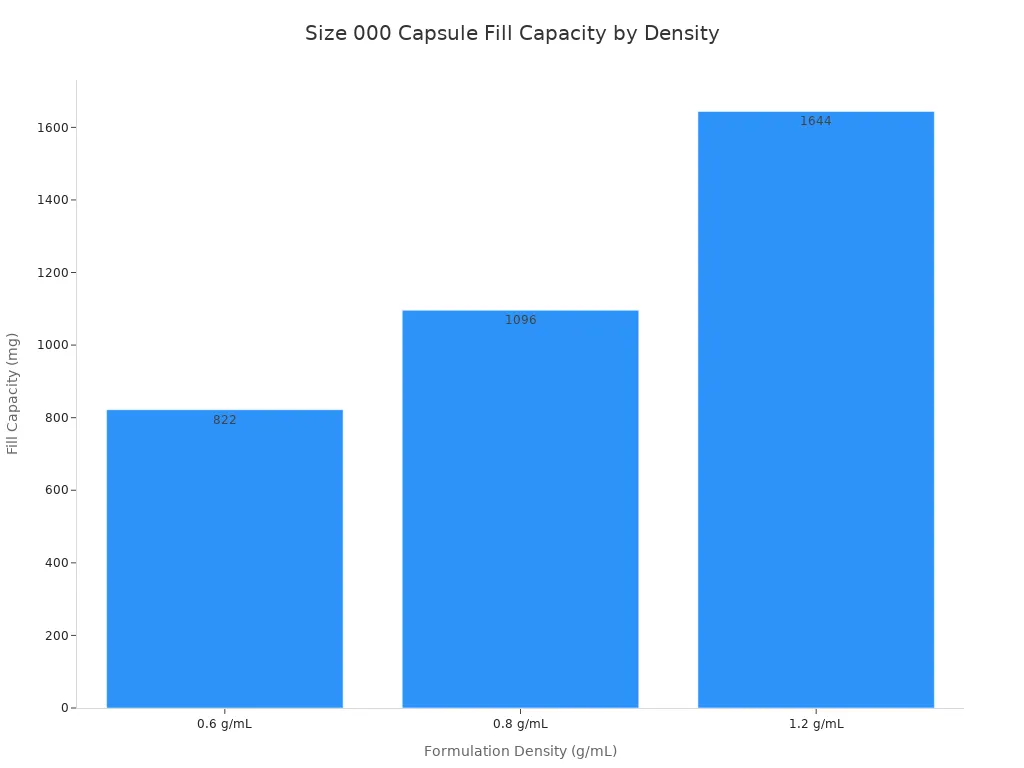
Powder density changes real capacity in size 000. Light powders take more room than heavy powders. Dense items fill less space than light herbs. See capacity details for size 000 capsules below:
Formulation Density (g/mL) | Size 000 Fill Capacity (mg) |
|---|---|
0.6 | 822 |
0.8 | 1096 |
1.2 | 1644 |
Fluffy powders require bigger capsule shells. Heavy powders pack easily into smaller shells. Check a Capsule Size Chart for exact weight capacity.
Elongated capsules give extra space without extra width. Size 00el measures longer than standard size 00. Extra length increases volume while keeping easy handling. Makers use these for tight recipe fits.
Dimension / Metric | Standard Size 00 | Elongated Size 00el |
|---|---|---|
Fill Volume (mL) | 0.95 | 1.20 (15–20% higher) |
Locked Length (mm) | 23.3 ± 0.3 | 26.1 ± 0.3 |
Cap & Body Length | Standard | 10–12% longer |
Body Diameter (mm) | 8.5 | 8.5 (Identical) |
Longer shells hold more volume without getting wider. Capsules stay easy for people to swallow. Extra length solves big dose problems. These special shells keep product lines simple.
markdown
Selecting capsule shells requires accurate calculation of powder fill capacity. You multiply capsule volume in milliliters by powder density in grams per milliliter, then multiply by 1000 to determine target fill weight in milligrams. Expressed simply, Fill Weight (mg) = Capsule Volume (mL) x Powder Density (g/mL) x 1000. In commercial operations, Fill Weight = Bulk Density × Dosing Disc Volume. Powder bulk density measures how tightly particles pack together within a container. You can determine uncompacted bulk density using standard laboratory steps:
Weigh your powder mix on a scale.
Pour it into a measuring tube carefully.
Record the volume to find density fast.
You can perform standardized density measurements using dedicated apparatus like the ERWEKA® SVM 222 tester. This device evaluates capsule-filling suitability by quantifying volume changes within a calibrated cylinder before and after applying automated mechanical taps. This mechanical process helps you measure realistic powder packing inside capsule bodies. Fluffy, light powders occupy more space per milligram. Dense powders require less internal volume inside the shell.
Your target fill volume depends on active pharmaceutical ingredients and excipients. Active ingredients provide the direct health benefit in your formula. Excipients include essential secondary components like fillers, glidants, disintegrants, and lubricants. Excipients improve powder flow through machinery and stabilize your capsule blends. High active doses leave limited space for fillers. Low active doses require extra filler volume to fill the capsule shell completely.
Patient age demographic factors and swallowing safety strongly influence your final capsule shell selection:
Geriatric Patients: Seniors swallow size 0 capsules easily. Size 00 causes big swallowing problems.
Pediatric Patients: Young kids under 6 need small pills. Use forms smaller than 5 mm.
You can identify your required capsule size quickly by matching total powder volume to standard values. Follow these steps when reading a Capsule Size Chart:
Add all powder weights together first.
Find the powder density using tools.
Divide weight by density for volume.
Check the chart volume column only.
Choose the smallest matching capsule size.
Test fills on machines before production.
Pick huge sizes for big recipes. Size 000 holds large herbal blends. Put these bulky powders inside Size 000:
Fat burners
Muscle builders
Pre-workout mixes
Size 00 fits popular health brands. Use it for these common items:
Daily vitamins and mineral blends
Joint care supplements
Adaptogen and greens formulas
Vitamin C and protein powders
Pick Sizes 0 and 1 for comfort. Dense powders fit 500 mg in Size 0. Standard machines handle Sizes 00 to 2 easily. No costly custom parts are needed.
Easy pills keep customers very happy. Take two Size 1 pills instead. New buyers prefer small Sizes 0 and 1.
Tiny shells help special users swallow. Kids and pets need small pills. Sizes 2 and 3 fit mild herbs.
Sizes 4 and 5 are smallest. Give tiny pet doses with these shells. Vets pick small pills for safe swallowing.
Use tiny shells for strong APIs. Small spaces stop dangerous over-dosing errors.
Capsule Size | Capacity (mL) | Primary Application |
|---|---|---|
Size 4 | 0.20 | Encapsulating micro-dosed ingredients |
Size 5 | 0.13 | Delivering minimal active substance dosages |
Small shells keep small doses safe. Low volumes ensure precise dosing.
You must match your capsule shell choice with compatible machinery. Hand-filling trays speed up manual batch production. Semi-automatic and fully automatic encapsulators require precise ring sizes for proper separation. Sizes 00 through 2 fit standard tray layouts without custom equipment adjustments.
Using wrong tray sizes damages empty capsules during loading. You push caps into body slots carefully. Proper tray alignment ensures consistent filling results every single time. Checking a reliable Capsule Size Chart helps you verify equipment parts before starting production.
Accurate powder measurement ensures uniform capsule dosing across every production run. You need digital analytical scales with 1-milligram precision to weigh target payloads. Calibrating your balance prevents costly filling errors and protects user safety. You can follow this calibration process:
Clean the weighing pan thoroughly.
Place a certified standard calibration weight onto the scale.
Adjust scale settings until display numbers match the test weight.
Target dose weight calculation uses a basic formula. You find target weight by multiplying volume by density, expressed as fill weight = volume x density x 1000. You weigh ten filled capsules together to calculate average dosing consistency.
Unfavorable ambient humidity and temperature alter capsule structural integrity over time. Shells that turn brittle, overly soft, or misshapen fail to feed, separate, or latch correctly during filling operations.
Exposing gelatin capsule shells to dry environments leads to a loss of essential moisture, rendering them brittle and increasing shatter risks. Measurements derived from refractive index analysis demonstrate that hard gelatin capsules experience a decline in shatter resistance when held in low relative humidity environments. Improper storage creates severe filling problems:
Moisture Absorption: High storage humidity causes hygroscopic capsule shells to retain excess water.
Physical Degradation: Excess moisture triggers shell softening and structural warping.
Operational Disruptions: Altered shells clump together and cause mechanical jamming within automated filling equipment.
You should store empty shells in sealed containers inside controlled spaces. Maintaining optimal environmental conditions preserves structural integrity for fast, clean machine filling.
Pick capsule shells with a clear process. First, check your exact dose needs. Next, test powder density using good tools. Check a Capsule Size Chart now. Match your volume calculation carefully. Finally, choose the best shell size.
Pick a comfortable size. It holds your target payload easily. Big shells carry heavy ingredients well. Smaller pills help people swallow daily. Use digital scales every time. Verify target fill weights fast. Keep shells in cool places. This stops bad moisture damage.
Sizes 00 and 0 are most popular. Size 00 holds 0.90 mL powder. This space fits normal supplement doses well. Most adults swallow these two sizes easily.
Capsule sizes use a backward number rule. Size 000 is the biggest shell. It holds 1.37 mL volume. Size 5 is the smallest option. Keep this scale rule in mind.
Multiply shell volume by powder density. Then multiply by 1000 for weight. First, check your powder density rate. Next, divide dose weight by density. Lastly, find your volume size matching online.
Yes, both options share identical size details. A Size 0 veggie shell equals gelatin. Their lengths and inner spaces match completely. You can switch materials without changing machine tools.