You use an sop for pharmacology to make clear rules for important jobs in drug handling and giving medicine. This helps you stop mistakes and keeps patients safe. When you follow an sop, everyone does the job the same way each time.
Standardized procedures lower the chance of making mistakes with medicine.
They help you follow all laws and quality rules.
Clear steps help you handle hard tasks and keep staff and patients safe.
By using a good sop for pharmacology, you make things safer and more dependable for everyone.
SOPs give clear rules for using medicines. This helps stop mistakes and keeps patients safe. Standardized procedures help everyone do tasks the same way. This builds trust and keeps things steady. Following SOPs helps you follow rules from groups like the FDA and WHO. This protects your job and your good name. Good record-keeping and audit trails are needed to track actions. They help show you follow rules during checks. Regular training helps all staff know their jobs. This leads to safer ways of working. Always try to get better; check and change SOPs often for new rules and tools. Let your team help make SOPs to get good ideas and make things better. Using technology can make SOP management easier. It helps you store, change, and share important papers.
Table of Contents
An sop for pharmacology gives you clear steps for important jobs. These jobs include drug research, making medicine, and handling drugs. The sop tells you what to do and who does each part. It also explains how to check if the job is done right. You follow these steps every time to get the same results. Standard operating procedures help stop confusion and mistakes. They give you a safe way to manage medicines and protect everyone.
Sops for pharmaceuticals keep patients and staff safe. These documents help lower the chance of mistakes with medicine. They help you when you handle, prepare, or give out drugs. Here is how they help you:
They give you clear rules for managing medicine, so you make fewer mistakes.
They help you talk better with other healthcare workers and patients, which keeps medicine use safe.
They help you handle high-alert drugs and teach patients, so mistakes happen less.
You also use sops in clinical research to make sure every test follows the same rules. This helps your data stay correct and your results stay trusted. Good clinical practice needs these clear steps.
You must follow strict rules when you work with medicine. Many agencies check your work to see if you use the right sop. These agencies are the FDA, EMA, WHO, and ICH. They make rules for every part of your job. The table below shows what these agencies want:
Category | Description |
|---|---|
Development | Rules for making new medicines. |
Production | Standards for how to make medicine. |
Distribution | Rules for sending out medicine. |
Inspection | Steps for checking medicine and places where it is made. |
Quality Control | Standards to make sure medicine is good quality. |
Regulatory Standards | General rules for all medicine. |
Prequalification | Special rules to make sure medicine meets world standards. |
If you do not follow these rules, you can have big problems:
Patients may not be safe.
Agencies might send warning letters or stop your products.
You may have to pay fines or extra money.
You might need to take back products, which can hurt your name.
Your new products may be late.
You could lose the chance to sell in some places.
People may stop trusting your company.
Your work may stop while you fix the problems.
You must use sops for pharmaceuticals to follow these rules and keep your work safe, legal, and trusted.
You need clear step instructions in every sop for pharmacology. These instructions guide you through each task, so you know exactly what to do. When you follow these steps, you avoid confusion and reduce mistakes. Well-written sops give you structured directions for each job. This helps you work faster and better. You do not waste time guessing what comes next. You can focus on important work and finish tasks on time.
You get clear instructions for each step.
You follow the same process every time.
You avoid extra steps that slow you down.
You increase your productivity and make fewer errors.
Safety protocols protect you and your team. You must follow these rules to handle medicines safely. These protocols tell you how to use equipment, wear protective gear, and clean your workspace. They also show you what to do if something goes wrong. When you follow safety protocols, you keep yourself and others safe from harm. You also protect the quality of the medicine.
Tip: Always check your safety gear before starting any task. This simple habit can prevent accidents.
You need to know your duties when you work with medicines. Each person has a special job. Some people prepare the medicine. Others check the work or give out the medicine. When everyone knows their role, you avoid mistakes and work better as a team.
Role/Responsibility | Description |
|---|---|
Show who is responsible for each part of the process. | |
Audit Trails | Mark who did each step, using labels like 'dispensed by' and 'checked by'. |
Training and Development | Make sure everyone knows how to do their job well. |
Quality Improvement Activities | Help you find ways to do better and train your team when needed. |
Oversight means someone checks the work to make sure it is done right. You need a leader or supervisor to watch over the process. This person checks that everyone follows the sop. Oversight helps you catch mistakes early and fix them before they cause problems. You build trust in your team when you have good oversight.
You must keep good records for every step you take. Good record-keeping helps you show what you did and when you did it. You use these records to prove you followed the rules. If someone checks your work, you can show them your records. This makes your work traceable and easy to check.
You create a record for each action.
You keep all records in a safe place.
You can find any record when you need it.
Audit trails help you track every action in the process. You use audit trails to see who did each step and when. If there is a problem, you can look back and find out what happened. The rule is simple: if you do not write it down, it did not happen. This helps you stay ready for audits and keeps your work safe and legal.
Note: Good audit trails are key for passing inspections and keeping your company trusted.
You can use advanced solutions from companies like marya to improve your quality assurance and documentation. Marya offers systems that help you keep records, track actions, and make sure your work meets high standards. These tools make it easier for you to follow best practices and stay ready for any check or audit. You can trust marya to support your pharmaceutical documents and help you build a strong system for quality and assurance.
Quality assurance helps you keep your work safe and correct. You use sops to make sure every step meets high standards. When you follow a good sop for pharmacology, you protect patients and keep your company trusted. You also meet the rules set by agencies like the FDA and EMA.
You need to check your work often. This is called monitoring. You look at each step to see if it follows the sop. You use tools and records to track your actions. If you find a problem, you fix it right away. This keeps your work safe and helps you avoid mistakes.
Here are some important quality assurance measures you should use:
Quality Assurance Measure | Description |
|---|---|
GMP Compliance | Makes sure you follow Good Manufacturing Practices to keep products safe and high quality. |
Documentation & SOPs | Helps you keep clear records so you can show what you did at any time. |
Risk Management | Lets you find and fix risks before they cause problems. |
Validation | Checks that your machines and steps work the way they should. |
Audits | Uses checks from inside and outside your company to keep you on track and improve your work. |
Training | Makes sure you and your team know how to do each job the right way. |
CAPA (Corrective & Preventive Action) | Helps you fix mistakes and stop them from happening again. |
You must keep your records safe and easy to find. Good monitoring means you can always show how you followed the rules. Companies like marya offer advanced systems that help you track your work, keep your pharmaceutical documents safe, and make sure you pass audits.
You should always look for ways to do better. Continuous improvement means you check your work, learn from mistakes, and make changes to get better results. You use feedback from audits, training, and team meetings to find what works and what does not.
Review your sops often to keep them up to date.
Ask your team for ideas on how to improve.
Use audits to find areas where you can do better.
Train your staff on new rules and better ways to work.
You can use solutions from marya to support your continuous improvement. Marya gives you tools to update your sops, train your team, and keep your quality high. When you focus on improvement, you build trust and keep your work safe for everyone.
Tip: Make small changes often. This helps you stay ready for new rules and keeps your team working well together.
Site operations sops help you run your pharmacy or lab. These sops keep your workplace safe and clean. They also help things work well every day. When you follow these rules, you protect staff and patients.
Facility management sops help you keep your space neat and safe. You check if rooms are clean and the air is good. You also make sure emergency exits are open. These steps help stop accidents and get your place ready for checks.
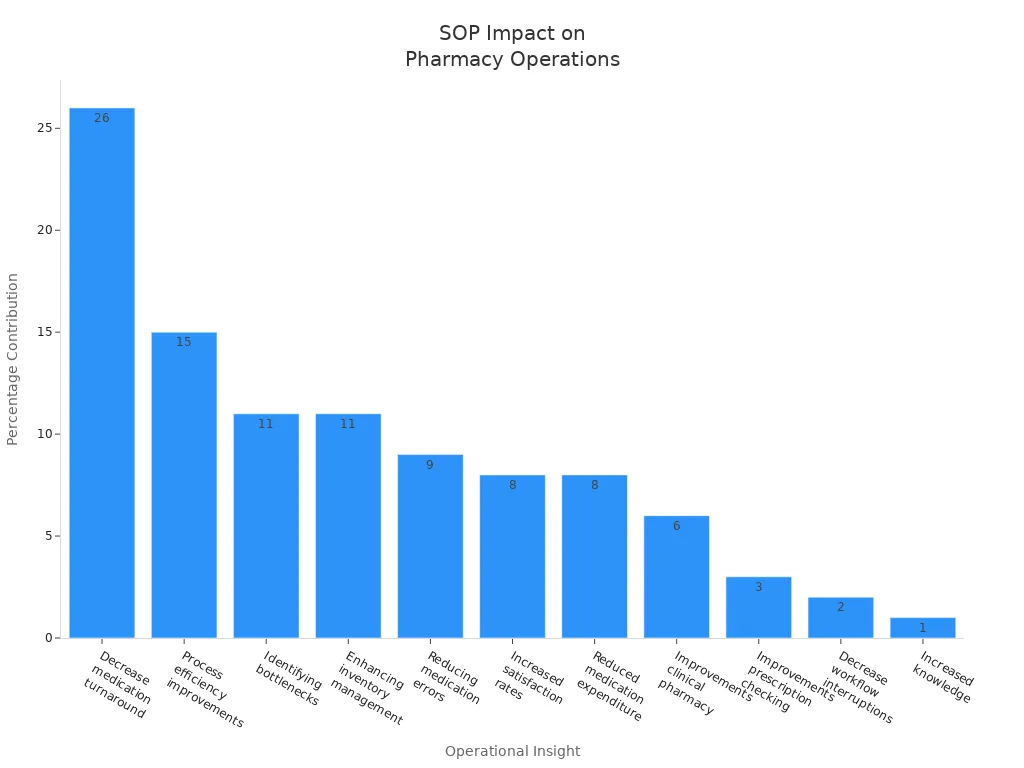
Insight Type | Percentage | Description |
|---|---|---|
Decrease in medication turnaround time | 26% | You give out medicine faster, which helps patients. |
Process efficiency improvements | 15% | You make your pharmacy work better and save time. |
Identifying bottlenecks | 11% | You find slow spots and fix them in your work. |
Enhancing inventory management | 11% | You keep track of medicine and stop running out. |
Reducing medication errors | 9% | You make fewer mistakes with medicine, so patients stay safe. |
Increased satisfaction rates | 8% | You make staff and patients happier by working better. |
Reduced medication expenditure | 8% | You save money by using your supplies well. |
Improvements in clinical pharmacy | 6% | You spend more time helping patients get better. |
Improvements in prescription checking | 3% | You check prescriptions better and find problems early. |
Decrease in workflow interruptions | 2% | You keep your pharmacy running without many stops. |
Increased knowledge | 1% | You learn new things and get better at your job. |
You can use marya’s advanced tools to help manage your facility. Marya gives you cleanroom systems and other solutions to keep your place safe and up to code.
Equipment maintenance sops help you take care of machines. You check and clean equipment often. You fix problems fast and write down every repair. This stops machines from breaking and keeps your work safe.
Marya has special filling lines and isolator systems. You can trust their tools to keep your machines working well and meeting high standards.
Record management sops help you keep patient and medicine info safe. You use these sops to protect privacy and keep data correct.
You keep patient records safe and easy to find. You use the same format for all files. You protect electronic records with passwords. You also back up files so you do not lose them.
Medication logs help you track every drug you use. You write down when you get, store, and give out medicine. You use audit trails and electronic signatures to show who did each step. This helps you follow rules and keep data safe.
Category | |
|---|---|
Ensuring Accessibility | Use the same format, make files easy to search, and use simple systems. |
Security of Electronic Records | Use encryption, passwords, and check security often. |
Backup and Disaster Recovery | Back up files often, store them safely, and test recovery plans. |
Use of Advanced Encryption | Use strong encryption, manage keys, and protect data all the way. |
Compliance with 21 CFR Part 11 | Use audit trails and electronic signatures for records. |
Training sops help you teach new staff and keep everyone updated. You use these sops to make sure your team knows the rules and handles medicine safely.
Onboarding sops help you train new workers. You show them how to use equipment and follow safety steps. You give them checklists and guides to help them learn fast.
Continuing education sops help your team keep learning. You plan training sessions and teach new rules. You use quizzes and feedback to check what they know. This keeps your team ready for changes in pharmacy work.
Tip: Check your training sops often. This helps your team stay ready and confident.
Financial SOPs help you manage money in your pharmacy or lab. You use these procedures to plan, track, and control spending. When you follow these steps, you keep your business healthy and avoid mistakes with money.
You need a clear plan for your money. Budgeting SOPs show you how to set up a budget for medicine, supplies, and staff. You check your spending often and compare it to your plan. If you see a problem, you can fix it before it gets bigger. Good budgeting helps you buy what you need and save money for emergencies.
Billing SOPs help you charge patients and insurance companies the right way. You use these steps to make bills, send them out, and collect payments. You keep records of every bill and payment. This helps you avoid errors and keeps your business running smoothly. You also follow rules for privacy and data safety.
Medication handling SOPs protect patients and staff from harm. You use these steps to keep medicines safe from the time you get them until you throw them away. These procedures help you stop contamination and make sure every medicine works as it should.
You check all medicines to make sure they are safe to use and store them in the right place.
You keep medicines at the right temperature and watch them during storage and transport.
You use clean equipment that does not damage the medicine.
You check medicines again before you use them.
You give clear information to staff and patients so they use medicines the right way.
You control and monitor storage temperatures, especially for items that need to stay cold.
You follow steps to lower risks when you move, store, or throw away medicines.
You use gloves and cleaning tools when you handle dangerous drugs.
You have rules for spills and accidents, including how to clean up and report them.
You cover every step from getting medicines to using and disposing of them.
You can use advanced systems from marya to help you follow these steps. Marya’s solutions help you keep medicines safe and meet all safety rules.
Prescription SOPs help you write and send prescriptions the right way. You use these steps to lower mistakes and keep patients safe.
Write prescriptions clearly and use ink.
Include the date, patient’s full name, age or birth date, and weight for children.
Sign each prescription and add your name and job title.
Use generic names for medicines and do not use short forms.
Write the type of medicine you want to give.
Electronic prescribing SOPs help you use computers to send prescriptions. You follow the same rules for safety and accuracy. These steps help you avoid errors and make sure patients get the right medicine.
Tip: Always double-check your prescription before you give it to the patient.
Patient management SOPs help you give the same care to every patient. You use these steps to make sure each part of the patient journey follows the same rules. When you use an SOP, you make fewer mistakes and keep everyone safer. You also make your work easier and more dependable.
You use the same medication steps, so mistakes happen less.
You handle equipment the same way, which stops accidents.
You use the same handover steps, so important info is not lost.
You train new staff with clear steps, so your team works better.
You use the same discharge steps, which helps patients and saves time.
Assessment SOPs help you check a patient’s health. You follow clear steps to gather information, look at medical history, and write down symptoms. You use the same process for each patient, so you do not miss anything. You use checklists and forms to stay organized. This makes your checks correct and easy to look over.
Follow-up SOPs help you watch how patients do after treatment. You plan regular check-ins and use reminders to make sure patients come back. You write down each visit and update patient files. You use these steps to find problems early and help patients stay healthy. You also make sure patients know what to do next and how to contact you if they need help.
Assistance program SOPs help you support patients who need extra help. You use these steps to connect patients with services and resources.
Support services SOPs show you how to help with medication costs, rides, or counseling. You use forms to find out what patients need and match them with programs. You keep records of each service you give. You make sure patients get help quickly.
Access SOPs help you guide patients through joining assistance programs. You explain who can join and help patients fill out forms. You track each request and check to make sure patients get help. You use these steps to make the process easy and fair for everyone.
Competency assessment SOPs help you check if staff can do their jobs well. You use different ways to measure skills and knowledge. You keep records of each check and use them to plan training.
Description | |
|---|---|
Written Exams | You test staff knowledge about stability, storage, and rules. |
Practical Demonstrations | You watch staff handle medicines safely and correctly. |
Peer Reviews | Experienced staff check how new team members work in real situations. |
Proficiency Logs | You track daily performance to see improvement and spot issues. |
You use these tools to build a strong team and keep your pharmacy safe.
Tip: Look at your SOPs often. This helps you keep your steps up to date and your staff ready for anything.
You should include everyone who works with medicine when making an sop. Stakeholders are people who use, check, or manage steps in your pharmacy or lab. You ask them for ideas and listen to what they say. When you work together, you make fewer mistakes and get better results. This helps everyone trust each other and know their job.
Ask staff about problems they have each day.
Let supervisors look at the steps and give advice.
Invite managers to help plan the process.
Get feedback from people who use the steps.
You can use marya’s tools to collect feedback and set up meetings. Marya helps you with process documents and checking steps, so it is easier to include everyone.
You need to write your sop using simple words. Clear language makes it easy for everyone to know what to do. This stops confusion and helps each person follow the steps right. Use short sentences and give direct instructions. Do not use hard words unless you explain them.
Tip: Ask a new staff member to read your sop. If they understand every step, your words are clear.
Here are some ways to make your instructions easy:
Use action words like "check," "record," or "clean."
Number each step in the right order.
Add pictures or diagrams if you can.
Keep sentences short and easy to read.
Marya can help you make simple documents. Their team helps you write clear instructions, so everyone understands.
You should check your sop often. Rules and technology can change, so your steps must stay up to date. Look at your procedures every few months or after big changes. Ask your team for ideas and ways to make things better. Update your documents and share new versions with everyone.
Step | Description |
|---|---|
Objective | Say why you need the SOP. |
Scope | Tell where and when to use the SOP. |
Responsibility | Name who does the SOP. |
Accountability | Pick who checks if rules are followed. |
Procedure |
You can use marya’s checking services to review your documents and make sure they follow all rules. Marya helps you keep your steps current and ready for checks.
Note: Checking your sop often helps you find mistakes early and keeps your pharmacy safe.
You need strong training to make sure everyone follows your sop. Training helps your team understand each step and why it matters. You teach new staff how to use equipment, handle medicine, and follow safety rules. You also show them how to keep records and report problems. When you train your team well, you lower mistakes and build confidence.
You can use different ways to train your staff. You might use hands-on practice, videos, or checklists. You can hold group sessions or teach one-on-one. You should test your team with quizzes or practical tasks. This helps you see who understands the steps and who needs more help.
Tip: Review your training plan often. Update it when rules change or when you get new equipment.
You can ask marya for help with training materials and process guides. Marya gives you clear documents and step-by-step instructions. Their experts help you set up training sessions and make sure your team learns the right way. You can trust marya to support your training and keep your staff ready for any task.
You must check if your team follows the sop every day. Compliance monitoring helps you find mistakes and fix them fast. You use different tools and checks to make sure everyone does their job right.
Here are some ways you can monitor compliance:
Quality control checks, like testing and inspecting medicine.
Quality assurance steps, such as audits and tracking problems.
Regulatory checks, including following GMP, GDP, and GCP rules.
Laboratory checks, like sampling and using correct methods.
You can use charts or tables to track your checks. You write down each test, inspection, or audit. You look for patterns and spot areas where you need to improve.
Monitoring Tool | What It Checks |
|---|---|
Testing | Medicine quality |
Inspection | Equipment and workspace |
Audit | Process and record accuracy |
Calibration | Machine performance |
Sampling | Product consistency |
Note: Keep your records safe and easy to find. This helps you show proof during inspections.
Marya offers advanced systems for compliance monitoring. Their tools help you track every step, keep records, and pass audits. You can use marya’s validation services to check your processes and make sure you meet all rules. With marya, you build a strong system for monitoring and stay ready for any inspection.
You should make your SOPs fit your own needs. Every pharmacy, lab, or clinic works differently. You might have special machines or different jobs for staff. Some places have unique patient needs. When you change your SOPs, you make sure each step matches your real work. This helps your team follow rules and keeps everyone safe.
Look at your daily jobs and write steps that match them.
Use examples from your own workplace to make things clear.
Change your SOPs when you get new machines or change how you work.
Marya gives you ready-to-use solutions to help you make SOPs for your setup. Their experts can help you with the process and make sure your documents fit your needs.
Tip: Ask your team to help change SOPs. They know each job well and can find missing steps.
You can use technology to make SOPs easier and faster. Digital tools help you store, update, and share SOPs with your team. You can find the right document quickly. You also lower the risk of losing important information.
Using Structured Content and Data Management (SCDM) makes data management better and reduces mistakes. SCDM lets you reuse information and keep it in one place. This helps with regulatory submissions and makes important data easy to find.
Marya gives you advanced technical help and digital systems for SOPs. Their solutions help you keep documents organized and easy to get. You can track changes and make sure everyone uses the newest version.
Use electronic SOPs to save time and use less paper.
Set alerts for updates or changes.
Let staff get SOPs on computers or tablets.
You should always listen to feedback from your team. Staff use SOPs every day. They see what works and what needs to change. When you collect feedback, you find ways to make your steps better and fix problems early.
Have regular meetings to talk about SOPs.
Use surveys or suggestion boxes for ideas.
Look at feedback before you change any document.
Marya helps you with technical support and advice. Their team can show you how to collect feedback and use it to make your SOPs better. Working together makes your workplace safer and more efficient.
Note: Feedback helps you find mistakes and keeps your SOPs current.
You build a safer and more reliable pharmacy when you use strong SOPs. These steps help you protect patients, keep your work legal, and improve quality.
Review your SOPs often.
Train your team with clear instructions.
Update your procedures as rules change.
Keep learning and stay ready for new challenges. When you follow best practices, you make your pharmacy stronger every day.
An SOP in pharmacology gives you step-by-step instructions for handling medicines. You use it to keep your work safe, organized, and legal.
You need SOPs to lower mistakes, protect patients, and follow the law. SOPs help you do your job the same way every time.
Pharmacy managers, quality teams, or trained staff write SOPs. You may help by sharing your daily work steps or giving feedback.
You should review SOPs every year or when you get new equipment, rules, or staff. Regular checks keep your SOPs up to date.
If you skip SOPs, you risk mistakes, harm to patients, and legal trouble. You may also fail audits or lose trust.
Yes! You can use digital tools to store, update, and share SOPs. These tools help you find documents fast and keep everyone on the same page.
You use hands-on practice, checklists, and group lessons. You test staff with quizzes or real tasks to make sure they understand each step.