Views: 0 Author: Site Editor Publish Time: 2026-07-21 Origin: Site
You see the process of vial filling when you look at sealed medicine vials at the pharmacy. This process ensures each vial has the correct amount of medicine and remains clean. Advanced machines, like those from marya, utilize robots and real-time data checks. These tools help make the process faster, more precise, and more efficient for producing large quantities of vials. New systems reduce errors and assist in compliance with regulations. Because of these advancements, you receive safer and more reliable medicine.
Vial filling helps give medicine safely and correctly. Advanced machines put the right amount of medicine in each vial.
The vial filling process has three main steps. These are preparation, filling, and finishing. Each step is important for keeping things clean and high quality.
Glass vials are best for keeping medicine stable. Plastic vials are lighter and cheaper. Both types are used for different needs in medicine.
Automation in vial filling makes work faster and easier. It also helps stop mistakes and keeps everything clean. This means medicine is safer for people.
Workers check vials often to make sure they are clean. Quality control checks help make sure every vial is safe and meets rules.
Marya’s advanced technology helps companies make good medicine. It also helps them follow strict rules.
Cleaning and sterilizing are very important. They stop germs and keep the medicine safe for people.
Vial filling machines can change quickly for different vials. This helps make many kinds of medicine fast and easy.
Table of Contents
Vial filling is an important part of making medicine. This step helps you get safe medicine from the pharmacy. Vial filling means putting the right amount of medicine or vaccine into a vial. Vials are small containers made from glass or plastic. Special machines help make sure each vial gets the correct amount. These machines also keep the medicine clean and safe by following strict rules.
There are three main steps in vial filling.
Stage
Description
Preparation
This step cleans all parts, checks the area, trains workers, and keeps machines working well.
Filling
The clean medicine goes into vials. Workers watch for problems and check the process.
Finishing
The vials are sealed, labeled, packed, and checked before they leave the factory.
All these steps work together to keep the medicine safe and ready to use.
Vial filling is important for safe and strong medicine. This process stops germs from getting in and keeps the medicine working well. You get medicine that helps you because vial filling keeps it good. Vial filling also helps keep patients safe, makes sure the medicine works, and lets you store it longer.
Patient safety: The process keeps vials clean so you do not get sick.
Efficacy: The medicine stays strong and does not change because it stays clean.
Product shelf life: You can keep medicine longer because vial filling keeps it stable.
You also get better accuracy, faster work, and the same results every time.
Here are some main jobs of vial filling in making medicine:
Key Function
Description
Better Accuracy
Each vial gets the right amount of medicine.
Improved Efficiency
The process is faster and has fewer delays.
More Consistent Results
The same thing happens each time, so the medicine is always good.
Reduced Manual Work
Machines do most of the work, so people do less.
Stronger Workflow Control
The process is organized and works better.
Companies like marya use new machines and strong checks to give you good medicine at the pharmacy.
There are two main kinds of vials used for medicine. About 65% are glass vials. Glass vials are used for medicine and vaccines because they do not break down with chemicals or heat. Plastic vials make up about 35%. Plastic vials are lighter and cost less money. You see plastic vials more where price and ease are important.
Glass vials: Used for medicine and vaccines when it is important to keep the drug safe.
Plastic vials: Used more in new markets because they cost less and are easy to use.
Both types help you get safe medicine from the pharmacy. Marya makes both glass and plastic vials to give you the best quality medicine.
The first step in vial filling is getting each vial ready. This is very important in the pharmacy and pharmaceutical industry. Every vial must be clean before you use it for dispensing. Washing takes away dust and small bits. Sterilization kills germs and bacteria. Special machines do the washing and sterilization. These machines spray water and cleaner inside and outside the vial. After washing, you use heat or chemicals to sterilize. This keeps the way medicine is dispensed safe for everyone.
Best Practices for Vial Preparation:
Always use aseptic technique when you get vials ready.
Use a new sterile syringe and needle for each patient.
Never use the same syringe for more than one patient.
Do not put a used syringe or needle into a medication vial.
Only use single-use medications for one patient.
Try to use multi-dose vials for just one patient if you can.
Wear facemasks when you give injections or put in catheters.
Get injections ready in a clean area.
Clean and disinfect the area where you prepare medicine often.
Make injections close to the time you give them.
You follow these steps to keep the sterile filling of vials safe and working well. Marya’s advanced washing and sterilization systems help you meet these rules every time.
Depyrogenation takes out harmful things called pyrogens from the vial. Pyrogens can make you get a fever if they go into your body. You use high heat in a special oven to remove them. This step is very important in the process of vial filling. You make sure the vial is not just clean but also safe for giving medicine. Depyrogenation keeps patients safe and makes the way medicine is dispensed reliable.
Liquid filling comes next. You fill each vial with the right amount of liquid medicine. Machines help control how much goes in. These machines use pumps and sensors to measure the liquid. You must keep the area clean and watch the temperature and humidity. This helps the liquid stay safe and good for dispensing. Marya’s filling lines use sensors to check the amount and find problems fast.
You watch important points to keep the process sterile.
You use pressure sensors to keep positive pressure in the isolator.
You check the air with particle counters for contamination.
You control temperature and humidity to protect the liquid.
You use sensors to make sure the filling is accurate.
You see these steps at the pharmacy when you get medicine. The way medicine is dispensed depends on careful liquid filling.
Some medicines are powders. You use powder filling machines for these vials. The machine measures the powder and puts the right amount in each vial. You must keep the powder dry and away from water. Special equipment helps control the environment. Marya’s powder filling lines help you keep vial filling safe and correct for dispensing.
You check the machines to make sure they work right.
You control the environment to keep the powder dry.
You use sensors to measure the powder for each vial.
You see powder vials at the pharmacy, especially for medicines that need mixing before use. The way medicine is dispensed stays safe and correct with these steps.
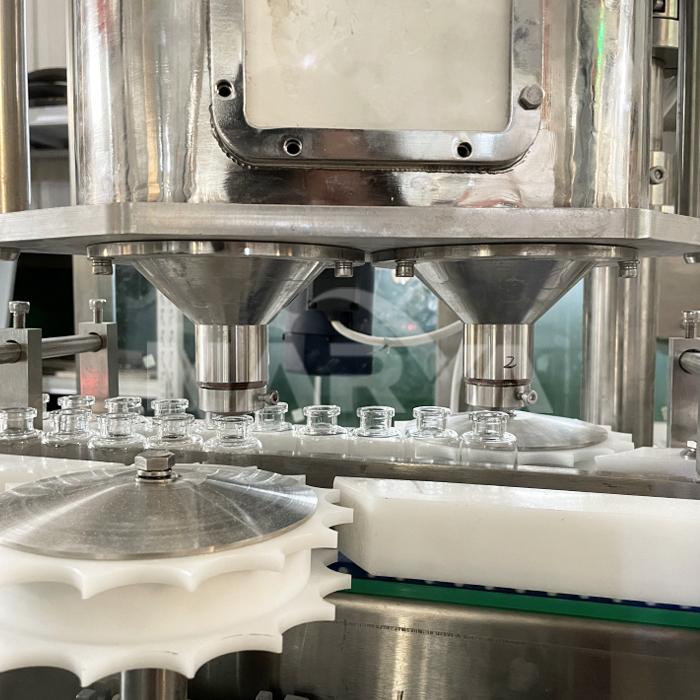
After filling, you put a stopper on each vial. The stopper keeps the liquid or powder inside and blocks germs. Most pharmaceutical vials use rubber stoppers. Machines put the stopper on fast and in the right way. This step is important for keeping vials sterile and medicine safe.
Fast machines put rubber stoppers on vials.
Automatic machines help keep the process quick and clean.
You finish by capping the vial. The cap holds the stopper and seals the vial. Most vials use an aluminum crimp cap. Machines with spinning capping plates make fewer particles. You can also use a special method to check if the seal is strong. Marya’s capping machines help keep vial filling fast and safe for pharmacy use.
Glass vials usually use rubber stoppers and aluminum crimp caps.
Spinning capping plates make fewer particles.
You use different capping machines for different jobs.
Industry Standards Table for Precision and Sterility:
Step
Description
Preparation
Clean and depyrogenate vials before filling.
Filling
Use precise dosing pumps for accurate liquid or powder filling.
Stoppering
Place and seal stoppers to keep the vial closed and sterile.
Inspection
Check every vial for sterility and container closure integrity.
You follow these steps to make sure vial filling meets the highest standards. You see the results every time you get medicine at the pharmacy. Marya’s technology helps keep every step safe, clean, and reliable.
After you fill, stopper, and cap each vial, you must check every vial for quality and safety. This step is called inspection and packaging. You make sure that only perfect vials reach patients. You also add labels and pack the vials for shipping. These steps protect the medicine and help you track each vial.
You start with visual inspection. You look at each vial to find any problems. You check for cracks, leaks, or particles inside the vial. You also look for cloudy liquid or broken seals. You use bright lights and magnifiers to help you see small details. Marya’s inspection systems use cameras and sensors to help you find even tiny defects.
You follow strict rules during inspection. You wear clean clothes and gloves. You clean the inspection area before you start. You check every vial, not just a few. You also test the vials over time to make sure they stay safe. You check on Day 0, Day 7, and Day 14. You look for signs of contamination or changes in the medicine.
Tip: Always check the calibration of your inspection tools. Good tools help you find problems early.
Here is a table that shows the main steps and rules for vial inspection:
Inspection Stage | Description | Acceptance Criteria |
|---|---|---|
Day 0 | Check vial seal and fill level | No contamination allowed |
Day 7 | Inspect after cold storage | If you find 1 vial with growth, investigate and test again |
Day 14 | Final check after warm storage | If you find 2 vials with growth, investigate and test again |
Procedure | Wear clean clothes, disinfect area, check for particles, leaks, or damage | Inspect every vial |
Calibration | Check inspection lights and machines | Keep the area controlled for best results |
You use these steps to make sure every vial is safe and ready for patients.
After inspection, you label each vial. The label tells you what medicine is inside, how much is in the vial, and when it expires. You also add a batch number. This helps you track the vial if there is a problem later. Marya’s labeling machines place each label in the right spot and check for mistakes.
You then pack the vials. You use clean boxes and trays. You make sure the vials do not touch or break during shipping. You seal the boxes and add shipping labels. You store the boxes in a safe place until they leave the factory.
Here is a simple checklist for labeling and packing:
Check each label for the right information.
Place labels straight and without bubbles.
Use clean packing materials.
Pack vials so they do not move or break.
Seal and label each box for shipping.
You follow these steps to keep medicine safe from the factory to the pharmacy. Marya’s advanced packaging lines help you work faster and with fewer mistakes. You can trust that each vial you receive has passed careful inspection and safe packing.
You need good machines to fill vials safely and correctly. Marya has many vial filling machine solutions for making medicine. These machines can fill both liquid and powder products. You can pick a liquid vial filling machine for medicines that stay as liquids. If you use powders, Marya has special powder filling machines too.
Marya makes each vial filling machine to do every step in the vial filling machine process. The machines wash, sterilize, fill, stopper, cap, and check vials. This helps your whole production line work well. Marya’s fully automatic vial filling machine lets you do less by hand and work faster. You can also get a semi-automatic vial filling machine if you want more control.
Marya’s vial filling machinery is made with strong materials and smart design. The machines work well and are easy to clean. They fit in your cleanroom and follow strict industry rules. Marya helps you with planning, building, setting up, and service after you buy. You can count on Marya for help from start to finish.
Automation changes how you run the vial filling machine process. With a fully automated vial filling production line, you make vials faster and with fewer mistakes. Marya’s automatic liquid vial filling machine uses sensors, robots, and smart controls. These tools help you fill each vial with the right amount of medicine every time.
You get many benefits from automation. The machines work fast and never get tired. You see fewer mistakes because the system checks each step. Automation keeps the area cleaner, so there is less risk of contamination. Marya’s vial filling automatic system connects all parts of the process. You can follow each vial from start to finish.
How Automation Improves Your Production:
Feature
Benefit
Makes more vials and fills them better, with fewer mistakes
Industry 4.0 integration
Makes filling more exact, lowers contamination, and keeps things clean
AI-enhanced inspection
Finds problems faster, follows rules, and keeps work moving
You can also use pharmacy automation machines to connect your vial filling line with other machines. This helps you move vials from one step to the next without touching them. You save time and keep your work area safe. Marya’s systems let you watch the whole process as it happens. You can find problems early and fix them before they slow you down.
You need a vial filling machine that works with many vial sizes and types. Marya makes machines that can change to fit your needs. You can switch between glass and plastic vials or change the fill amount quickly. This helps you keep up with new products and what people want.
Marya’s vial filling machine process has quick changeover features. You can go from one product to another with little waiting. The machines use parts you can swap for different vial sizes. Rotary filling machines keep the filling steady with good timing. Linear filling machines use a simple design and steady spots for easy changes. Peristaltic pump filling machines move liquids gently to keep your product safe.
You can fill small or big vials with the same machine.
You can change the fill amount for each batch.
You can switch between liquid and powder filling when you need to.
You can use the same line for different medicines or vaccines.
This flexibility means you do not need a new machine for every product. You save money and space in your work area. Marya’s vial filling line gives you what you need to grow and meet new needs.
New technology is changing how vial filling lines work. These changes help you get safer medicine faster. Companies like Marya use advanced machines and smart systems to improve each step.
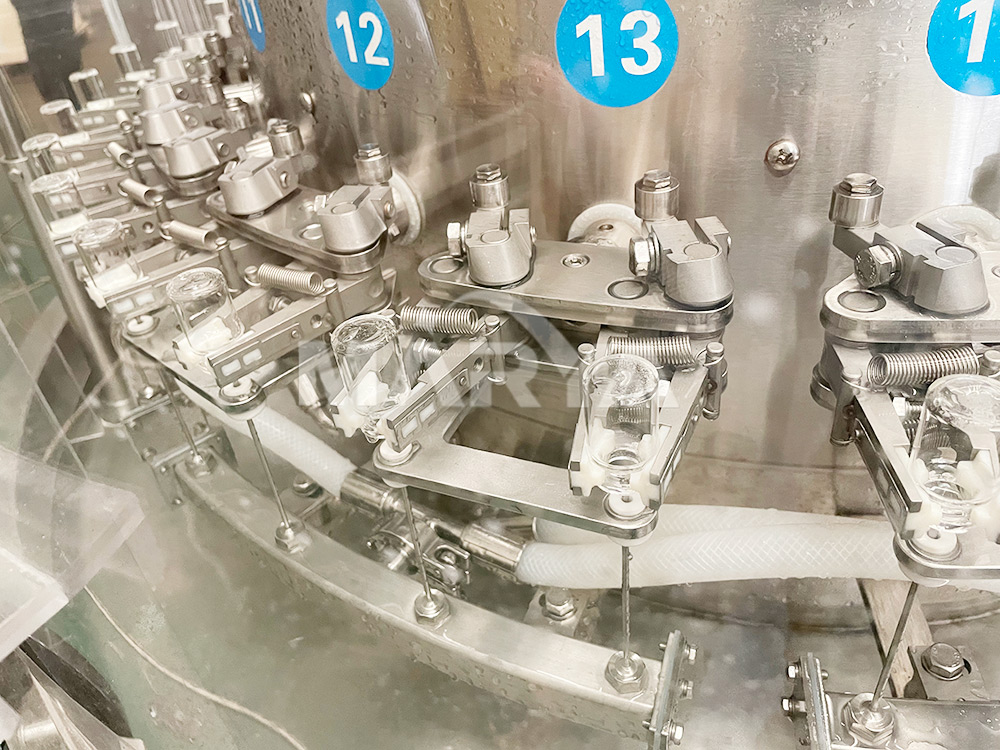
Modern filling lines use robots to move vials. Robotic vial filling machines use Planar Motor technology. This lets robots move vials with high precision and no friction. Parts last longer because there is less wear. Robots work quietly and keep the area clean. You get better control over each vial.
Levitated transport systems move vials without touching them. These systems use magnets to lift and carry vials. No mechanical parts touch the vials. This keeps the process clean and lowers contamination. Medicine stays safe in aseptic environments.
Aseptic processing techniques keep germs away. Blowing stations clean vials with air. Cleanroom conditions protect medicine from dust and bacteria. Environmental monitoring checks air and surfaces for safety. Medicine meets strict standards.
Filling lines handle many vial sizes and shapes. Versatile machines let you switch between products quickly. You can fill small vials for vaccines or large bottles for other medicines. This flexibility helps you meet changing needs.
Validation processes make sure machines work right. Before full operations, tests and checks happen. Machines must meet regulatory standards. Medicine follows the rules and stays safe.
Marya uses these innovations to build strong filling lines. Marya’s machines have advanced sensors, smart controls, and quick changeover features. Marya’s filling lines help you work faster and safer.
Tip: New filling lines use real-time data checks. You can spot problems early and fix them before they affect the medicine.
Here is a table showing some recent innovations in vial filling lines:
Feature | Description |
|---|---|
Specializes in round bottles up to 250ml with six filling stations and robust inertisation. | |
Uses blowing stations, cleanroom conditions, and environmental monitoring for sterility. | |
Versatility | Handles various bottle sizes and shapes, enhancing flexibility in filling different products. |
Validation Processes | Undergoes validation to meet regulatory standards before full-scale operations. |
You also see these innovations in Marya’s filling lines:
Robotic vial filling machines use Planar Motor technology for precise motion.
Levitated transport systems keep vials clean without mechanical parts.
Increased contamination control helps you get safer medicine.
Steriline is a leader in robotic filling. They showed new machines at INTERPHEX. Their robotic vial filling machine uses advanced technology to improve flexibility and cleanliness. These innovations help you get medicine that is safe and reliable.
Marya brings these innovations to your production line. You get machines that fill vials quickly, keep them clean, and meet strict rules. Technology makes the process better for everyone.
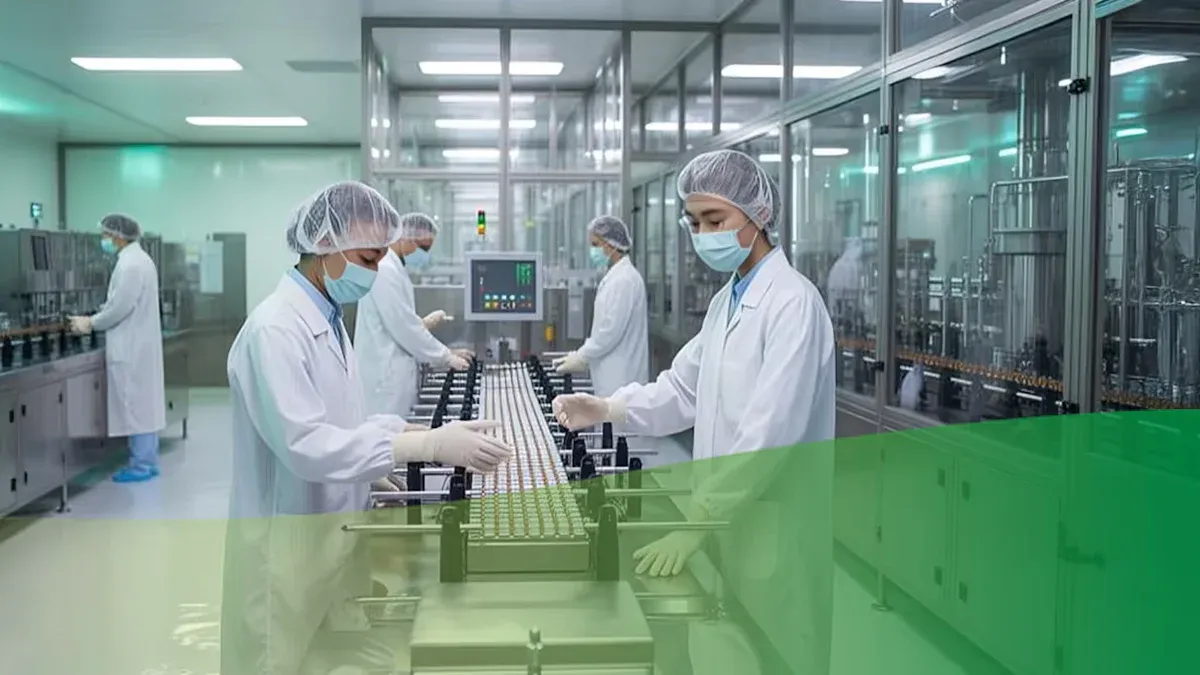
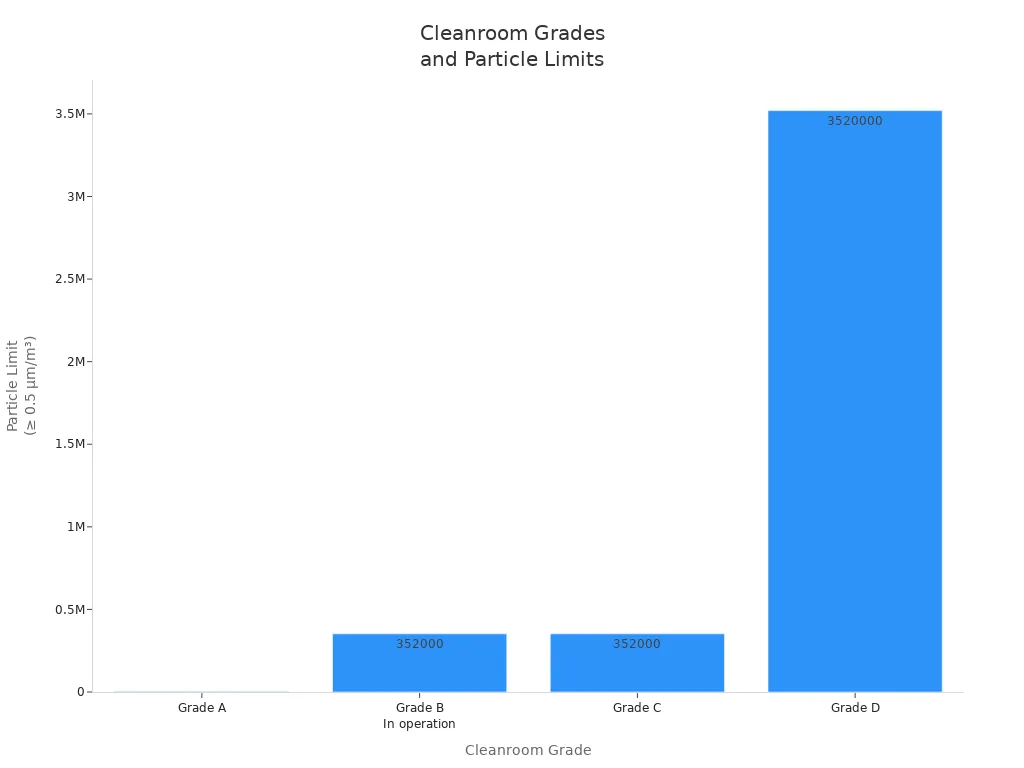
You need a very clean room to keep medicine safe. Cleanrooms use special air filters to stop dust and germs. There are strict rules for how clean the air must be. These rules set limits for tiny particles in the air. They help protect every vial from getting dirty.
Here is a table that shows the main cleanroom grades and their particle limits:
Cleanroom Grade | ISO Equivalent | Particle Limit (≥ 0.5 µm/m³) |
|---|---|---|
Grade A | ISO Class 5 | ≤ 3,520 |
Grade B | ISO Class 5 (at rest), ISO Class 7 (in operation) | At rest: ≤ 3,520; In operation: ≤ 352,000 |
Grade C | ISO Class 7 (at rest), ISO Class 8 (in operation) | ≤ 352,000 |
Grade D | ISO Class 8 | ≤ 3,520,000 |
Marya’s cleanroom solutions help you follow these tough rules. You get a safe place for vial filling. This makes sterility better and lowers risks.
You must check each step to keep medicine safe. Quality control checks help you find problems early. You use special tests and watch the room closely.
Quality Control Check | Description |
|---|---|
Aseptic Techniques | Workers learn clean methods and wear special clothes. |
Media Fill Simulations | You test the process with a safe growth medium to look for germs. |
Environmental Monitoring | You check air and germs in the cleanroom during filling. |
Sterility Testing | You test each batch to make sure there are no germs before release. |
While filling vials, you test samples for leaks, fill levels, and particles. You use sensors and cameras to find problems fast. This helps you fix things before moving to the next step.
At the end, you look at every vial for cracks, leaks, or other problems. You also check labels and seals. Marya’s systems use smart cameras and data checks to make sure only safe vials leave the factory.
You must follow strict rules to keep medicine safe. These rules come from groups like the FDA and ISO. You also follow cGMP guidelines for making drugs. You keep records of every step and clean machines often.
cGMP (Current Good Manufacturing Practices): Sets rules for drug quality.
FDA (Food and Drug Administration): Checks drug safety in the U.S.
ISO (International Organization for Standardization): Sets world rules for making medicine.
Validation: Makes sure machines work right and follow rules.
Cleaning and Sanitation: Stops contamination.
Documentation: Keeps track of all work and checks.
You need to show your machines work the right way. The validation process checks every part of the system. Here are the main steps:
Design Qualification (DQ): You check if the machine design fits your needs and rules.
Installation Qualification (IQ): You make sure the machine is set up right and matches the maker’s guide.
Operational Qualification (OQ): You test the machine in different ways to see if it works as it should.
Performance Qualification (PQ): You run the machine with real products to check for steady, good results.
Process Validation: You test the whole filling process to make sure it follows all rules.
Requalification: You check the system again over time to keep up with standards.
Marya’s validation services help you finish these steps with confidence. You get steady, safe, and high-quality production every time.
Tip: Regular validation and cleanroom checks help you keep your medicine safe and your company ready for audits.
You can run into many problems when filling vials. Every step must be done right to keep medicine safe. If you do not control the process, things can go wrong. Here is a table that lists some common problems you might see:
Issue | Description |
|---|---|
Product on Stopper | Medicine can get on the stopper and make the seal weak. This can also make inspection confusing. |
Container Closure Integrity | If the seal is not perfect, the vial might not stay sterile. |
Filling Parameters | Humidity and airflow can change how filling works. Sometimes this makes crusts form at the needle tip. |
Stopper Positioning Errors | Fast machines might put stoppers in the wrong spot. This can cause leaks or let germs in. |
Pump Calibration Drift | Pumps can lose accuracy over time. This means some vials get too much or too little medicine. |
Temperature-related Variations | Changes in temperature can make the medicine thicker or thinner during filling. |
You need to watch for these problems to keep your line working well.
It is very important to keep vials free from germs and dirt. You must clean and take care of your machines all the time. The table below shows ways to stop contamination:
Strategy | Description |
|---|---|
Establishing a Cleaning Schedule | Clean before and after each batch, and between different products. |
Use of Appropriate Cleaning Agents | Pick safe cleaners that are okay for food and follow the rules. |
Comprehensive Cleaning Procedures | Take machines apart and clean every piece to remove all leftovers. |
Staff Training and Compliance | Teach workers how to clean right and check that they do it. |
Ensure Regular Machine Maintenance | Check and fix machines often so they do not break and cause germs. |
Disassemble and Clean Modules Separately | Clean parts like nozzles by themselves so products do not mix. |
Advanced Technologies in Filling Machines | Use machines with HEPA filters and special nozzles to block germs. |
Environmental Controls | Use air filters and teach workers about hygiene to keep the room clean. |
Tip: Always write down when you clean and fix machines. This helps you see what you did and find any missed steps.
You can fix many vial filling problems by using the right machines. Marya has tools that help you work faster and more accurately. Here are some ways Marya helps you do better:
Advanced filling lines make vial filling quicker and more exact.
Cleanroom systems keep the area sterile and lower the chance of germs.
Custom vial options let you change vial types and sizes easily.
Automation and digital tools mean you do less by hand and can check quality more.
When you use Marya’s machines, your work goes smoother and you get better results. You spend less time fixing mistakes and more time making safe medicine. Marya’s help lets you follow the rules and keep your line running well.
Vial filling is very important in pharmacies. Most drug companies use vial filling to get medicine ready for patients. This process keeps medicine safe and working well. You need vial filling for many medicines, like vaccines and shots. Pharmacies use vial filling to keep medicine clean and ready.
Vials and ampoules filling will have almost half the market in 2026.
Nearly half of all drugs and vaccines use vial filling.
This is because more people need COVID-19 vaccines.
When you get a vaccine, vial filling keeps it safe from germs. You can trust that each dose is measured and sealed right. Drug companies use vial filling so you get the right amount every time.
Vial filling is not only for vaccines. You see vial filling in many parts of medicine and pharmacy. Vial filling helps you get medicine for different needs. The table shows how vial filling helps many medical uses:
Application Type | Description |
|---|---|
Vaccines | Needed for filling both regular and new mRNA vaccines. |
Antibiotics and hormones | Both liquid and dry forms go in vials. |
Biopharmaceuticals | Sensitive drugs need a clean filling process. |
Oncology drugs | Expensive drugs need careful dosing. |
R&D and clinical trials | Used for small batches in studies. |
You see vial filling when you pick up antibiotics or hormone medicine. Drug companies use vial filling for biopharmaceuticals and cancer medicine. You also find vial filling in labs. Scientists use it to make small batches for tests. This helps you get new medicine faster and safer.
Marya helps many drug companies with vial filling. Marya’s work is seen in almost 60 countries. Marya’s machines help make medicine in places like Malaysia, Bangladesh, Uganda, and Indonesia.
Marya’s technology keeps medicine clean and accurate. You can trust Marya’s systems to keep medicine safe. Marya’s cleanrooms stop germs from getting in. You see Marya’s work every time you get medicine at the pharmacy.
Note: Marya’s projects show why vial filling is important for safe medicine. You get good medicine because of these advanced systems.
You rely on vial filling for almost every medicine you get. This process helps make vaccines, antibiotics, and other drugs. Marya’s global work helps millions of people get safe medicine every day.
You can see how vial filling keeps medicine safe and ready. Marya’s machines help make sure vials are clean and meet rules. Aseptic filling stops germs from getting in and lowers human touch. Strong trays and matching vials help the process go faster.
You can also reach out to marya for expert help and answers.
You fill vials with medicine or vaccines using special machines. This process keeps the medicine clean and safe for patients.
Sterilizing vials removes germs and dirt. You protect patients from infections and keep the medicine pure.
You pick glass vials for strong, stable medicines. You use plastic vials when you want lighter weight or lower cost.
Marya’s machines use advanced technology. You get fast, accurate, and clean filling. You can trust the machines to meet strict safety rules.
You clean machines often. You use cleanrooms and special filters. Workers wear protective clothing. You check the air and surfaces for germs.
Some machines let you switch between liquids and powders. You change parts and settings to match the product.
Validation checks if your machines and process work right. You test each step to make sure you meet safety and quality standards.