Views: 0 Author: Shanghai Marya R&D Team Publish Time: 2026-10-26 Origin: Site
How do HEPA filters work in a cleanroom? HEPA (High-Efficiency Particulate Air) filters remove airborne particles by passing air through a dense network of fine fibers. Three main mechanisms—interception, inertial impaction, and diffusion—capture particles as air flows through the filter.
A conventional HEPA filter removes at least 99.97% of airborne particles at 0.3 microns under its specified test conditions. In European EN 1822 classifications, H13 and H14 HEPA filters provide minimum integral efficiencies of 99.95% and 99.995% at the most penetrating particle size (MPPS).
Inside a cleanroom, HEPA filters work together with HVAC equipment, controlled airflow, sealed filter housings, and monitoring systems to maintain the required airborne particle concentration.
For pharmaceutical cleanrooms, effective HEPA filtration helps protect manufacturing processes from particulate contamination and supports a broader contamination control strategy.
Table of Contents
HEPA filtration does not work like an ordinary sieve that simply blocks particles larger than its openings.
Instead, air moves through a complex network of microscopic fibers. Particles collide with or contact these fibers through several physical mechanisms.
The three primary mechanisms are interception, inertial impaction, and diffusion.
Interception occurs when an airborne particle follows the airflow around a filter fiber but passes close enough to touch its surface.
Once the particle contacts the fiber, surface forces help retain it.
Interception is especially important for particles large enough to contact fibers while following airflow streamlines.
Inertial impaction occurs when particles have enough momentum that they cannot follow the airflow as it changes direction around a fiber.
Instead of flowing around the obstacle, particles collide with the fiber and become trapped.
This mechanism is particularly important for larger airborne particles and at airflow conditions where particle inertia is significant.
Diffusion plays an important role in capturing extremely small airborne particles.
Tiny particles undergo random movement caused by collisions with surrounding gas molecules. This process is known as Brownian motion.
Their irregular movement increases the probability of contacting filter fibers.
This explains why HEPA filters can efficiently capture many particles smaller than 0.3 microns.
Mechanism | How It Works | Particle Behavior |
|---|---|---|
Interception | Particles touch fibers while following airflow | Contact near fiber surfaces |
Inertial impaction | Particle momentum causes collision with fibers | Larger particles cannot follow curved airflow |
Diffusion | Random Brownian motion brings particles into contact with fibers | Very small particles move irregularly |
These mechanisms work simultaneously. Their relative contributions vary according to particle size, airflow velocity, and filter media characteristics.
The 0.3-micron particle size is commonly used in conventional HEPA efficiency specifications because it is near the most challenging filtration range for many traditional filter designs.
However, the exact most penetrating particle size depends on the filter media and test conditions.
MPPS refers to the particle size at which a filter has its lowest collection efficiency under specified operating conditions.
Particles larger than the MPPS are generally captured more effectively through interception and impaction.
Particles smaller than the MPPS are increasingly influenced by diffusion.
The result is a filtration efficiency curve in which efficiency is lowest around the MPPS and higher for many particles on either side.
Important: A 99.97% efficiency rating at 0.3 microns does not mean that particles smaller than 0.3 microns pass freely through the filter.
Different standards may use different test methods and efficiency classifications, so filter specifications should always identify the relevant testing standard.
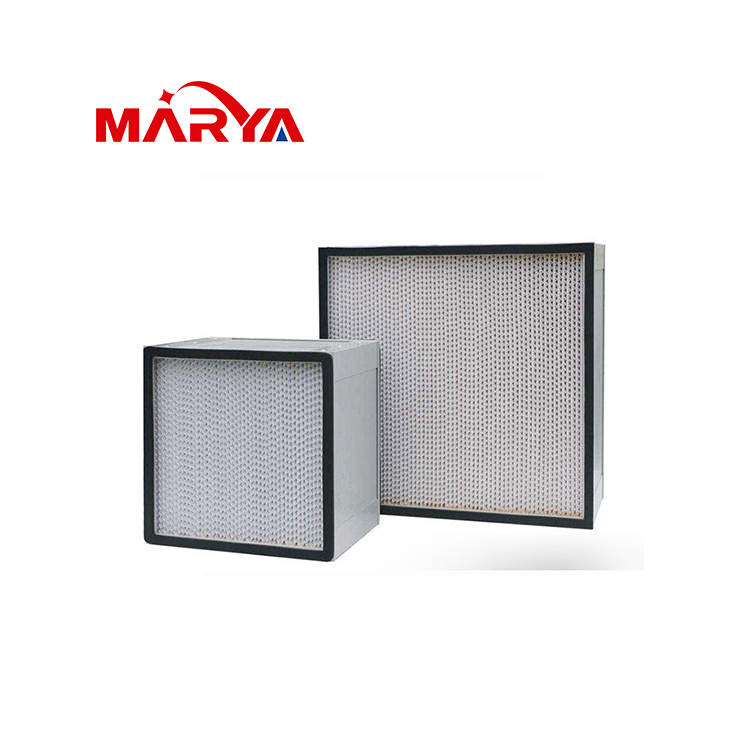
A cleanroom HEPA filter contains several components that work together to provide efficient particle removal and prevent contaminated air from bypassing the filtration media.
The filter media forms the main particle capture surface.
Many cleanroom HEPA filters use fine glass-fiber media, while other designs may use suitable synthetic or membrane-based materials.
The arrangement and properties of the media affect particle removal efficiency, airflow resistance, and filter performance.
HEPA filter media is usually folded into multiple pleats.
This design increases the effective filtration area within a relatively compact frame.
A larger media area allows air to pass through more filter surface, helping balance particle collection efficiency and pressure drop.
The frame supports the filtration media and maintains the filter's structural integrity.
Gaskets or gel seals help prevent air from passing around the filter instead of through it.
Even highly efficient filtration media cannot protect a cleanroom if contaminated air bypasses the installed filter.
Component | Main Function | Why It Matters |
|---|---|---|
Filter media | Captures airborne particles | Determines filtration performance |
Pleated structure | Increases filtration surface area | Supports airflow and resistance control |
Filter frame | Supports and protects the media | Maintains structural integrity |
Gasket or gel seal | Prevents bypass airflow | Helps protect installed filter integrity |
Filter housing | Holds the filter in position | Connects filtration to the air distribution system |
HEPA filters do not operate independently in pharmaceutical cleanrooms.
They form part of an HVAC system that supplies filtered air, controls airflow patterns, and removes particles generated inside the room.
Outdoor air and recirculated air enter the air handling system according to the facility's ventilation design.
The incoming air may contain dust, airborne particles, and other contaminants.
Air passes through preliminary filtration stages.
Prefilters capture larger dust particles and fibers before the air reaches the final HEPA filtration stage.
This helps reduce particle loading on the HEPA filters and supports reliable operation.
Air handling equipment regulates important environmental parameters such as temperature, humidity, and airflow.
Fans provide the pressure required to move air through ducts, filters, and terminal devices.
Air passes through HEPA filters installed at appropriate locations within the cleanroom air supply system.
Final HEPA filters are commonly positioned close to the cleanroom supply outlets, reducing the possibility of downstream contamination.
Clean air enters the room through terminal filter units, diffusers, or fan filter units.
The airflow pattern depends on the cleanliness requirements and process design.
Airborne particles generated by personnel, equipment, and production processes are transported away from critical locations.
Air then leaves through return or exhaust paths, depending on the ventilation and pressure-control design.
A portion of the air may be recirculated through the filtration system.
The complete process combines HEPA filtration, airflow distribution, and controlled ventilation to maintain cleanroom conditions.
Marya's Cleanroom Systems integrate air purification, HVAC equipment, and cleanroom engineering requirements for pharmaceutical production facilities.
HEPA filter efficiency is only one factor influencing cleanroom cleanliness.
The airflow pattern determines how filtered air reaches working areas and how effectively particles are removed.
Unidirectional airflow moves filtered air in a controlled, predominantly single direction.
It is commonly used to protect critical processing zones in aseptic manufacturing.
For example, appropriately designed downward airflow can help move contaminants away from exposed sterile products and critical surfaces.
The effectiveness of the airflow pattern should be demonstrated through airflow visualization and qualification.
Non-unidirectional airflow relies on mixing and dilution.
Filtered supply air enters the room and mixes with the existing room air, reducing the overall particle concentration as contaminants are removed.
This arrangement is common in many pharmaceutical support areas and cleanrooms where unidirectional airflow is not required.
Feature | Unidirectional Airflow | Non-Unidirectional Airflow |
|---|---|---|
Air movement | Predominantly one direction | Mixed airflow |
Main function | Protects critical zones through controlled displacement | Dilutes and removes airborne contamination |
Common application | Critical aseptic processing zones | General cleanroom and support areas |
Design consideration | Airflow uniformity and disturbance control | Air distribution and effective particle dilution |
The appropriate airflow strategy should be determined by the manufacturing process, contamination risks, and applicable cleanroom requirements.
HEPA filter efficiency is often discussed alongside ISO cleanroom classifications, but these terms describe different performance characteristics.
HEPA filter efficiency measures how effectively a filter removes particles from air passing through it.
ISO cleanroom classification measures airborne particle concentrations within a controlled environment.
Therefore, installing a particular HEPA filter class does not automatically make a room compliant with a particular ISO cleanliness class.
Under EN 1822, H13 and H14 filters have different minimum integral efficiencies at MPPS.
Filter Class | Minimum Integral Efficiency at MPPS | Maximum Integral Penetration |
|---|---|---|
H13 | 99.95% | 0.05% |
H14 | 99.995% | 0.005% |
Both classes can be considered for cleanroom applications according to the project requirements.
The final specification should account for the overall HVAC design, airflow performance, contamination control strategy, and filter qualification.
ISO 14644-1 specifies cleanroom classifications based on airborne particle concentrations.
It does not establish a universal rule that ISO Class 5 must use H14 filters or that cleaner classes must always use ULPA filters.
Achieving the intended cleanliness classification requires coordinated system design and verification.
For a detailed comparison of filter technologies, read our related article: HEPA vs. ULPA Filters: What's the Difference?.
HEPA filtration plays an important role in pharmaceutical environments where airborne contamination must be controlled.
The required filtration configuration depends on the manufacturing process and the associated contamination risks.
During aseptic filling, exposed sterile products and critical components require appropriate environmental protection.
HEPA-filtered airflow helps support contamination control around filling equipment, open containers, and other critical processing locations.
However, HEPA filters alone cannot establish sterile conditions. Suitable facility design, personnel practices, sterilization processes, monitoring, and qualification are also necessary.
Pharmaceutical isolators create controlled environments separated from the surrounding room by a physical barrier.
HEPA filtration may be integrated into their supply or exhaust airflow systems according to the isolator design and containment requirements.
Marya provides Isolator Systems for pharmaceutical applications requiring controlled processing environments.
HEPA filtration is also used in cleanroom facilities supporting pharmaceutical preparation, packaging, and other controlled manufacturing activities.
Different processing areas may require different environmental classifications, pressure relationships, and airflow arrangements.
Marya's Cleanroom Projects bring together facility layout, air purification equipment, and engineering integration to support pharmaceutical manufacturing requirements.
Testing is essential because a filter's factory efficiency rating does not establish that the installed filtration system is free from leaks.
A cleanroom HEPA filter must perform correctly within its housing and air distribution system.
Installed filter system leakage testing is used to identify possible defects in the filter media, seals, frames, and installation.
A suitable challenge aerosol may be introduced upstream of the filter.
Testing equipment is then used downstream to identify leakage according to an established procedure.
The test criteria depend on the applicable standards, facility requirements, and filter system design.
Airflow testing confirms that the system supplies air according to its design requirements.
For unidirectional airflow areas, appropriate velocity and airflow uniformity measurements may also be necessary.
Differential pressure across a HEPA filter indicates its resistance to airflow.
As particles accumulate, pressure drop may increase.
Monitoring these changes helps maintenance personnel identify filter loading and potential operating problems.
The ISO 14644 standards provide the broader framework for cleanroom classification.
ISO 14644-3 addresses test methods, including installed filter system leakage testing.
For sterile pharmaceutical manufacturing, qualification and monitoring activities should also align with applicable GMP requirements.
HEPA filter replacement should be based on filter condition, operational performance, and the facility's approved maintenance procedures.
A single replacement interval cannot be applied to every pharmaceutical cleanroom.
Common indicators include:
Differential pressure exceeding approved limits
Reduced airflow under comparable operating conditions
Failed installed filter integrity testing
Physical damage to the filter or its seals
Changes affecting cleanroom qualification
Manufacturer-defined end-of-service conditions
A pressure drop outside the expected range does not automatically prove the filter must be replaced. The cause should be investigated.
Most conventional cleanroom HEPA filters are not intended for routine washing or regeneration.
Cleaning may damage the filter media, compromise the seals, or change filtration performance.
Unless a specific filter design and validated maintenance procedure permit cleaning, replacement using an approved method is generally the appropriate approach.
Preventive maintenance helps maintain stable airflow, reduce unexpected operational interruptions, and preserve cleanroom performance.
It should include appropriate prefilter maintenance, pressure monitoring, inspections, and scheduled qualification activities.
HEPA filters use fine fibrous media to capture airborne particles through interception, inertial impaction, and diffusion. They operate within a cleanroom HVAC system that supplies filtered air and removes airborne contamination.
Yes. HEPA filters can efficiently capture particles smaller than 0.3 microns. Diffusion becomes increasingly important for very small particles, so a 0.3-micron rating should not be interpreted as a minimum removable particle size.
Under EN 1822, H13 filters have a minimum integral efficiency of 99.95% at MPPS, while H14 filters achieve at least 99.995%. The appropriate class depends on the cleanroom design and process requirements.
Terminal HEPA filters are often installed near ceiling supply outlets to deliver filtered air directly into the controlled space and minimize potential contamination downstream of the final filtration stage. Actual placement depends on the airflow design.
Testing frequency depends on the facility's applicable standards, regulatory requirements, contamination control strategy, and approved qualification schedule. Additional testing may be necessary after relevant maintenance, damage, replacement, or system modifications.
HEPA filters primarily capture airborne particles, including particles that may carry microorganisms. They do not generally sterilize captured particles or guarantee that trapped microorganisms have been inactivated.
Understanding how HEPA filters work in a cleanroom requires looking beyond the filtration media.
HEPA filters capture airborne particles through interception, inertial impaction, and diffusion. Their performance also depends on filter construction, proper sealing, airflow distribution, HVAC operation, and regular verification.
In pharmaceutical manufacturing, reliable HEPA filtration is one part of a broader cleanroom contamination control strategy.
At Marya, we provide integrated Pharmaceutical Cleanroom Systems and engineering solutions for pharmaceutical production environments.
Contact Marya to discuss your cleanroom design, filtration system integration, and pharmaceutical facility requirements.