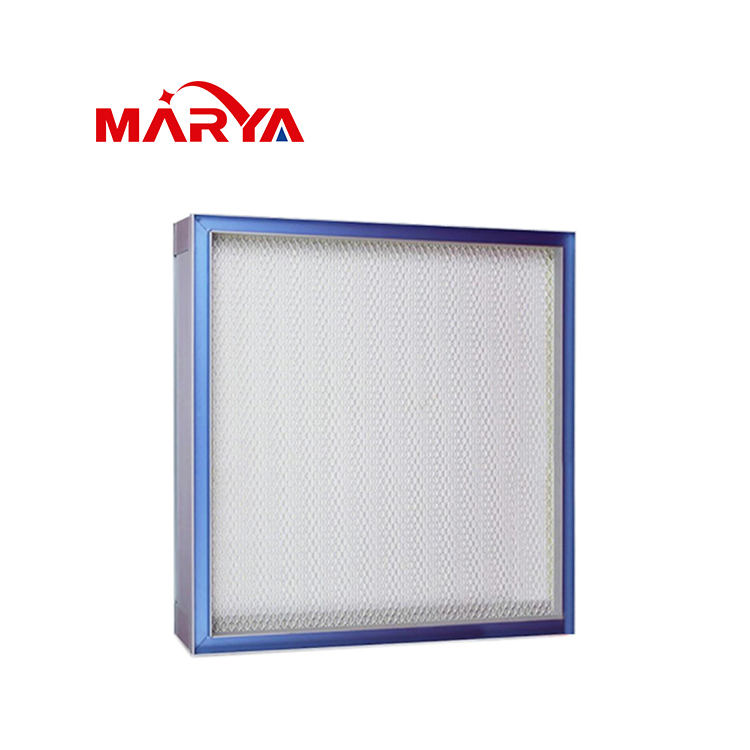
Views: 0 Author: Shanghai Marya R&D Team Publish Time: 2026-10-26 Origin: Site
HEPA vs. ULPA filters: what is the difference? HEPA (High-Efficiency Particulate Air) and ULPA (Ultra-Low Penetration Air) filters both remove fine airborne particles, but ULPA filters achieve higher particle collection efficiency under their specified test conditions.
A conventional HEPA rating is at least 99.97% efficiency at 0.3 microns. Under EN 1822, H13 and H14 HEPA filters achieve at least 99.95% and 99.995% efficiency at the most penetrating particle size (MPPS), respectively. U15 ULPA filters achieve at least 99.9995% efficiency at MPPS.
However, higher efficiency does not automatically mean better cleanroom performance. Airflow, pressure drop, filtration standards, contamination risks, and operating costs all influence the final result.
This guide compares HEPA vs. ULPA filter efficiency, explains their filtration classes, and examines their applications in pharmaceutical cleanrooms and other controlled environments.
Table of Contents
The main difference between HEPA and ULPA filters is their particle collection efficiency. ULPA filters provide higher efficiency, but the most appropriate choice depends on the complete air filtration system.
Comparison | HEPA Filter | ULPA Filter |
|---|---|---|
Full name | High-Efficiency Particulate Air | Ultra-Low Penetration Air |
EN 1822 classes | H13, H14 | U15, U16, U17 |
Minimum MPPS efficiency | H13: 99.95%; H14: 99.995% | U15: 99.9995%; U16: 99.99995%; U17: 99.999995% |
Particle removal | Very high efficiency | Ultra-high efficiency |
Pressure drop | Often lower in comparable conventional designs | May be higher, depending on construction |
Airflow requirements | Must match rated operating conditions | Must match rated operating conditions |
Initial cost | Generally lower | Generally higher |
Typical applications | Pharmaceutical cleanrooms, laboratories, controlled production areas | Semiconductor facilities, advanced research, specialized ultra-clean processes |
Main consideration | Efficiency, airflow, and cost balance | Higher particle retention where justified |
Key takeaway: HEPA filters are suitable for many pharmaceutical cleanroom applications. ULPA filters are appropriate when a process requires exceptionally low particle penetration and the ventilation system can support the selected filter.
A HEPA filter is a high-efficiency air filtration device designed to remove fine particles from an airflow.
HEPA filters use specialized fibrous media to capture dust, airborne microorganisms, and other particles. They are widely used in pharmaceutical manufacturing, laboratories, healthcare environments, and industrial cleanrooms.
Under EN 1822, HEPA filters are classified according to their efficiency at the most penetrating particle size.
H13 HEPA filter: Minimum integral efficiency of 99.95% at MPPS.
H14 HEPA filter: Minimum integral efficiency of 99.995% at MPPS.
These values differ from the commonly cited 99.97% efficiency at 0.3 microns because they use a different classification and testing basis.
HEPA filters support particle control in environments such as:
Pharmaceutical production cleanrooms
Aseptic processing areas
Sterile manufacturing isolators
Biotechnology laboratories
Medical device manufacturing
Controlled packaging facilities
Their main advantage is the ability to provide high particle removal efficiency while supporting the airflow required by the facility.
A ULPA filter is an ultra-high-efficiency air filter designed to provide very low particle penetration.
Under EN 1822, ULPA filters are classified as U15, U16, and U17.
Filter Class | Minimum Integral Efficiency at MPPS | Maximum Penetration |
|---|---|---|
U15 | 99.9995% | 0.0005% |
U16 | 99.99995% | 0.00005% |
U17 | 99.999995% | 0.000005% |
These values demonstrate how progressively higher ULPA classes reduce particle penetration under standardized testing.
ULPA filters are commonly associated with processes where extremely small particle concentrations can affect product quality.
Typical applications include semiconductor manufacturing, microelectronics, nanotechnology research, and specialized ultra-clean production environments.
They may also be specified in pharmaceutical projects when the process design and contamination risk assessment justify their use.
Important: ULPA filtration is not a universal requirement for sterile pharmaceutical manufacturing. A correctly designed and qualified HEPA filtration system can meet demanding pharmaceutical cleanroom requirements.
Understanding particle size is essential when comparing HEPA and ULPA filters.
The commonly quoted HEPA efficiency rating of 99.97% at 0.3 microns is a conventional test-based definition.
It does not mean that HEPA filters cannot capture particles smaller than 0.3 microns.
High-efficiency filters remove particles through several physical mechanisms, including interception, inertial impaction, and diffusion.
As particle size changes, the relative importance of these mechanisms changes.
MPPS stands for Most Penetrating Particle Size.
It refers to the particle size at which a particular filter has its lowest collection efficiency under specified test conditions.
Depending on filter media and operating conditions, the MPPS commonly falls in the approximate range of 0.1–0.3 microns.
The European EN 1822 classification method evaluates HEPA and ULPA filters using their performance at MPPS.
Therefore, when comparing HEPA vs. ULPA filter efficiency, the test method matters as much as the efficiency percentage.
H13, H14, and U15 are common filtration classes used when discussing high-efficiency cleanroom air filtration.
Filter Class | Category | Efficiency at MPPS | General Application Consideration |
|---|---|---|---|
H13 | HEPA | ≥99.95% | High-efficiency cleanroom air filtration |
H14 | HEPA | ≥99.995% | Critical cleanroom applications requiring greater particle retention |
U15 | ULPA | ≥99.9995% | Specialized applications requiring ultra-low particle penetration |
An H14 filter provides higher minimum particle collection efficiency than H13, while U15 provides higher efficiency than both.
However, filter efficiency alone cannot determine whether a room will achieve its cleanliness target.
Air distribution, particle generation, personnel movement, equipment operation, and room leakage also affect airborne particle concentrations.
For pharmaceutical environments, the filter must be evaluated as part of the complete cleanroom design and contamination control strategy.
Filtration efficiency is only one part of cleanroom performance.
Airflow resistance, fan capacity, energy consumption, and maintenance requirements also affect long-term operation.
Pressure drop refers to the pressure difference across a filter as air passes through it.
Some ULPA filter designs have higher resistance than comparable HEPA filters, particularly when higher efficiency is achieved through denser filtration media.
However, pressure drop also depends on media technology, pleat arrangement, filtration area, and rated airflow.
A ULPA filter should not automatically be assumed to have a fixed percentage of additional resistance.
For an accurate comparison, review the manufacturer's pressure-drop data at the same operating airflow.
Fan energy requirements are influenced by the pressure needed to move air through the filtration system.
If a replacement filter produces a higher pressure drop, the ventilation system may require additional fan power to maintain the same airflow.
This can increase operating costs.
On the other hand, optimized filter construction and larger filtration areas may reduce resistance.
Both HEPA and ULPA filters require appropriate inspection and performance monitoring.
Important factors include:
Differential pressure trends
Airflow performance
Installed filter integrity
Prefilter condition
Process contamination risks
Facility maintenance procedures
Filter life should not be determined using a universal replacement interval. It depends on the operating environment, contamination load, filter design, and validated maintenance requirements.
Pharmaceutical cleanrooms require controlled airborne particle concentrations to protect manufacturing operations and product quality.
In sterile manufacturing, the filtration system is part of a wider contamination control strategy.
The appropriate solution depends on the manufacturing process, required environmental grade, airflow design, and regulatory expectations.
HEPA filtration is widely used in pharmaceutical facilities to support controlled manufacturing environments.
Applications include:
Aseptic filling operations
Sterile product preparation
Cleanroom air handling systems
Isolators and restricted access barrier systems
Biopharmaceutical manufacturing areas
For example, a properly designed HEPA-filtered unidirectional airflow system can protect critical zones during aseptic processing.
The system must also demonstrate appropriate airflow patterns, installed filter integrity, and environmental performance.
ULPA filters may be considered where a pharmaceutical process has particularly demanding particle control requirements.
The decision should be supported by process-specific evidence rather than the assumption that higher filtration efficiency is always necessary.
Potential considerations include highly particle-sensitive processes, specialized research facilities, and equipment with unusually stringent airborne contamination limits.
For pharmaceutical projects, filtration must operate together with the cleanroom HVAC system, air distribution, pressure control, and environmental monitoring arrangements.
At Marya Cleanroom System, we provide integrated cleanroom engineering solutions covering air purification systems, cleanroom materials, design, installation, and technical support.
Our Cleanroom Projects combine filtration requirements with the broader facility design to support reliable pharmaceutical production environments.
Several standards are relevant to cleanroom filtration, but they address different aspects of system performance.
Standard or Guidance | Main Purpose |
|---|---|
EN 1822 | Classification and testing of EPA, HEPA, and ULPA filters |
ISO 29463 | International classification and testing of high-efficiency filters |
ISO 14644-1 | Cleanroom air cleanliness classification by particle concentration |
ISO 14644-3 | Cleanroom test methods |
EU GMP Annex 1 | Contamination control expectations for sterile medicinal product manufacturing |
EN 1822 and ISO 29463 provide technical frameworks for evaluating high-efficiency air filters.
They address filtration efficiency, test procedures, and classification.
An important concept is MPPS-based efficiency testing.
When specifying filters, buyers should confirm the filter class, applicable standard, rated airflow, and individual test documentation.
ISO 14644-1 classifies cleanrooms according to airborne particle concentration.
It does not prescribe a universal HEPA or ULPA filter class for each ISO cleanroom class.
For example, achieving ISO Class 5 cleanliness depends on the overall cleanroom system, not simply installing one particular filter type.
The official ISO 14644-1 standard provides the framework for cleanroom particle classification.
EU GMP Annex 1 addresses contamination control in sterile medicinal product manufacturing.
It emphasizes risk-based facility design, airflow protection, qualification, environmental monitoring, and contamination control.
A HEPA or ULPA filter must therefore be considered within the validated pharmaceutical production environment.
Refer to the official EU GMP Annex 1 guidance for detailed requirements.
Even a high-efficiency filter cannot provide adequate protection if it is installed incorrectly or develops leaks.
Installed filter system leakage tests help identify potential leakage through the filter medium, frame, seals, or installation.
Testing should follow the applicable cleanroom standards, procedures, and facility qualification requirements.
Airflow and differential pressure measurements help operators evaluate whether the system continues to perform within its approved operating limits.
Significant deviations should be investigated because they may affect cleanroom performance.
Filter testing must be considered alongside other cleanroom verification activities, including airflow visualization, airborne particle classification, and pressure differential checks.
For integrated cleanroom projects, Marya provides technical support through its Cleanroom Solutions and related engineering services.
HEPA filters are suitable for many pharmaceutical and industrial cleanroom applications, while ULPA filters provide additional particle retention for processes where ultra-low particle penetration is necessary.
There is no universally superior filter.
For pharmaceutical cleanrooms, the most effective solution is the one that meets the required cleanliness level, supports validated airflow conditions, and operates reliably over time.
A well-engineered HEPA filtration system can outperform a poorly designed ULPA installation at the room level.
Therefore, cleanroom engineering should focus on the entire contamination control system rather than filter efficiency alone.
The main difference is particle collection efficiency. HEPA filters provide very high efficiency, while ULPA filters achieve even lower particle penetration under specified testing conditions. ULPA filters may also have different airflow resistance and operating cost characteristics.
Not always. ULPA filters offer higher rated filtration efficiency, but HEPA filters can satisfy many demanding cleanroom requirements. Overall room cleanliness depends on airflow, filtration performance, room design, and contamination control.
Yes. Properly designed and qualified HEPA filtration systems can be used in ISO Class 5 environments. ISO 14644-1 defines airborne particle concentration limits rather than prescribing a particular filter class.
No. ULPA filtration is not a universal requirement for aseptic pharmaceutical manufacturing. HEPA filtration is widely used in appropriately designed and qualified sterile manufacturing environments.
A replacement may be possible, but engineering assessment is necessary. The new filter must be compatible with the installation, fan capacity, airflow requirements, pressure drop limits, and cleanroom qualification requirements.
There is no universal replacement interval. Filter replacement should be based on the operating environment, differential pressure, integrity testing, contamination risks, and approved maintenance procedures.
The HEPA vs. ULPA filters comparison involves more than filtration efficiency.
HEPA filters offer high particle removal performance and are widely used in pharmaceutical cleanrooms, laboratories, and controlled manufacturing environments. ULPA filters provide higher particle retention for processes with more demanding contamination control requirements.
Both options must be evaluated according to their testing standards, airflow performance, pressure drop, installation quality, and long-term maintenance requirements.
For pharmaceutical manufacturing, reliable contamination control depends on the entire cleanroom system.
At Marya, we provide integrated Cleanroom Systems, Isolator Systems, and pharmaceutical engineering solutions to support cleanroom planning, installation, and validation.
Contact Marya to discuss your pharmaceutical cleanroom project and filtration requirements.