
Views: 0 Author: Site Editor Publish Time: 2025-11-17 Origin: Site
An ampoule filling sealing line is an integrated pharmaceutical production system designed to wash, sterilize, fill, and seal ampoules under controlled manufacturing conditions.
A typical glass ampoule production line combines:
Ampoule Washing → Sterilization & Depyrogenation → Aseptic Filling → Nitrogen Flushing (if required) → Flame Sealing → Inspection
For sterile pharmaceutical production, these processes must work together as a controlled system. The equipment configuration, production capacity, filling method, barrier technology, and validation requirements should therefore be considered together rather than selecting each machine independently.
Shanghai Marya provides pharmaceutical filling equipment and integrated pharmaceutical engineering solutions, including ampoule filling and sealing lines.
This guide explains how an ampoule filling sealing line works, the main equipment involved, critical process parameters, common problems, and what to consider when selecting a production line.
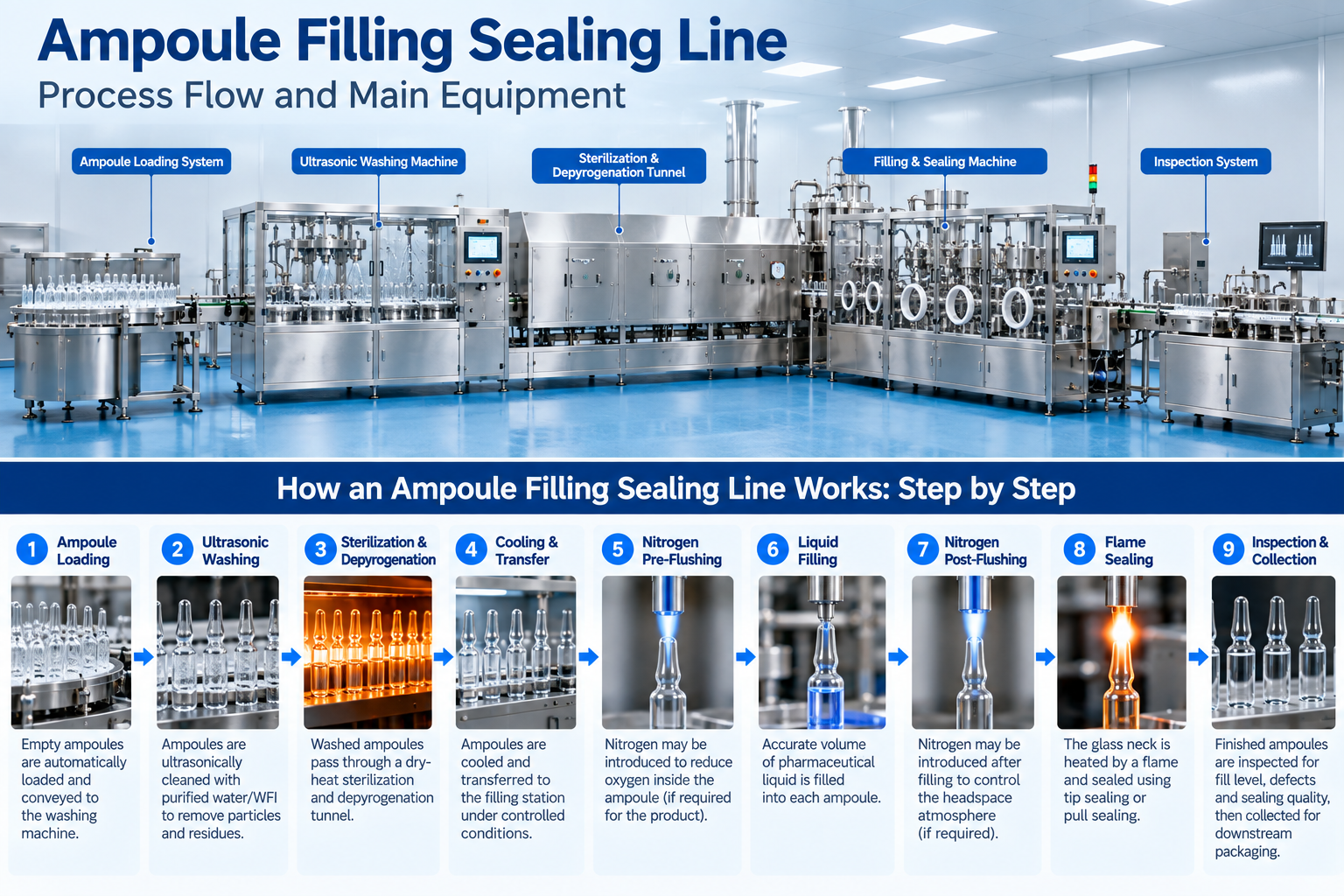
An ampoule filling sealing line is used to process glass ampoules containing sterile liquid pharmaceutical products.
Depending on the production configuration, the complete line may include:
Ampoule loading system
Ultrasonic washing machine
Sterilization and depyrogenation tunnel
Ampoule filling and sealing machine
Nitrogen flushing system
Inspection equipment
Labeling and downstream packaging equipment
The objective is not simply to fill liquid into an ampoule.
The complete process must control:
Container Cleanliness + Sterility + Filling Accuracy + Sealing Quality + Contamination Risk
For aseptically manufactured sterile products, exposed sterile containers and products must be protected through appropriately controlled processing conditions. The FDA Guidance for Sterile Drug Products Produced by Aseptic Processing provides guidance covering areas including cleanroom design, process design, environmental monitoring, sterilization, and aseptic processing.
A typical glass ampoule production process follows:
Empty Ampoules
↓
Ultrasonic Washing
↓
WFI Rinsing
↓
Sterilization & Depyrogenation
↓
Cooling
↓
Aseptic Transfer
↓
Nitrogen Pre-Flushing — If Required
↓
Liquid Filling
↓
Nitrogen Post-Flushing — If Required
↓
Flame Sealing
↓
Inspection
↓
Finished Ampoules
The exact configuration depends on the pharmaceutical product, ampoule specification, production capacity, and manufacturing requirements.
Empty glass ampoules enter the production line through a loading and conveying system.
The feeding system transfers the containers continuously to the washing machine while maintaining stable orientation and minimizing glass-to-glass impact.
Important factors include:
Ampoule dimensions
Feeding speed
Conveyor synchronization
Container stability
Correct handling at this stage helps reduce breakage further downstream.
Ampoules must be thoroughly cleaned before entering sterile filling operations.
A typical ampoule washing machine can combine:
Ultrasonic Cleaning + Internal Rinsing + External Rinsing + Compressed Air Blowing
The objective is to remove particles and residues from both the internal and external surfaces.
Depending on the line design, the washing sequence may use purified water and Water for Injection (WFI).
After washing, ampoules are transferred automatically to the sterilization tunnel.
Washed glass ampoules pass through a dry-heat sterilization and depyrogenation tunnel.
A typical tunnel contains:
Preheating Zone → High-Temperature Zone → Cooling Zone
The process parameters must be established and validated for the specific container and production process.
FDA guidance notes that glass containers used in aseptic processing may be subjected to dry heat and that sterilization processes require appropriate validation and control.
The tunnel should also provide controlled transfer toward the filling area while minimizing contamination risk.
After dry-heat processing, ampoules must cool to a temperature suitable for filling.
They are then transferred toward the filling and sealing machine under controlled conditions.
At this point, maintaining the state of control becomes critical because sterilized ampoules will soon be exposed during filling.
Equipment layout should therefore minimize:
Unnecessary container movement
Operator intervention
Uncontrolled exposure
Transfer delays
For oxygen-sensitive products, the line may include nitrogen flushing before filling.
The purpose is to reduce the amount of oxygen inside the ampoule before the pharmaceutical liquid is introduced.
Nitrogen flushing is not required for every formulation.
Whether it is needed depends on:
Product sensitivity
Formulation
Process requirements
Validated manufacturing parameters
The filling station accurately dispenses the required volume of pharmaceutical liquid into each ampoule.
A simplified sequence is:
Ampoule Positioning → Filling Nozzle Entry → Dosing → Nozzle Withdrawal
Depending on the equipment and product, filling systems may use different dosing technologies.
Critical parameters include:
Fill volume
Filling accuracy
Filling speed
Product viscosity
Nozzle position
Foaming characteristics
Modern equipment can also incorporate no-ampoule-no-fill control to reduce product loss when a container is missing.
Where required, nitrogen may also be introduced after filling and before sealing.
This can help control the headspace atmosphere for products that require protection from oxygen.
Again, nitrogen use should be based on the specific pharmaceutical formulation and validated process—not applied automatically to every product.
After filling, the ampoule moves immediately to the sealing station.
The glass neck is heated by a controlled flame until the glass reaches the required condition for sealing.
Depending on the machine and ampoule design, the line may use:
Tip Sealing
or
Pull Sealing
The sealing process must produce a consistent closure while avoiding excessive heat exposure, glass deformation, or product contamination.
After sealing, finished ampoules are discharged for inspection and downstream processing.
Inspection may evaluate:
Fill level
Visible particles
Glass defects
Sealing defects
Cosmetic defects
Depending on the factory configuration, acceptable ampoules can then move to labeling and secondary packaging.
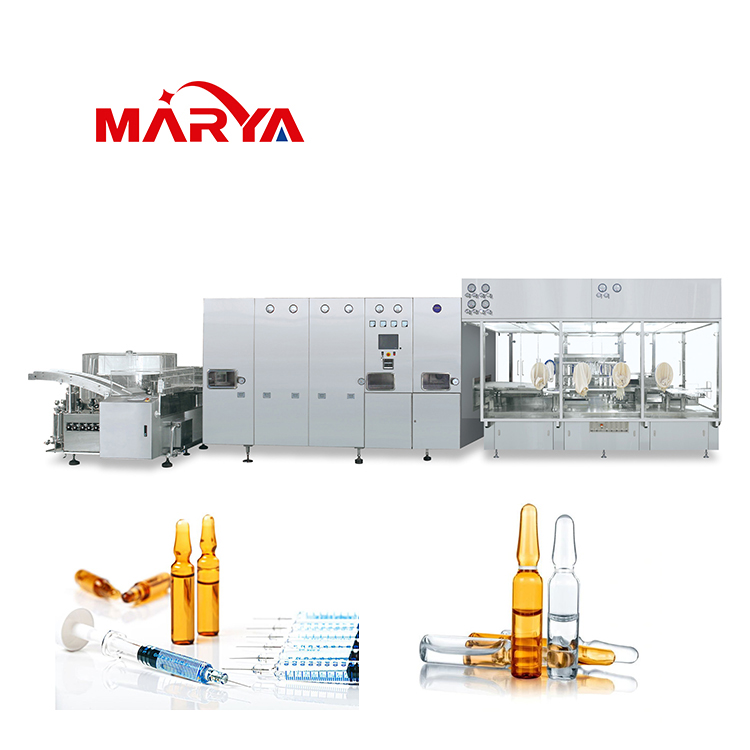
A complete line typically integrates several machines rather than relying on one standalone filler.
| Equipment | Main Function |
|---|---|
| Ampoule Loading System | Feeds empty ampoules |
| Ultrasonic Washing Machine | Cleans internal and external surfaces |
| Sterilization & Depyrogenation Tunnel | Processes washed glass ampoules |
| Filling & Sealing Machine | Doses product and seals ampoules |
| Nitrogen System | Controls headspace where required |
| Inspection System | Identifies specified defects |
| Labeling Machine | Applies product labels |
| Packaging Equipment | Handles secondary packaging |
The machines should be properly synchronized to create a stable production flow.
Line integration becomes particularly important at higher production speeds because one machine can become a bottleneck for the entire process.
Filling accuracy directly affects product quality and material utilization.
Several factors influence filling performance.
The filling technology should match the product characteristics and required fill volume.
Nozzle position affects dripping, splashing, foaming, and filling consistency.
Viscosity, temperature, surface tension, and foaming behavior can affect dosing performance.
Increasing production speed without properly adjusting the filling process can reduce stability.
The filling system should be calibrated and verified according to the pharmaceutical manufacturer's validated procedures.
When comparing ampoule filling machines, buyers should therefore evaluate filling accuracy under their actual product and operating conditions, rather than relying only on maximum machine speed.
Glass ampoules can be sealed using different flame-sealing techniques.
The upper portion of the ampoule neck is heated and closed to form the seal.
It can be suitable for specific ampoule and production configurations.
The neck is heated while part of the softened glass is mechanically pulled away, forming the final sealed container.
The correct method depends on factors such as:
Ampoule design
Glass characteristics
Neck dimensions
Machine configuration
Product requirements
Sealing quality should always be evaluated as part of the validated production process.
Contamination control is one of the most important considerations in sterile ampoule production.
Key measures can include:
Controlled Environment
The filling process should operate within an appropriately designed cleanroom and contamination-control strategy.
Minimized Operator Intervention
Automation can reduce unnecessary direct interaction with exposed sterile containers.
Barrier Technology
Depending on the project, RABS or isolator technology may be considered to provide greater separation between the aseptic process and operators.
Validated Cleaning and Sterilization
Product-contact parts and relevant equipment surfaces require defined cleaning and, where applicable, sterilization procedures.
Environmental Monitoring
Environmental conditions should be monitored according to the facility's contamination-control and GMP requirements.
The European Commission's EU GMP Annex 1 — Manufacture of Sterile Medicinal Products provides current guidance for sterile medicinal-product manufacturing, including contamination control, cleanroom qualification, barrier technologies, aseptic processing, environmental monitoring, and related controls.
Before purchasing equipment, define the production requirements clearly.
| Parameter | What to Confirm |
|---|---|
| Ampoule Size | Required container range |
| Fill Volume | Required dosing range |
| Capacity | Ampoules/minute or hour |
| Filling Accuracy | Product requirement |
| Product | Characteristics and viscosity |
| Filling Method | Suitable dosing technology |
| Nitrogen Flushing | Required / Not required |
| Sealing Method | Tip / Pull sealing |
| Automation | Standalone or integrated line |
| Barrier System | LAF / RABS / Isolator |
| Changeover | Required ampoule formats |
| Inspection | Manual / Automated |
| Validation | Documentation requirements |
| Downstream Process | Inspection / Labeling / Packaging |
Do not select an ampoule filling line based only on maximum output.
The equipment must match the actual pharmaceutical product, container, process, facility, and validation strategy.
For pharmaceutical production, equipment performance should be supported by appropriate qualification and validation activities.
Depending on the project, documentation may include:
Confirms that the proposed equipment design is suitable for the intended pharmaceutical process and user requirements.
Confirms that equipment and supporting systems have been installed according to approved requirements.
Demonstrates that the equipment operates as intended within defined operating ranges.
Demonstrates that the equipment can perform consistently under the defined production conditions.
Additional considerations can include:
Material certificates
Product-contact materials
Surface finish
Cleaning procedures
Calibration
Alarm records
Recipe management
User access
Batch data
FAT
SAT
Technical documentation
Shanghai Marya states that its service scope includes FAT, installation/debugging, SAT and 4Q documentation support for pharmaceutical projects.
FDA also emphasizes that sterilization and aseptic processes require appropriate validation and control rather than relying only on environmental classification.
Possible causes include:
Incorrect dosing parameters
Filling-system wear
Air in the product path
Product viscosity changes
Incorrect nozzle position
Check: filling parameters, dosing components, product characteristics, and calibration.
Possible causes include:
Incorrect container positioning
Poor transport alignment
Mechanical impact
Incorrect change parts
Inconsistent ampoule dimensions
Check: feeding, guides, star wheels, transport synchronization, and ampoule specifications.
Possible causes include:
Incorrect flame adjustment
Incorrect gas-air ratio
Ampoule neck variation
Improper rotation
Incorrect sealing parameters
Check: burner position, flame condition, ampoule alignment, and sealing settings.
This can indicate unsuitable flame or sealing conditions.
Check: burner adjustment, gas-air ratio, neck cleanliness, and process parameters.
Possible factors include:
Excessive filling speed
Incorrect nozzle position
Foaming
Improper fill level
Check: filling speed, nozzle height, dosing profile, and product characteristics.
Modern lines can incorporate no-ampoule-no-fill control so the dosing system does not dispense product when a container is absent.
Modern ampoule filling lines can integrate:
PLC Control + HMI + Recipe Management + Automatic Fault Detection + No-Ampoule-No-Fill + Process Monitoring
Automation can help improve process consistency and reduce unnecessary manual intervention.
For integrated lines, communication between the washing machine, sterilization tunnel, filling machine, inspection equipment, and downstream packaging equipment also helps maintain stable production flow.
Automation should support the validated process rather than simply maximizing production speed.
Start by defining the pharmaceutical process—not by choosing a machine model first.
Provide the equipment supplier with:
1. Ampoule Specifications
Size, dimensions, glass type, and drawings where available.
2. Pharmaceutical Product
Product characteristics, viscosity, sensitivity, and special handling requirements.
3. Fill Volume
Minimum and maximum required dosage.
4. Production Capacity
Required ampoules per minute or per hour.
5. Filling Requirements
Accuracy and dosing technology.
6. Sealing Requirements
Tip sealing, pull sealing, or other specified process.
7. Nitrogen Requirements
Whether pre- or post-filling nitrogen protection is required.
8. Cleanroom Strategy
Required cleanroom environment and barrier technology.
9. Validation Requirements
Required documentation, FAT, SAT, DQ, IQ, OQ, and PQ support.
10. Line Integration
Whether the project requires only a filling machine or a complete:
Washing → Sterilization → Filling → Sealing → Inspection → Packaging Line
A clear URS at the beginning of the project can significantly improve equipment selection and project communication.
Shanghai Marya provides pharmaceutical machinery, cleanroom systems, and integrated pharmaceutical engineering solutions.
For ampoule production projects, the line can be configured around:
Ampoule Washing
↓
Sterilization & Depyrogenation
↓
Filling & Sealing
↓
Inspection
↓
Secondary Packaging
The appropriate configuration depends on the pharmaceutical product, ampoule format, production capacity, facility layout, automation requirements, and GMP strategy.
Shanghai Marya also provides project services covering equipment manufacturing, FAT, installation and commissioning, SAT, technical support, and qualification documentation.
For pharmaceutical manufacturers planning a new ampoule production line or upgrading an existing facility, defining the complete process before equipment selection can help avoid capacity mismatches between individual machines.
An ampoule filling sealing line is an integrated pharmaceutical production system used to wash, sterilize/depyrogenate, fill, and seal ampoules under controlled manufacturing conditions.
Ampoules are positioned at the filling station, the required quantity of pharmaceutical liquid is dispensed through filling nozzles, and the containers are then transferred to the sealing station.
The exact filling mechanism depends on the equipment and product.
A typical line includes an ampoule washing machine, sterilization and depyrogenation tunnel, filling and sealing machine, and inspection equipment.
Labeling and packaging machines can be added downstream.
Washing removes particles and residues from the ampoule before sterilization/depyrogenation and aseptic filling.
In a typical integrated glass-ampoule line, washed ampoules pass through a validated dry-heat sterilization/depyrogenation tunnel before being transferred toward aseptic filling.
Nitrogen may be used for oxygen-sensitive pharmaceutical products to help control the atmosphere inside the ampoule.
It is not required for every formulation.
It is a control function that prevents the filling system from dispensing product when an ampoule is missing from the filling position.
Possible causes include unsuitable flame settings, gas-air ratio, ampoule alignment, neck dimensions, glass variation, or incorrect sealing parameters.
Both use heat to close a glass ampoule, but the glass-forming process differs.
The appropriate method depends on the ampoule design, machine configuration, and validated production process.
Define the ampoule size, fill volume, product characteristics, production capacity, filling accuracy, sealing method, nitrogen requirements, automation level, barrier technology, validation requirements, and downstream process before selecting equipment.
The required barrier strategy depends on the product, process design, contamination-control strategy, facility, and applicable GMP requirements.
The decision should be made as part of the overall sterile-manufacturing design.
An ampoule filling sealing line works as a coordinated pharmaceutical production system:
Washing → Sterilization & Depyrogenation → Aseptic Filling → Sealing → Inspection
Each stage affects the next.
Reliable ampoule production therefore depends not only on filling speed but also on container cleanliness, sterilization control, filling accuracy, sealing quality, contamination control, equipment integration, and validation.
When selecting an ampoule filling line, pharmaceutical manufacturers should define the product, ampoule specification, required output, filling process, cleanroom strategy, barrier technology, validation requirements, and downstream equipment before determining the final configuration.
Shanghai Marya provides ampoule filling equipment and integrated pharmaceutical production solutions covering equipment selection, engineering, manufacturing, FAT, installation, commissioning, SAT, and qualification-document support.


